The Week Lexington Lined Up on Main Street to See a Dead Whale
→ Read the original on lexingtonky.news
On the morning of April 17, 1930, readers of The Lexington Herald found an unusual promise on the front page: the city was about to receive “the largest guest in its history.”
The guest was a whale. A dead one.
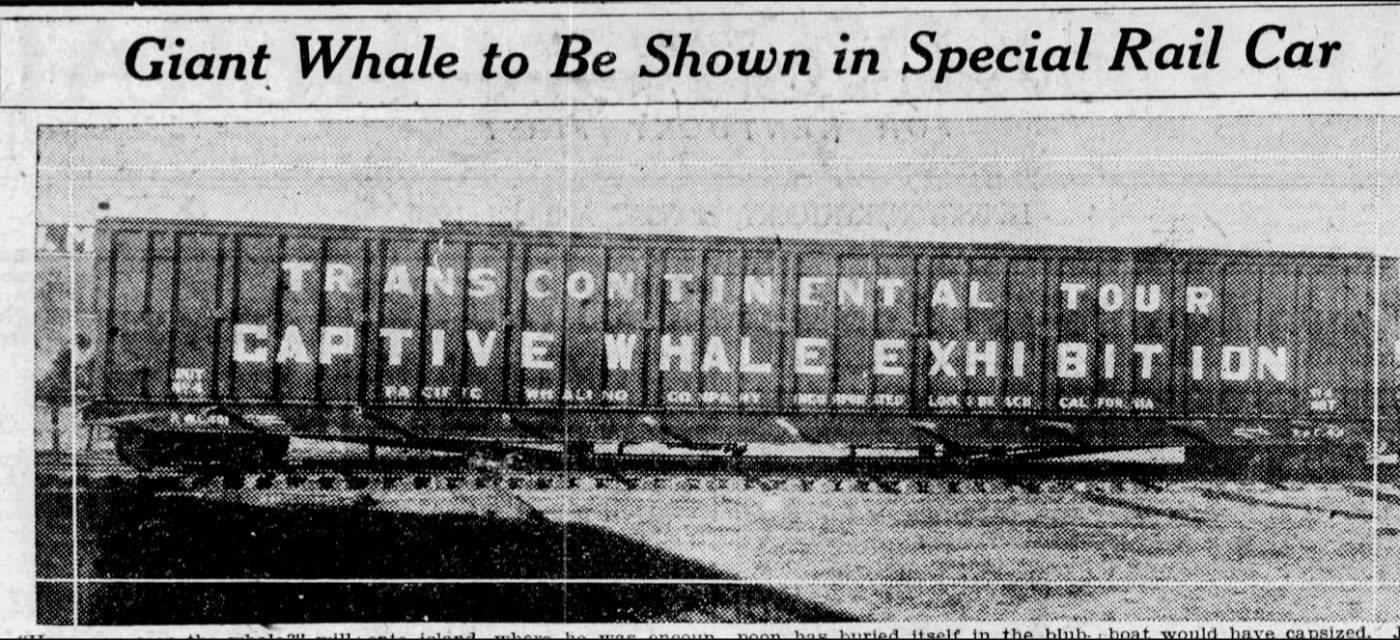
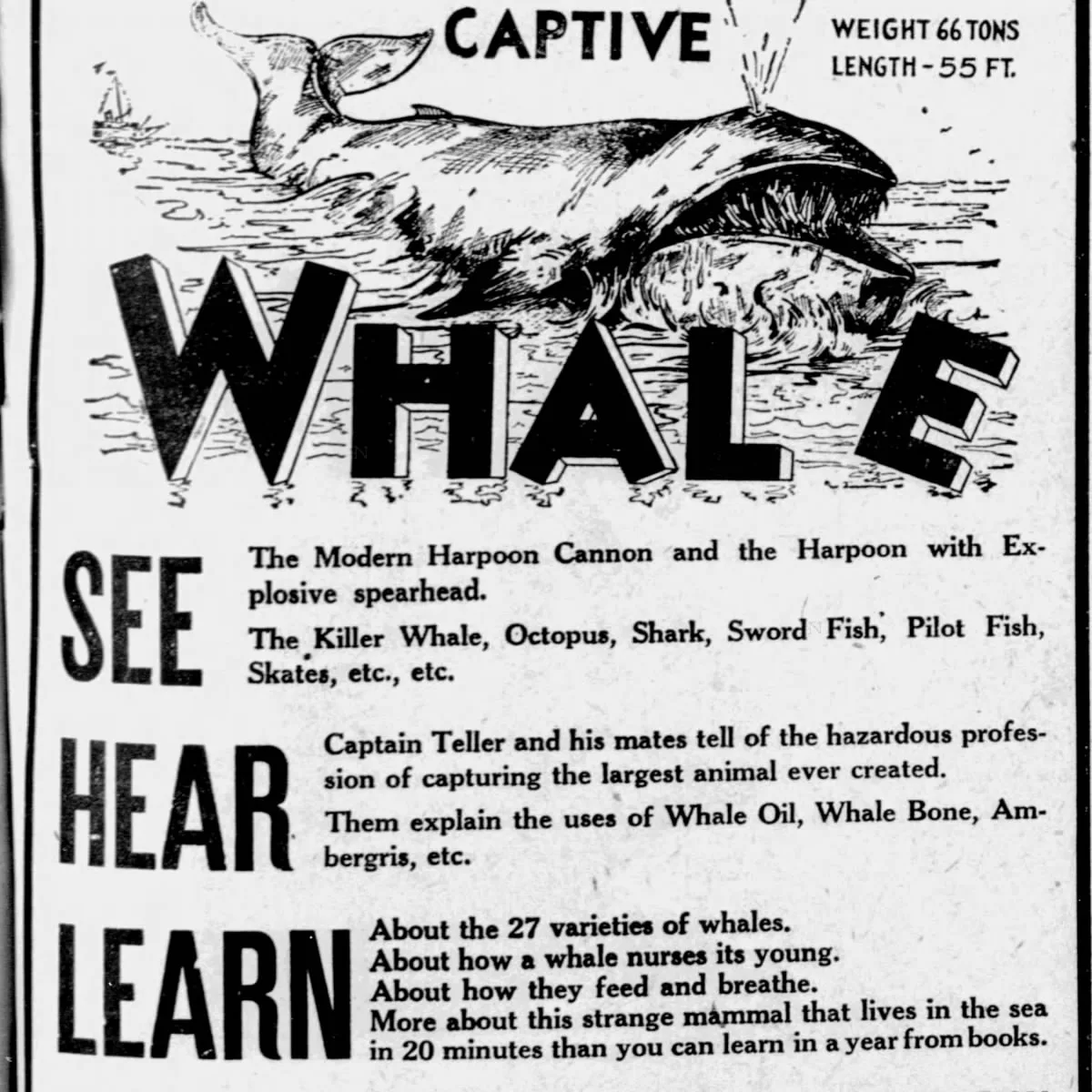
“Goliath,” a finback caught off San Clemente Island, about 65 miles southwest of Long Beach, California, was traveling America in a 72-foot, glass-enclosed railway car, courtesy of the Pacific Whaling Company, Inc. He arrived in Lexington from Louisville — “where for the past 10 days he has been shown to thousands of interested Kentuckians” — and was parked on the C&O spur tracks at East Main Street, on view from 9 a.m. to 11 p.m. through Thursday. The company’s display ad promised that a giant searchlight would sweep the sky to guide Lexingtonians to the siding, where they would learn “more about this strange mammal that lives in the sea in 20 minutes than you can learn in a year from books.”
How big was Goliath? It depended on the day you bought a paper. The Herald’s first story said 55 feet and “more than 60 tons.” The next day he had grown to 70 tons. By Saturday he had settled at 66. What no one disputed was the spectacle: an embalmed leviathan “in a wonderfully preserved condition,” attended by Captain Lee Teller of the whaler *Hawk* — the man billed as having caught him — and two mates who lectured around the clock.
“’Have you seen the whale?’ will be a Lexington slogan this afternoon,” the Herald wrote on April 21, over a photograph of the railcar, its slats painted in enormous letters: TRANSCONTINENTAL CAPTIVE WHALE.
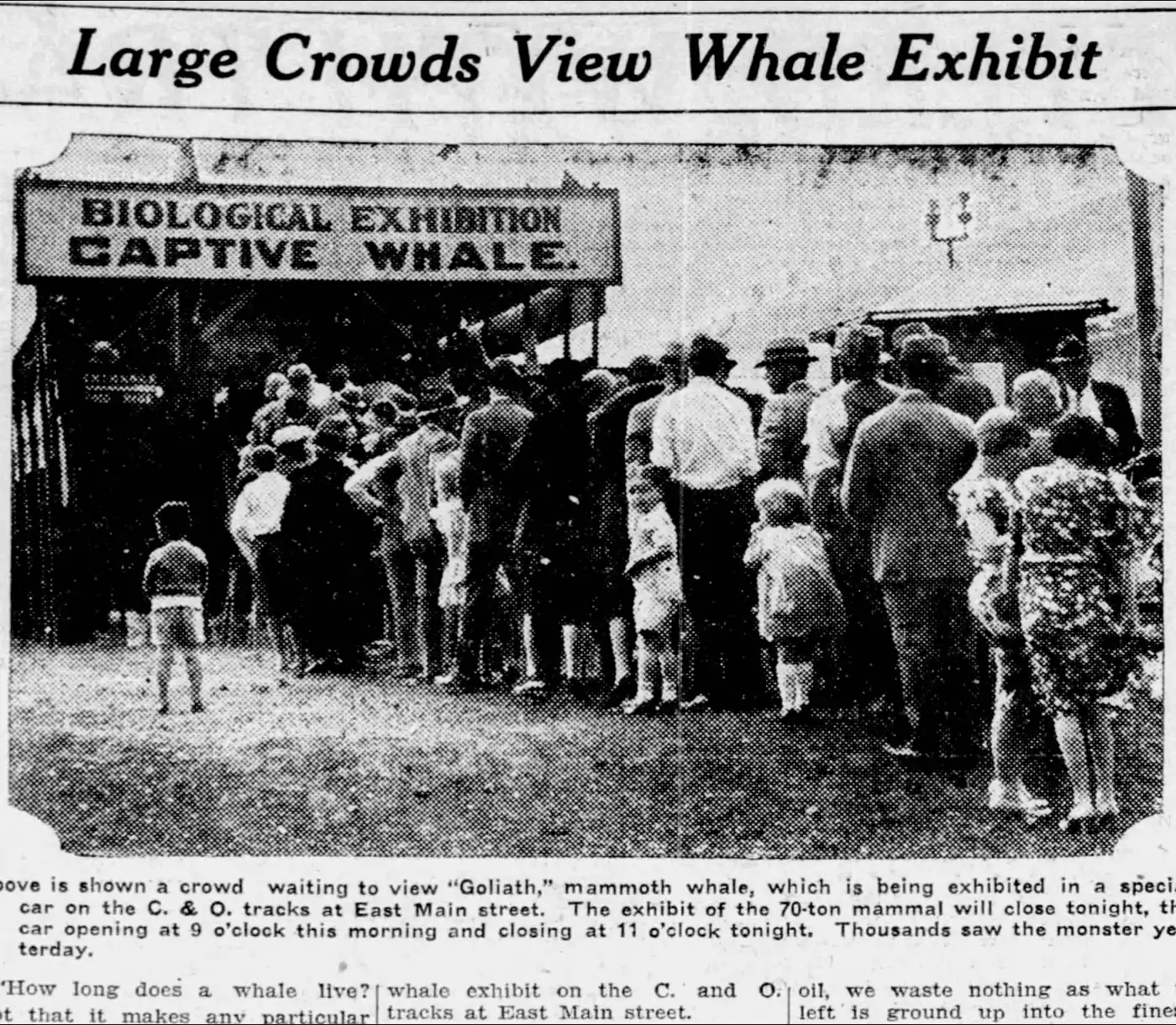
The city obliged. Three thousand people filed past the first night alone, in a city of roughly 45,000. The Herald’s April 23 dispatch is a small masterpiece of the genre: “Jonah may or may not have been swallowed by a whale,” it began, “but according to Capt. Lee Teller last night, ’Goliath’ ... does not have a throat large enough to swallow anything but shrimp and sardines.” (Earlier in the week, readers had learned that “an ordinary grapefruit would choke it to death.”) The paper pronounced Goliath “the best looking whale ever to visit Lexington in his beautiful palatial railroad car,” adding, generously, that he “behaves very nicely.”
The whale-men worked the town like a political campaign. Col. Bill E. Green, traveling with the exhibit, turned up at the Lions Club luncheon at the Lafayette Hotel on April 23, explained “the habits of the whale,” and invited the entire club to come inspect Goliath as his guests. (He shared the program, in a pairing history could not improve upon, with University of Kentucky law professor Roy Moreland, lecturing on “The Right of Privacy, or The Right To Be Let Alone.” Goliath had neither.)
Teller’s lectures doubled as a portrait of an industry at its most mechanized and most doomed: 1,000-horsepower motor boats, harpoon cannons, hand grenades, compressed-air machines to inflate the carcass for towing, spotter airplanes, and factory mother ships that swallowed whales whole at the bow “as the whale was supposed to have swallowed Jonah.” There were 27 kinds of whales, he told crowds; only the sperm and killer whales had teeth. Goliath, a finback, had baleen.
Nobody in the rail yard seems to have dwelt on the arithmetic, but Lexington’s editorial readers got it anyway. That same week, the Herald-Leader’s opinion page reprinted an Atlanta Journal editorial on the international conference for the preservation of whales, noting some 30,000 were being killed a year — “whales cannot last at the present rate of extermination.” The finback that 3,000 Lexingtonians lined up to see was both an advertisement for that slaughter and, in embalmed retrospect, a preview of its endpoint.
By Sunday, Goliath had passed into local comedy. A Herald humor columnist recounted his wife announcing, “We are going to have a visit ... from a whale,” and his relief: “Thank the Lord, we thought you meant the stork.” Then the railcar rolled on — one stop on a barnstorming circuit of preserved whales that crisscrossed inland America around 1930, bringing the ocean’s largest animal to people who would never see the ocean.
Ninety-six years later, the visit has left no trace in Lexington’s public memory: no marker on Main Street, no mention in the standard local histories. Just four days in April when the biggest thing ever to visit the city sat on a siding downtown, smelling faintly of formaldehyde, behaving very nicely.
Newspaper page images: original newsprint; pages of this era are in the public domain.
Sources
- The Lexington Herald, Apr 17, 1930, p1
- The Lexington Herald, Apr 18, 1930, p2
- The Lexington Herald, Apr 19, 1930, p2
- The Lexington Herald, Apr 20, 1930, p27 display ad
- The Lexington Herald, Apr 21, 1930, p2
- The Lexington Herald, Apr 23, 1930, sec2 p6
- Lexington Herald-Leader, Apr 23, 1930, p18
- The Lexington Herald, Apr 24, 1930, p7
- Lexington Herald-Leader, Apr 15, 1930, p4
- The Lexington Herald, Apr 27, 1930, p25