
Kentucky Can Reform Property Taxes While Protecting Residents, Schools and Other Public Services
The property tax is essential to how Kentuckians fund schools, public safety and other vital local services, and is the primary source of local revenue for school districts and most local governments. But recent sharp increases in property values in parts of Kentucky are spiking property tax bills, straining budgets and giving rise to proposals to amend the constitution that will do more harm than good.
Instead, Kentucky should pursue sensible reforms that many other states have already enacted and that do not require changing the constitution. Those solutions, described further below, can help residents stay in their homes, ensure property tax bills do not outstrip the ability to pay and offer easier options for payment. They also target aid to those who most need help while protecting schools and other public services that rely on property taxes.
The context of housing inflation, periodic property reassessment and the state constitution
Property Valuation Administrators (PVAs) — the local elected officials who determine the value of properties for taxation — are required by law to examine all real property at least once every four years. PVAs follow a schedule that divides the county into quadrants, which means that roughly 25% of residential property in each county is physically examined and reassessed each year.
During the recent period of high inflation, residential property values increased significantly in fast-growing areas and neighborhoods. At the same time, many PVAs fell behind on the assessment schedule during COVID and are only now catching up. This combination has resulted in sharp increases in assessed property values in certain communities over the past few years. And because of the way property tax revenues are capped, some property owners can receive a significantly higher property tax bill when reassessed even while property tax rates are flat or declining and revenues are only modestly growing.1 For individuals and families whose incomes are not keeping up with growth, higher bills can be difficult to manage.
Lawmakers and other observers have proposed various pieces of legislation to try to address this issue over the past several years. Nearly all these proposals involve capping or freezing property assessment increases based on the age, status of the property owner or rate of growth without considering a property owner’s ability to pay.
But the Kentucky constitution requires all property to be assessed for tax purposes at its fair cash value, “estimated at the price it would bring at a fair voluntary sale.” All proposals that change assessments therefore require amending the constitution. But that provision in our state’s founding document is important; it ensures all properties are assessed equally based on what they are worth and avoids favoritism or underassessment of property driven by politics. Increased property value does mean greater wealth and therefore ability to pay taxes if the tax is designed properly.
Capping or freezing assessments will worsen inequities and unfairly shift tax responsibility
One proposal in Frankfort would freeze property tax assessment when a homeowner turns 65. At that point, the taxable value of a home would not increase until it is sold or transferred. This tax break would be provided in addition to the homestead exemption, the only existing reduction currently allowed to property values in the state constitution. Under this exemption, residents age 65 or over or who have a total disability are eligible to have their home’s assessed value reduced by $49,100. That amount is adjusted by inflation every two years.
Though our focus in this report is on property tax assessment freezes for seniors, the same general problems arise with all other proposals to cap assessment growth (for example, amendments that prevent assessments from rising more than 3% per year). Caps on assessments:
- Favor places where property values and therefore wealth is growing over places where property wealth is stagnant, shifting taxes away from prosperous neighborhoods and onto those who can least afford it;
- Favor homes owned by wealthier families over those owned by working class families because the value of the reduced taxes due to artificially lower assessments will be larger on wealthier properties;
- Favor older homeowners and people who live longer over younger people who often face the same or even greater fiscal constraints as they struggle to support their families in inflationary times;
- Worsen the housing crisis by incentivizing residents to stay in their existing homes, which can result in seniors choosing not to downsize to continue taking advantage of lower property tax bills, and thereby staying in larger homes that would be good for families with kids.
Mansion owners get huge tax breaks, the poor receive little or nothing
Proponents say that a constitutional amendment freezing property tax assessments for homeowners over the age of 65 will help seniors who are on fixed incomes. However, the poorest homeowners will benefit little and the 18% of seniors who rent — but whose rent payments include the cost of property taxes passed through — will not benefit at all. And because the frozen assessment only applies going forward, the proposal will not address the recent steep run-up in home prices, and therefore property tax assessments, from 2020 to 2026.
In the graph below, we provide estimates of the tax cuts that owners with a range of home values would receive from freezing assessments at age 65. Using the average property tax rate across Kentucky, and taking into account the existing homestead exemption, a low-income rural senior with a $50,000 home would save only $2 a year by age 70 and $6 annually by age 80. At the same time, a rich retiree with a $2 million home would save $3,699 annually by age 70 and $12,959 a year by age 80. These high-income individuals have already received enormous federal and state tax breaks in recent years.
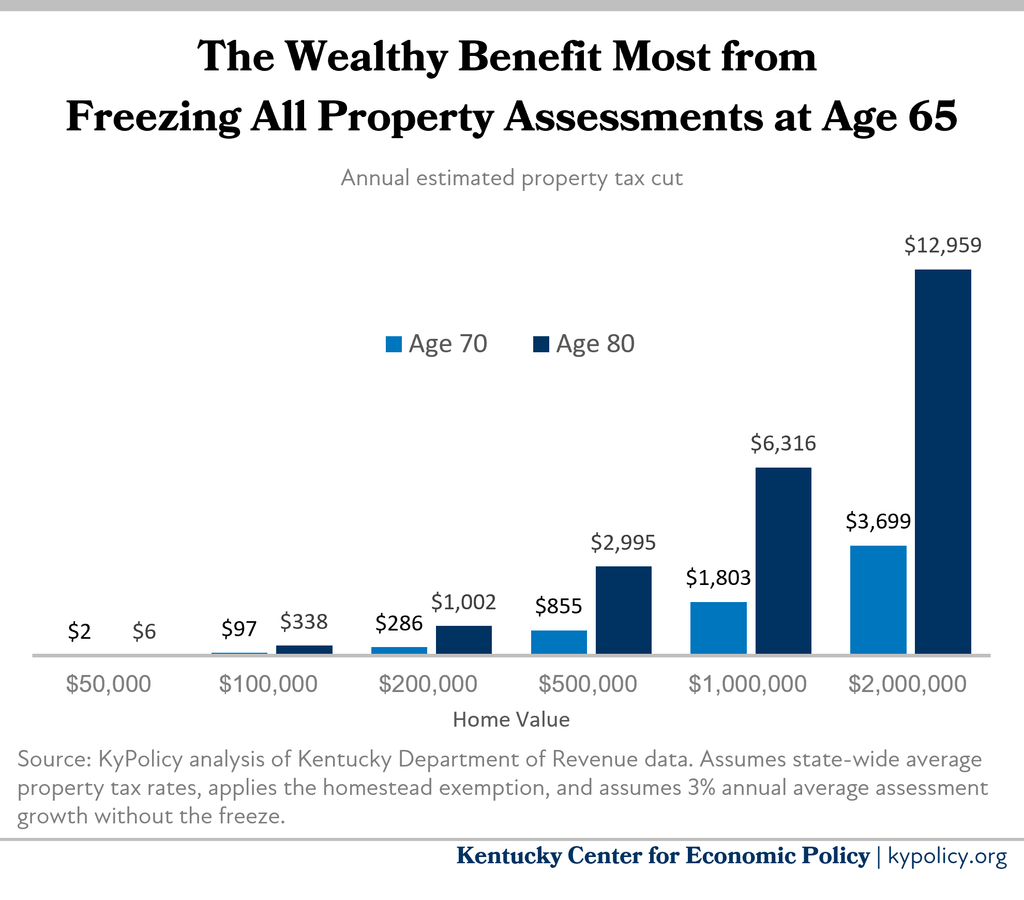
While many Kentuckians live in modest or even sub-standard housing, there are also many very valuable homes whose owners would be the big winners with this change. The median home value in Kentucky is $226,000, according to Census data, and county median home prices range from $62,180 in Breathitt County to $418,320 in Oldham County. Kentucky has 17,606 homes valued at over $1 million, and Zillow currently has several Kentucky homes priced to sell for over $10 million.2
Wealthier homeowners also own a large share of the assessment that would be frozen under the constitutional amendment. According to that same Census data, the 13% of homes in Kentucky valued at more than $400,000 a year account for approximately 43% of the total state-wide home values.
What’s more, the benefits of a frozen assessment grow the longer the elderly live and stay in their homes, and the wealthiest Americans live 10-15 years longer than the poorest on average. Of Kentucky’s 432,000 senior homeowners, 69% are 70 or over and 22% are 80 years old and above.3
Freezing or capping property assessments will shift costs and take funds from schools, roads and health care
Meanwhile, freezing property tax assessments at age 65 would take significant revenue from public services over time. Census data shows that about one-third of homeowners in Kentucky are 65 or older, and that share is growing as the large baby boomer population ages and as fewer young people enter homeownership (the average first-time homebuyer is now 40 years old, compared to 28 in 1991). Freezing such a large portion of the assessed property value will shift costs to working-age families that are often facing the financial burdens of childrearing. And it will increase pressure to reduce public services on which Kentuckians depend.
Although Kentucky already has relatively low property taxes, they are an essential revenue source at the local level. The state and localities collect over $3 billion annually from residential property taxes, and nearly half of that revenue goes to local schools with the remainder funding counties, cities, the state and special districts for libraries, health departments, ambulance services and other needs. These services are under growing pressure from the recent, deep cuts to the state individual income tax — Kentucky’s largest revenue source historically — as well as federal budget cost shifts now under way. Local governments do not have meaningful alternatives to the property tax available. That makes protecting local revenues even more important.
Capping or freezing assessments can worsen the housing crisis
Capping or freezing growth in assessments also incentivizes people to stay in their current residences. Moving to a different home will mean their property tax bill will again be based on 100% of its fair market value. This unfairly advantages those who have lived in the same home for the longest, harming people who move more often because of family formation, job changes or other needs.
This lock-in also has the potential to make the housing market worse. The large baby boomer population is a huge share of current homeowners, many of whom bought family-size homes when they had children. But their incentive to downsize to a smaller residence when their children have grown is decreased if their property assessment is frozen. That can encourage keeping more family-size homes off the market, driving up their value further due to scarcity.
Targeted alternatives that protect public services are available
For residents with modest and fixed incomes who are truly strained by property taxes, there are much better, affordable and targeted ways states can help residents afford their bills and stay in their homes. These reforms would help those struggling because of the sharp increase in home values over the last five years while a constitutional amendment, which only applies from the point it is passed forward, would not. Key improvements, which numerous other states have already adopted, include:
Create a property tax circuit breaker program that limits costs as a share of income
Kentucky is one of only five states without an income-based property tax assistance program. The most common and effective such program is a “circuit breaker,” which provides a refund when property tax bills exceed a certain percentage of household income and is often available for renters as well. A circuit breaker, unlike an assessment freeze, targets aid to those who truly cannot afford their bills — including those whose incomes have fluctuated due to a lost job or income source.
Circuit breaker programs recognize that the quickly rising value of homes can create difficulties for those on fixed incomes or facing hard times. With a circuit breaker, a resident whose property tax bill exceeds a certain share of income (for example, 4% in West Virginia and 6% in Maine) receives a refund paid by the state for the amount above that threshold (with reasonable limits on the size of the refund and the income of the household). Circuit breaker programs exist in 29 states.
Create a property tax deferral program for people 65 and over
Kentucky could also follow other states in creating a low-interest deferral program that allows seniors with rising home values to postpone paying property taxes until their home is sold. This measure helps seniors whose property values and therefore wealth in the form of home equity has grown but the cash they have available to pay their taxes has not.
Many Kentucky seniors are on fixed incomes and live in neighborhoods where their home values are rising while their incomes are not. In a property tax deferral program, those 65 and over may choose to defer paying their property taxes in any one year or every year until the home is sold or they pass away. Each year the tax is deferred, the state would send the amount of money that would otherwise be paid to the local taxing district. The state is reimbursed with interest when the property is sold or transferred, with interest rates kept low to make the program affordable for residents while still covering all state costs of administration. Eligible homeowners must have a minimum amount of equity in their home and there are limits on how much can be deferred as a share of home value to protect the state from risk. Deferral programs exist in 12 states.
Make other improvements so property taxes are more predictable and easier to pay
Property taxes can be made more predictable and easier to pay through administrative changes. For example, property taxes could be paid in quarterly installments rather than once a year. In addition, Kentucky could also better modernize the systems of PVAs to support more regular (ideally annual) reassessments – thereby avoiding large one-time increases in values – and invest in technology that allows the most accurate and fair assessments possible. More modernized systems could allow smoother, more regular reassessments, thereby preventing sudden spikes in bills.
The post Kentucky Can Reform Property Taxes While Protecting Residents, Schools and Other Public Services appeared first on Kentucky Center for Economic Policy.