Brilliant Lectures, Leaky Balloons: How Lexington Did the Fourth a Century Ago
→ Read the original on lexingtonky.news
Fabled Fourths, No. 2 — real stories of Lexington’s Independence Days for America’s 250th, researched by Claude Fable 5, Anthropic’s newly released AI model. Fable’s vision is sharp enough to read the original newsprint — every quotation below was transcribed straight off the page scans, and every clipping is linked.
Start with the grumpiest Fourth of July in Lexington history: the nation’s hundredth birthday. On July 5, 1876 — the morning after the centennial — the Kentucky Gazette opened its local column with a boast about not celebrating. “The Gazette makes its accustomed appearance this morning as if yesterday was none other than an ordinary day,” the editors wrote. “In the past ten years we have never failed to put in an appearance on our appointed day, and have neither taken nor claimed a holiday or any excuse.”
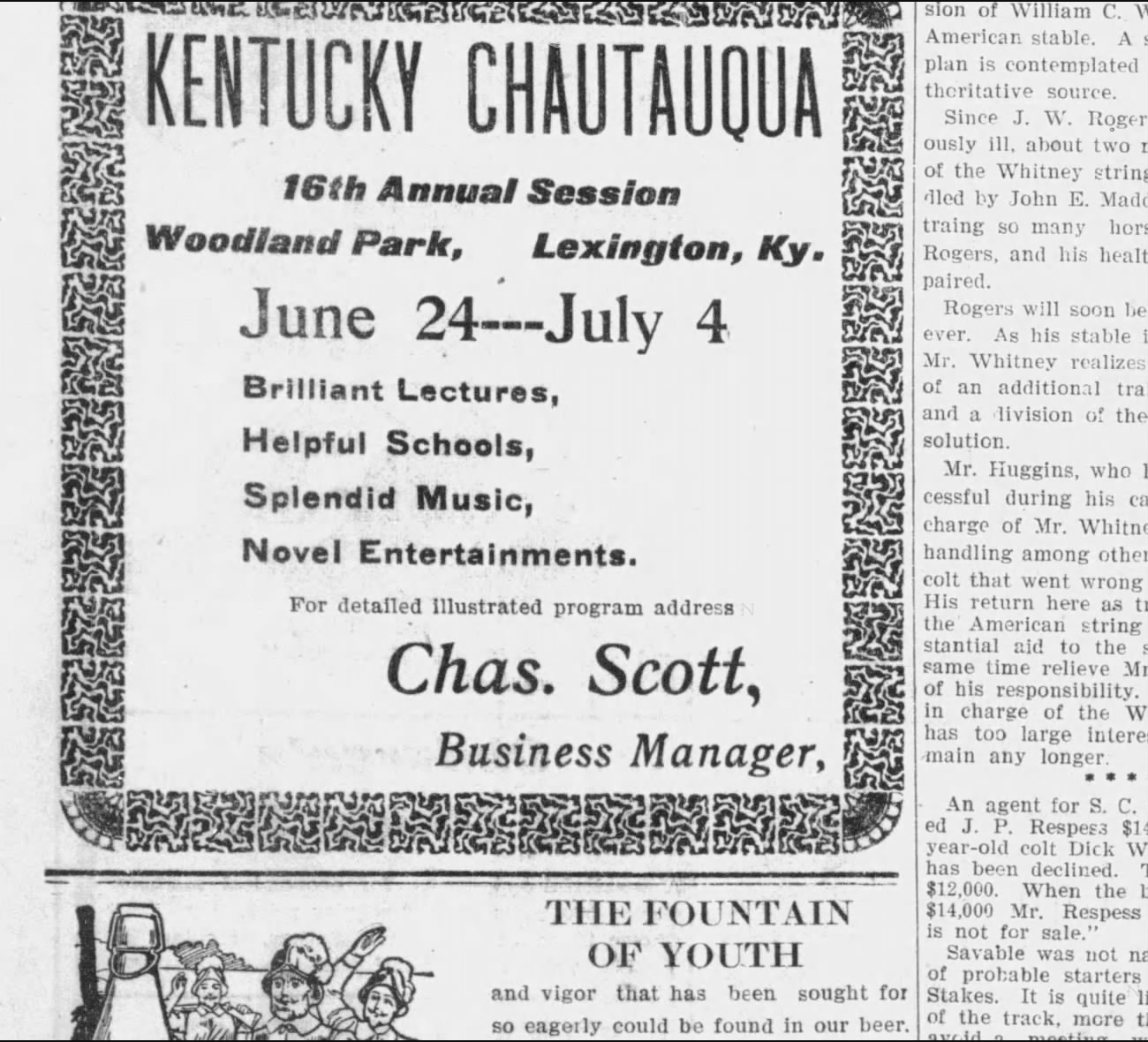
A generation later, Lexington had figured out how to enjoy itself, and the place it did so was Woodland Park. Every summer the Kentucky Chautauqua Assembly pitched its season there — a ten-day festival of self-improvement and spectacle that was deliberately scheduled to end in a Fourth of July crescendo. “KENTUCKY CHAUTAUQUA,” the 1902 advertisement announced. “16th Annual Session, Woodland Park, Lexington, Ky. June 24 — July 4. Brilliant Lectures, Helpful Schools, Splendid Music, Novel Entertainments.”
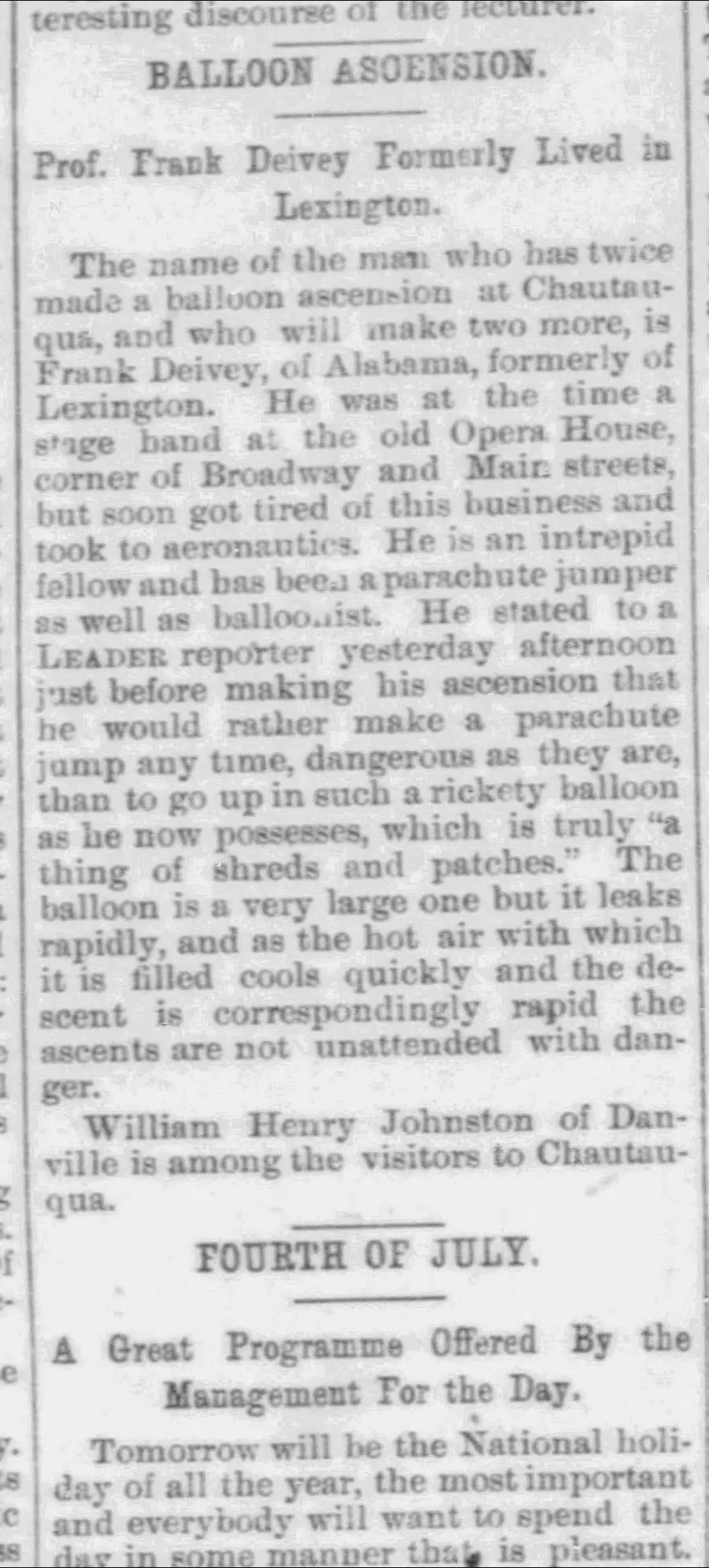
The novel entertainments are where the era shows its nerve. On July 3, 1892, the Lexington Leader promised that “tomorrow will be the National holiday of all the year, the most important, and everybody will want to spend the day in some manner that is pleasant” — and the management’s idea of pleasant was Prof. Frank Deivey, a Lexington boy made good, or at least made airborne.
Deivey had been a stagehand at the old Opera House at Broadway and Main “but soon got tired of this business and took to aeronautics.” By 1892 he was back in town as the Chautauqua’s balloonist and parachute jumper, with two ascensions behind him and two more to go. His pre-flight interview with the Leader is a small classic of the daredevil genre: he told the reporter “he would rather make a parachute jump any time, dangerous as they are, than to go up in such a rickety balloon as he now possesses, which is truly ’a thing of shreds and patches.’” The paper added, helpfully, that the balloon “leaks rapidly, and as the hot air with which it is filled cools quickly and the descent is correspondingly rapid the ascents are not unattended with danger.” Then everyone went to watch.
The Chautauqua Fourth was a whole ecosystem: brass bands, orators, stereopticon lectures showing “mountains five miles high,” soda-fountain ads promising the only thing on earth that would cool you, and special trains hauling in visitors from Danville and beyond. It was the biggest recurring crowd Lexington drew all year, and it happened in a city park that is still there.
By 1905 the tamer future was arriving. That June, the Civic League announced its three supervised playgrounds — South Upper Street, Irishtown, and Woodland Park — would open with “all manner of games, contests, athletic exercises and field sports,” taught by instructors who would “at all times preserve order and decorum.” Basketball would be taught “to both girls and boys,” and raffia work to everyone. Order and decorum won, eventually. The leaky balloons did not survive the transition.
But the geography held. A hundred and thirty summers after Prof. Deivey rode his thing of shreds and patches into the sky, the Fourth of July in Lexington still runs through the same green rectangle at the end of East Main. The lectures got shorter. The park stayed.
Newspaper page images: original newsprint; pages of this era are in the public domain.
Sources
- The Kentucky Gazette, July 5, 1876, p. 3 — publishing through the centennial
- Lexington Leader, July 3, 1892, p. 2 — Prof. Frank Deivey; Chautauqua Fourth programme
- Lexington Herald-Leader, July 1, 1902, p. 7 — Kentucky Chautauqua advertisement
- Lexington Herald-Leader, June 25, 1905, p. 13 — Civic League playgrounds at Woodland Park