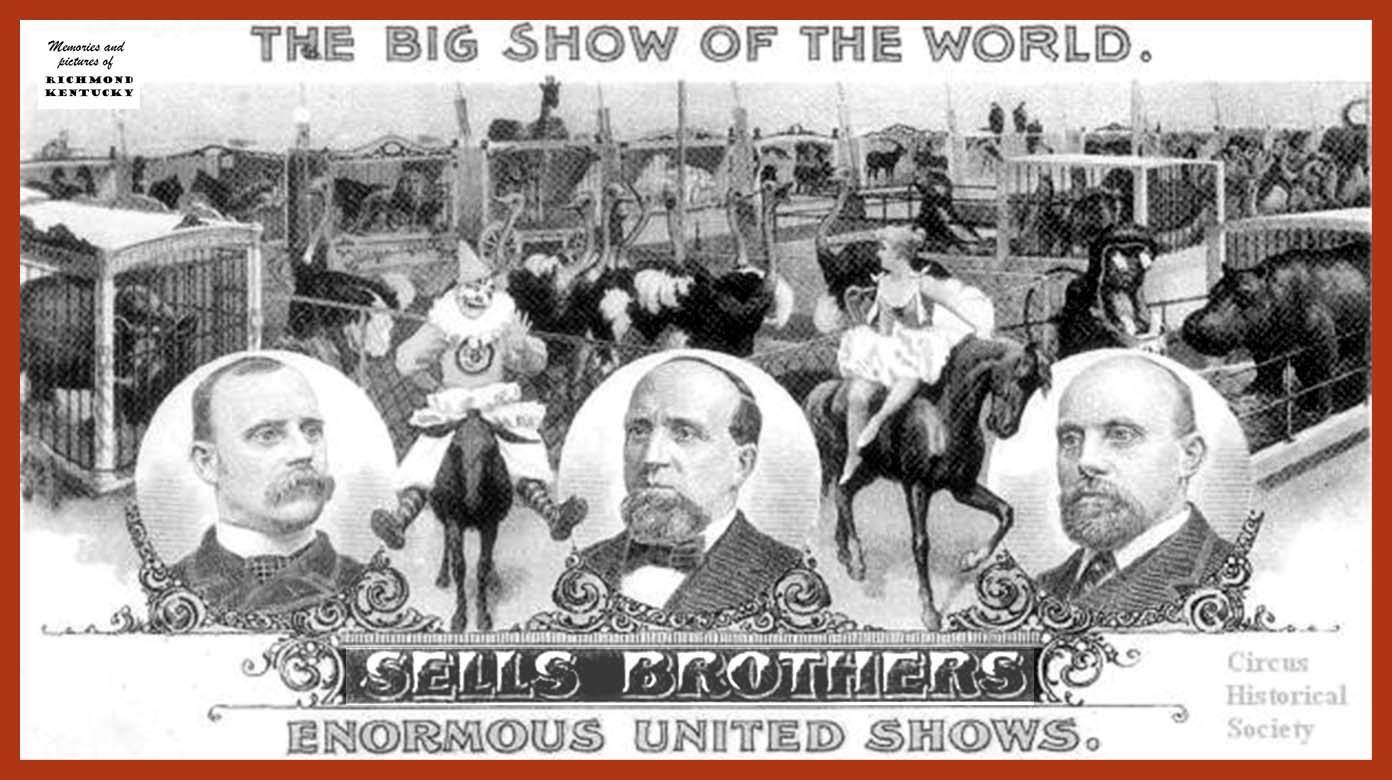
Off-Beat: The Lexington clown cemetery is folklore. The 1882 Paint Lick circus wreck is paperwork.
This is Off-Beat: a slow read of the public-record substrate underneath a story Lexington is telling itself this week. The substrate, on inspection, isn't in Lexington at all. It's thirty miles down the rail line.
At three-thirty on the morning of Sunday, September 24, 1882, the Sells Brothers Circus train ran past its brakes about three hundred yards short of the Paint Lick depot, in Garrard County, Kentucky. The cars piled. The cages — wood and iron, lashed to flatcars — burst. A tiger and a lion stepped out into the dark. Three people were dead. Eleven to twenty more were hurt. The county physician walked down from his house up the road and later wrote about what he found there.
That doctor was J. B. Kinnaird. His account survives because the Lancaster Women's Club preserved it in their local-history compilation Patches of Garrard County:
“A heap of dead and dying; the howls of wild animals that had been frightened; the confusion in the dark, with the cries of dazed men and women made an everlasting impression upon those who witnessed the scene.”
The wreck is in the paperwork. It's in the New York Times. It's in 1882 Kentucky newspapers digitized free on the Library of Congress's Chronicling America — the Semi-weekly Interior Journal in Stanford, the Evening Bulletin in Maysville, the Breckenridge News, the Bourbon News. It's in the standing archive of national circus-history work. It happened on the rail line out of Lexington toward the eastern Kentucky hills.
None of which has anything to do, on the record, with the post that ran up r/lexington this week.
The legend, and the consensus
The post — six hours old at the time we read it, 33 comments, zero net upvotes — claimed there's a “clown cemetery” outside Lexington. The poster's version: a traveling circus packed up after a Lexington show, took the road east toward the next town, sheltered in a cave during one of the area's “famous rainstorms,” and was found a few days later slaughtered and buried near the cave. The dead were, the post says, “dismembered, eaten or sacrificed depending on who's telling it.” The wagons supposedly still mark the graves. A goat-featured creature, “similar to the Pope Lick monster,” supposedly haunts the site.
The replies are uniform. The top comment, 41 upvotes: “So the consensus is none of us have actually heard of this urban legend lol.” Below it, a self-identified Lexington native: “I was born and raised in Lexington, this isn't a thing or any urban legend I've ever heard of.” Another: “Born and raised in Lexington. Neither of these things exist.” Another, ten upvotes: “Even the people who are from Kentucky have never heard this.”

r/lexington/comments/1f1ml3s. (Screenshot of a DuckDuckGo search for the post title, May 18, 2026.)What's not in the record
We checked. The Lexington Times's coverage archive returns nothing on a clown cemetery, a circus burial, or a circus-train derailment in Fayette County. The LFUCG meeting archive — forty-plus years of municipal proceedings, indexed — returns nothing. The Lexington Cemetery's published roster of notable burials lists no circus performers. The LFUCG GIS historic-cemeteries inventory, which maps every documented small family and unknown-grave site in the county, has no unaccounted-for circus-era mass burial east of town.
The Kentucky Folklife Program archive at WKU, which holds 150+ collections of recorded Kentucky folklore, has no surface index entry for it. The Kentucky Historical Society's database of installed roadside markers has exactly one “Mystery Cemetery” in central Kentucky, and it's in Bullitt County, off KY 245 — two competing 1854 theories on its file card: cholera deaths among railroad workers, or unmarked Civil War casualties. Not Fayette. Not circus.
The Library of Congress's full Chronicling America corpus, searched for Kentucky-paper hits matching “circus” against “killed,” “wreck,” or “derailed” in the late nineteenth century, surfaces one event with a Lexington-area geography. That event is Paint Lick.
What IS in the record: Sunday, September 24, 1882
The Sells Brothers Circus had played in Richmond, Kentucky on Saturday night and was running south by rail toward London, in Laurel County, for the Sunday show. Their cars went off the track on a downhill grade in the dark, about three hundred yards short of the Paint Lick depot in Garrard County. Two contemporary accounts agree the train was overspeed.
The two contemporary accounts disagree on why. The New York Times, in a wire dispatch dated September 27, three days after the wreck, blamed the operator:
“Several brakes had been removed by Sells, in order to facilitate the loading of wagons upon the cars.”
Dr. Kinnaird, the local physician, blamed the equipment — the absence of patent couplers and air brakes on circus rolling stock that was running the same grades, at the same hours, as a Class-1 passenger train. The disagreement is itself in the record. It tracks the period's national fight about who paid for railway safety upgrades and whose paperwork they would eventually appear in: a fight that Westinghouse, who had been selling the air brake commercially for a decade by then, was still trying to win.
Three men died at the scene. Two were unnamed circus employees. The third was William Underwood, of Mt. Vernon, in Rockcastle County, riding without a ticket. The reason Underwood was on the train, per the contemporary accounts: he was heading down the line to London to see his sweetheart. Between eleven and twenty other people were hurt depending on which paper you read.
The tiger
Two of the cages broke open. The lion was secured first. The tiger — variously described in 1882 prints as a Bengal — got further from the wreck before it was found again. The Breckenridge News of September 27, 1882, has the line that has been repeated in every retelling since: the animal was “crouching” near the wreckage and “crept back once more into his prison and was secured.”
The how of that securing has been preserved more bluntly in the Garrard County local history: at the point of pitchforks, at daybreak. Dr. Kinnaird's own line on the larger scene puts it differently again:
“Ferocious lions and tigers were roaming at large in the vicinity … the wild beasts were licking up blood from the injured.”
This is a real loose tiger, in the Kentucky hills, in the dark, on a rail line running south out of Lexington. It is exactly the geography the r/lexington post gestures toward.
What's actually new
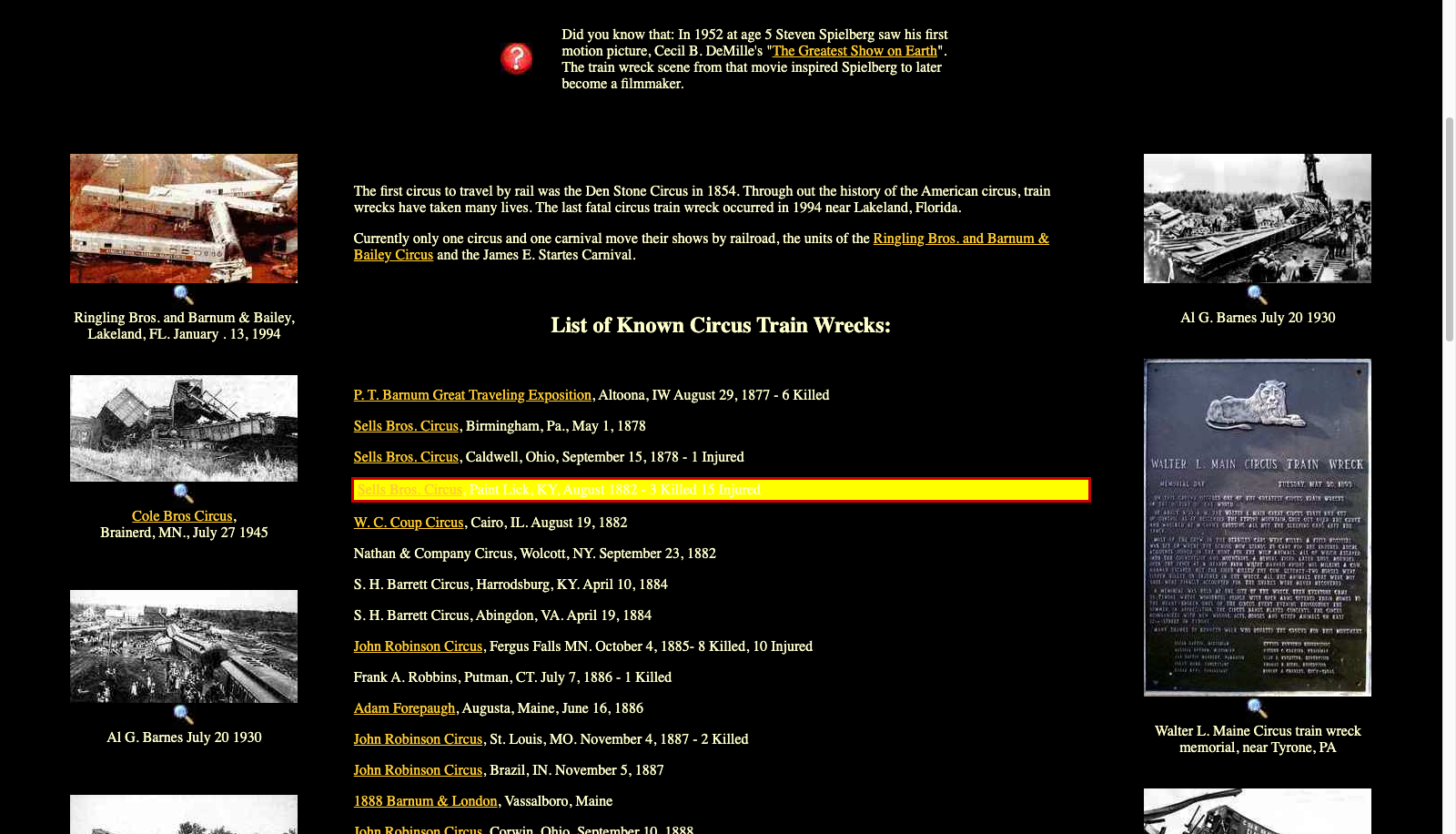
The wreck has been written about. A circus-history aggregator at circusesandsideshows.com lists it among the era's American circus-train disasters. A 2016 local-history blog out of Garrard County reproduces Dr. Kinnaird's account at length and is by far the most thorough single piece of writing on Paint Lick on the public web. The disaster-database gendisasters.com transcribes a half-dozen 1882 wire stories about it. The 1882 Kentucky paper coverage itself — the Interior Journal, the Breckenridge News, the Evening Bulletin, the Bourbon News — has been free, full-text-searchable, and digitized on Chronicling America for the better part of a decade.
What is not new is the legend. There is no Fayette County cemetery, no documented carnie slaughter, no goat creature, no cave, no haunting. The folk telephone game probably compressed three real things into one:
- Paint Lick — a real circus disaster on the right kind of rail line, in the right direction, with a real escaped tiger, in 1882.
- The Pope Lick Monster — the Louisville goatman legend, post-1960s, whose own origin story attributes the creature to “a circus train derailment” that, on inspection, doesn't appear in any contemporary record either. The Lexington version is borrowing Pope Lick's animal.
- Showmen's Rest — the actual circus cemeteries, where performers are buried as a group. The two famous ones are in Forest Park, Illinois (where 56 victims of the 1918 Hagenbeck-Wallace train wreck were laid out behind five granite elephants) and in Hugo, Oklahoma. Neither is in Kentucky.
The Lexington version has none of these substrates near it. It has, instead, the rail line.
What the corpus invites
The most durable fact about Paint Lick is that it has been documented on the public web for years, in primary sources scanned and made free by a federal library, and nobody reads it. The legend, by contrast, had 33 comments on Reddit this week and won't be there next week. That asymmetry is the whole shape of public-record work right now.
If you want to read the wreck in its own voice, Chronicling America's KY-paper hits for the relevant date range are at loc.gov. The Garrard County local-history compilation that preserves Dr. Kinnaird's account is at the One and Only Garrard County blog, drawing from the Lancaster Women's Club's Patches of Garrard County. The disaster-database transcript of the 1882 wire stories is at gendisasters.com.
For the broader shelf of “unknown rural Kentucky graves” that the legend is aesthetically borrowing from: the Kentucky Archaeological Survey's 2022 report on Horse Park Cemetery (site 15FA315) is a real Fayette County unknown-burial excavation, free as a PDF at kentuckyarchaeologicalsurvey.org. The Kentucky Historical Society's “Mystery Cemetery” marker file in Bullitt County is at history.ky.gov.
None of them are a clown cemetery. All of them are real.
This is Off-Beat: public-record stories that don't fit anywhere else. We read the files so you don't have to. We'll be back when the next paperwork drop is worth pulling out of the news cycle for a slow read.
Sources
- Chronicling America KY-paper search: 'Sells Bros' wreck, 1882–1883 (Library of Congress)
- Tigers Roaming Paint Lick — the Circus Trainwreck (One and Only Garrard County, citing Lancaster Women's Club's Patches of Garrard County)
- Paint Lick, KY Circus Train Accident, September 1882 (Gendisasters — transcripts of contemporary wire coverage)
- A List of Circus Train Wrecks (circusesandsideshows.com — standing reference, includes Sells Bros. Paint Lick)
- Pope Lick Monster (Wikipedia — the legend the Reddit post invokes, also lacking a derailment in the record)
- Mystery Cemetery historical marker, Bullitt County (Kentucky Historical Society)
- Horse Park Cemetery (15FA315) archaeological report — Kentucky Archaeological Survey, 2022
- Notable People — The Lexington Cemetery
- Kentucky Folklife Program Archive — Western Kentucky University
- Original r/lexington thread, May 18, 2026
- List of Known Circus Train Wrecks (circusesandsideshows.com) — standing circus-history reference