Planning Commission reviews contested solar ordinance on agricultural land
→ Read the original on lexingtonky.news
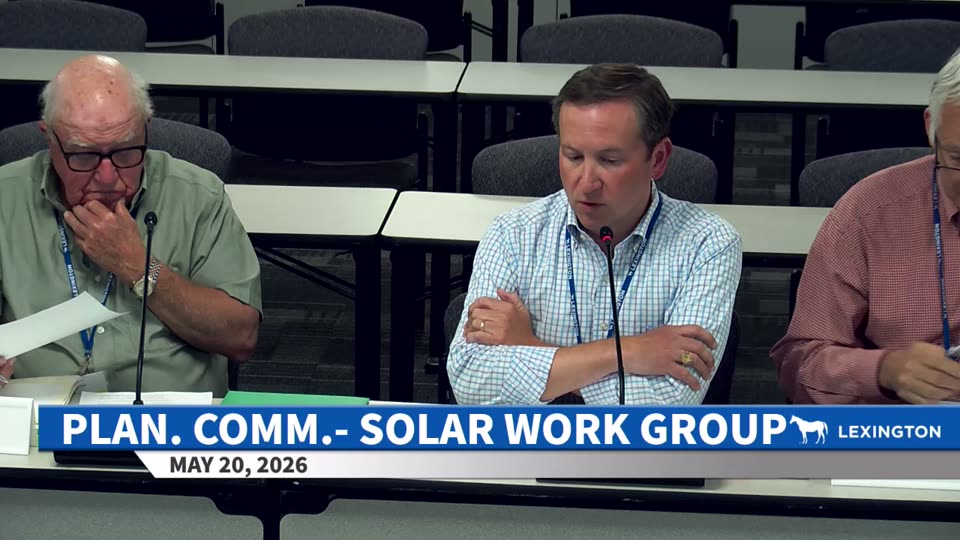
LEXINGTON, Ky. — A work group of the Lexington-Fayette Planning Commission met Wednesday to gather information and recommendations on a contentious proposed revision to the city's solar ordinance that would permit large-scale solar farms on agricultural land for the first time. The group must complete its review and return recommendations to the full Planning Commission by July 9, giving the council time to vote by August 11 under state statute.
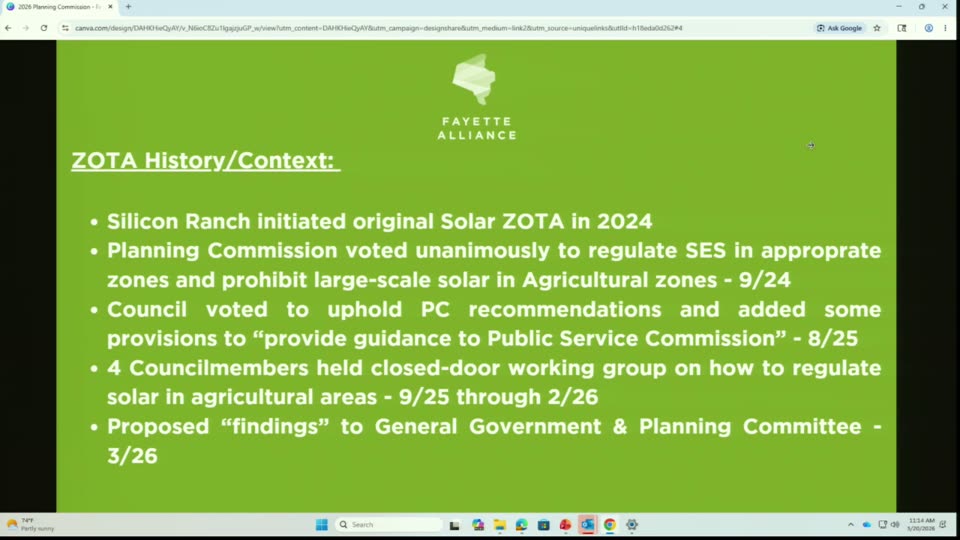
The discussion centered on whether to allow large-scale solar installations exceeding five acres on agricultural land under a conditional use permit, a reversal of the Planning Commission's September 2024 recommendation to prohibit such development. The General Government and Planning Committee voted 6-4 in March to advance the council-initiated proposal, sending it back to the Planning Commission for further review.
Brittany Roethemeier, Executive Director of Fayette Alliance, testified against the proposal, emphasizing concerns about Fayette County's prime agricultural soils and economic impact. "We believe that it must be thoughtfully addressed and informed by robust research and analysis," she said, noting that Fayette Alliance supports solar development on rooftops, parking lots, and brownfields instead of farmland.
The work group, led by Planning Commission Chair Zach Davis, will hold at least one additional meeting on June 9 to accommodate schedule constraints and allow stakeholders additional opportunities to comment. Council Member Hil Boone and other members have raised concerns about the proposal, and the Environmental Commission and Rural Land Management Board have also been asked to provide feedback.
The proposed ordinance includes conditions such as continued farming on-site, annual inspections, and at least 85 percent ground cover remaining vegetated under panels. The debate reflects the city's tension between meeting its net-zero carbon emissions goal by 2050 and protecting the region's agricultural heritage and soil quality.