The Red Mile's tax payout was supposed to be off the books. Open records pried loose five years of it: $2.16 million, recalculated by the state nearly every year.
→ Read the original on lexingtonky.news
When the Urban County Council expanded the Red Mile's tax-increment-financing district on June 4 — in a nine-day sprint to beat a state deadline, with no debate and not one member of the public at the microphone — this newspaper reported that the one number a taxpayer would most want to know was absent from every budget document: how much the 2010 subsidy had actually paid out. Kentucky's annual TIF reports list only the authorized ceilings, never the year-by-year checks. We wrote that the figure existed only behind open-records requests, and that the article would be updated when the records came.
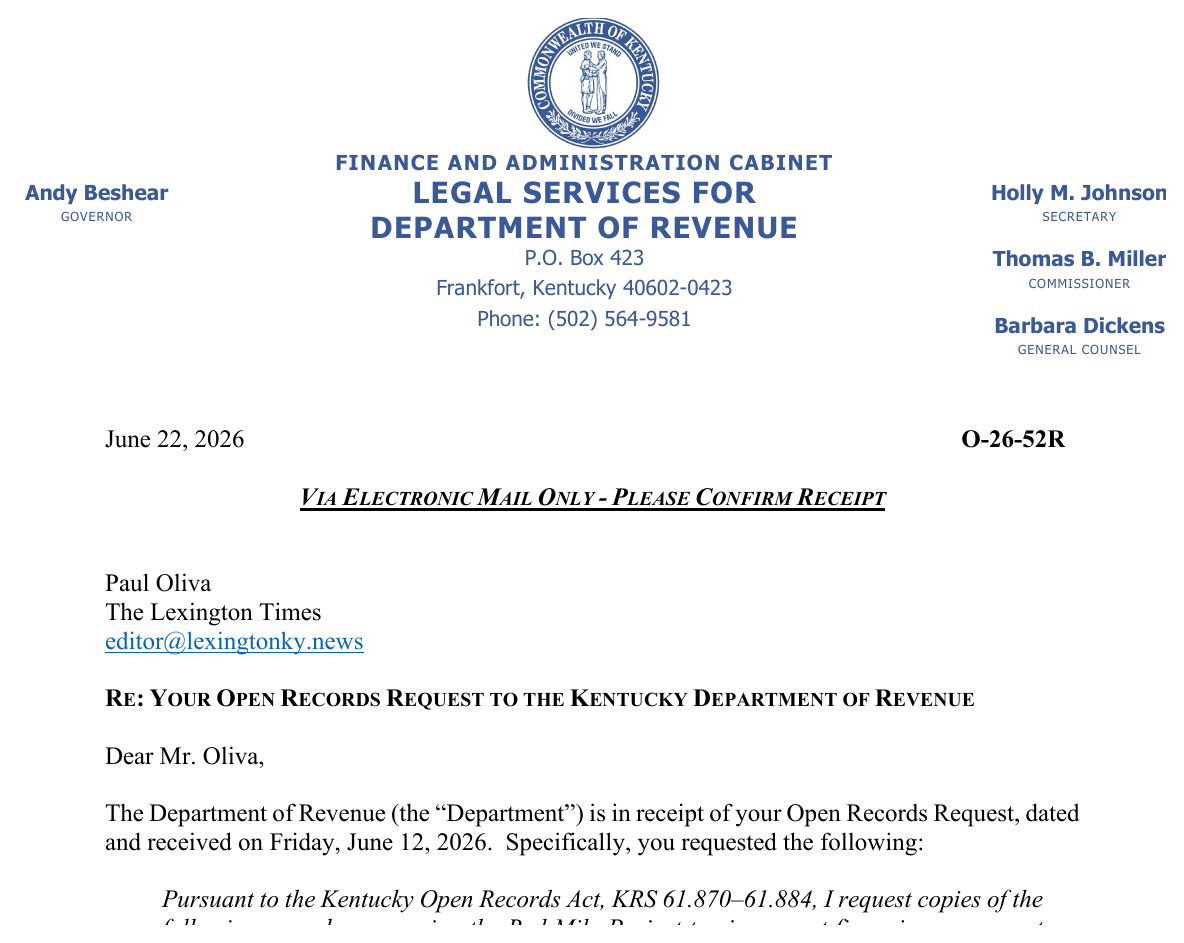
They have come. In response to an open-records request, the Kentucky Department of Revenue — the agency that signs the checks — produced its annual increment letters for the Red Mile. For the first time, here is what the Commonwealth has actually handed over.
$2.16 million in five years
From 2020 through 2024, the state released $2,163,369.59 in increment to the project — its share of the new property, payroll-withholding and sales taxes generated inside the district, routed back to reimburse the development instead of flowing to the state's general fund. The year-by-year figures, taken from the Revenue Department's own final calculation letters:
| Calendar year | City requested | State released |
|---|---|---|
| 2020 | $323,616.58 | $242,296.50 |
| 2021 | $352,035.08 | $353,831.58 |
| 2022 | $499,226.50 | $432,528.33 |
| 2023 | $518,798.85 | $511,278.25 |
| 2024 | $541,501.41 | $623,434.93 |
| Total | $2,235,178.42 | $2,163,369.59 |
That is the state side alone, measured against the $13,786,000 state ceiling this newspaper reported in June — itself barely half the $25.32 million figure repeated throughout the council's public discussion. Five years have drawn down roughly one-sixth of that halved ceiling. The Department says it is still searching for the project's 2015–2019 records and will produce them by July 15, so the running total is larger than $2.16 million; the city's separate local increment — the taxes Lexington itself diverts — sits behind a parallel request to LFUCG's finance office and is not part of the state's production.
The state cut the city's number nearly every year
One pattern runs through all five letters: the Revenue Department was “unable to verify” the increment Lexington asked for, in every single year, and recalculated it from scratch. Usually the state's figure came in lower — about $81,000 below the 2020 request, nearly $67,000 below in 2022. In 2020 the cut was sharpened by a negative sales-tax increment: that pandemic year, taxable sales inside the district fell below the inflation-adjusted base, so the sales line actually subtracted $4,815.70 from the payout.
But twice the state paid more than the city requested — modestly in 2021, and by nearly $82,000 in 2024, when Revenue's final calculation of $623,434.93 overshot Lexington's own $541,501.41 ask. The reason that happened is its own story, and the subject of a companion report: a 2023 change in state law, since extended twice, that recalculates these payouts as if Kentucky's income tax were still at a rate the state has since cut.
The engine is the gaming floor
The letters confirm what the structure of the deal implied. Payroll withholding — not property, not sales — drives the increment, supplying between 64 and 88 percent of the total in every year. The letters do not say whose paychecks; a separate set of records the city produced earlier this month does. The payroll backup behind each annual request identifies KRM Wagering, LLC — the historical-horse-racing operation the Red Mile runs as a joint venture with Keeneland — as the single largest withholding payer in the district, supplying roughly 58 to 61 percent of the withholding behind the 2021 through 2023 requests.
That is the same uncomfortable arithmetic the June report flagged, now visible in the records. The 2012 amendment that halved the recoverable ceiling did so by fencing out “Instant Racing” — the historical-horse-racing gambling then of contested legality. Yet the payroll those same machines generate is the largest single source of the increment the project draws. The activity walled off from the ceiling is the activity paying the subsidy down.
A keyhole into a $3.1 billion black box
What makes these letters worth prying loose is that almost no comparable figures exist. Kentucky has approved 24 TIF projects for state participation since 2002, pledging up to $3.1 billion in future state taxes; only ten have advanced far enough to draw any increment. And as the Kentucky Center for Economic Policy has documented, “there is no way to know how much each project receives in incremental revenue payments each year as this information is not required by law to be made public.” The Red Mile's five years of letters are not a curiosity; they are a rare look inside a statewide account the public is otherwise barred from auditing.
The question two agencies won't answer
Which leaves the single fact that decides what this deal is actually worth, and which remains unanswered after two state agencies and two open-records requests.
The Red Mile's ceiling was cut to $13.786 million on a contingency: that historical horse racing would be found illegal. It wasn't. In September 2020 the Kentucky Supreme Court ruled the machines were not the pari-mutuel wagering state law allowed; in 2021 the General Assembly rewrote the definition of pari-mutuel to make them explicitly legal. The original agreement was built with two ceilings — the $13.786 million “illegal” tier and a $25.32 million tier if the racing stood — and the racing now stands. So does the higher ceiling now apply?
The Lexington Times asked. The Cabinet for Economic Development, which administers the agreement, pointed to the Department of Revenue. The Department of Revenue produced the payment letters, offered no analysis of the ceiling question, and pointed back to the Cabinet. Neither has produced a single record showing the contingency was revisited after the law changed — whether the cap should have moved, and whether anyone in Frankfort looked. The difference between the two answers is more than $11.5 million in public money.
The 2015–2019 records are due in mid-July. The city's local-increment figures are still outstanding. And the one determination that would tell Lexington whether the meter on this deal runs to $13.786 million or to $25.32 million is, so far, a document neither agency will admit exists.
The Department of Revenue's full open-records production — the response letter and every annual increment letter and disbursement request for 2020 through 2025 — is posted here as a single 44-page PDF.
Sources
- Kentucky Department of Revenue — open-records response O-26-52R (June 22, 2026); Red Mile TIF final increment letters, calendar years 2020–2024 (full 44-page production hosted with this article)
- The Lexington Times — "Lexington just made the Red Mile's tax deal bigger" (June 5, 2026), the original investigation this report updates
- Kentucky Cabinet for Economic Development — TIF Projects with State Participation (Red Mile: eligible incentive $13,786,000; estimated project costs $186,891,071)
- Kentucky Cabinet for Economic Development — open-records production (June 12, 2026): KEDFA Tax Incentive Agreement dual cap ($25,321,000 / $13,786,000) and annual payroll backup identifying KRM Wagering, LLC as the largest withholding payer (records on file)
- Kentucky Center for Economic Policy — "TIF Creep Means Growing Costs, Less Accountability" (24 state-participation projects; $3.1 billion pledged; payouts not public)
- Family Trust Foundation of Kentucky, Inc. v. Kentucky Horse Racing Commission — Ky. Supreme Court (Sept. 24, 2020): historical horse racing machines not pari-mutuel wagering
- Kentucky Senate Bill 120 (2021 R.S.) — redefined pari-mutuel wagering to include historical horse racing; signed Feb. 22, 2021
- KRS 154.30 — Commonwealth Participation Program for Tax Increment Financing