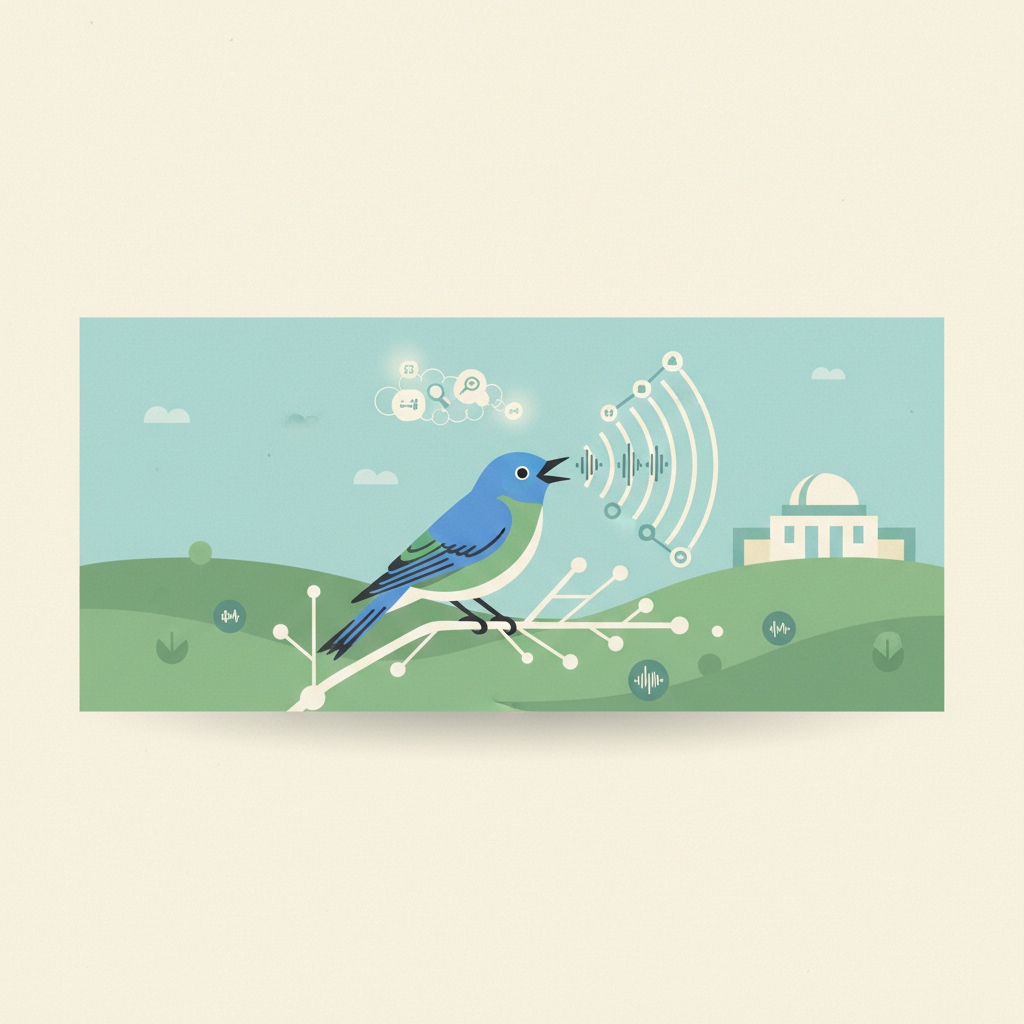
UK researchers use AI to identify individual bird songs
LEXINGTON, Ky. — Scientists at the University of Kentucky are partnering with universities across the country to develop artificial intelligence software that could revolutionize how researchers track one of Appalachia's most vulnerable songbirds.
Darin McNeil, an assistant professor of wildlife management in UK's Martin-Gatton College of Agriculture, Food and Environment, is leading the collaborative effort to teach computers to recognize individual cerulean warblers by their unique songs. While existing smartphone apps can already identify whether a bird is a cerulean warbler, this project aims to go further — pinpointing which specific bird is singing.
"We don't just want to identify whether it is a cerulean warbler; we want to know which cerulean warbler it is," McNeil said. "You could identify these individual birds by their voices as well."
The cerulean warbler, a small blue songbird, has experienced a population decline of nearly 70 percent over the past 40 years, according to conservation research. The species is on the U.S. Fish and Wildlife Service's Birds of Conservation list as one of the agency's highest priorities.
Traditionally, researchers wanting to track individual birds have had to capture them, band their legs with colored tags, then return repeatedly to recapture or observe those birds. For elusive species like cerulean warblers that nest high in forest canopies, the process is arduous and intrusive. The new system would allow researchers to identify birds through the songs they naturally sing, potentially eliminating the need for capturing birds entirely.
Though humans hear cerulean warbler songs as largely identical, computers can detect tiny differences in pitch, timing and pattern — much like how people recognize individual human voices. McNeil said the process is simple in concept. "This new method would allow us to tell one individual from another based on their song," he explained.
Such capability could help researchers understand population dynamics without relying solely on traditional banding methods. By tracking which singers return to the same locations year after year, scientists can begin measuring survival rates and site fidelity, potentially revealing why numbers are declining and where conservation efforts matter most.
The project, led by Ph.D. student Lauren Chronister at the University of Pittsburgh, is in its early stages of development. Currently, researchers are using parabolic microphones and specialized equipment rather than consumer smartphones, so the primary users will likely be field scientists rather than casual birders.
The collaboration includes UK, the University of Pittsburgh, Indiana University of Pennsylvania, Massachusetts Department of Conservation and Recreation and Arkansas State University. McNeil suggested the approach has broader potential. "If we can learn to recognize individual birds by voice, there's no reason the same approach couldn't work for other species that are just as hard to track," he said.