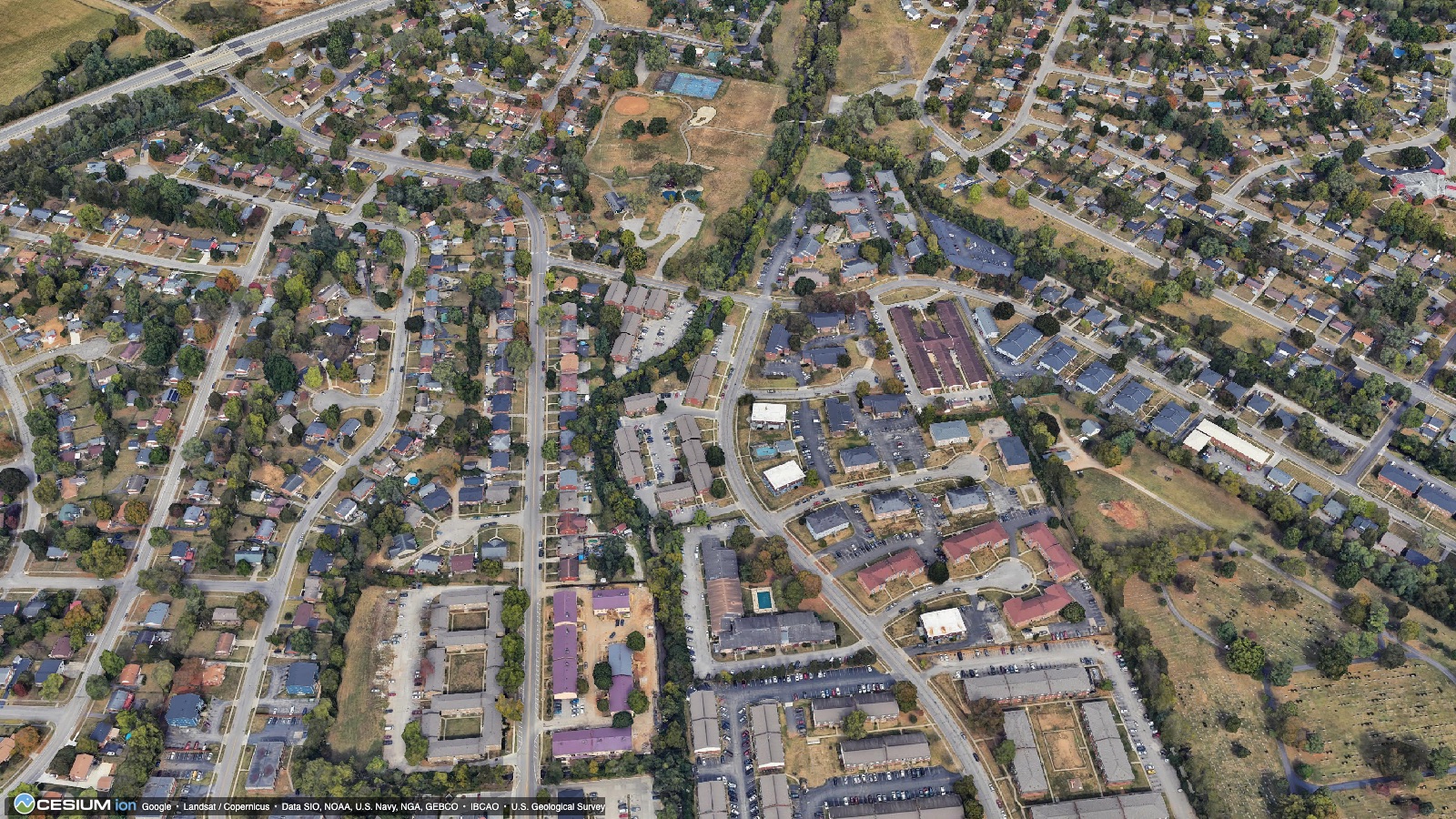
More than 400 Cardinal Valley apartments go to auction in the shadow of a $50 million fraud case
Starting August 24, anyone with an internet connection and a notarized surety affidavit can bid on more than 400 apartments in Cardinal Valley — the entire Lexington portfolio of Vision & Beyond, the collapsed Cincinnati investment firm whose owners were federally indicted in January in what prosecutors describe as a bank-fraud conspiracy exceeding $50 million.
The four complexes — Cambridge Park at 2045 Cambridge Drive, the Cambridge Homes buildings at 1980–2016 Cambridge Drive, Creekside North at 2223 Devonport Drive, and the Ashland buildings at 1328–1344 Devonport Drive — will be sold in a single court-ordered online auction that opens August 24 and closes August 26, conducted by the Fayette County Master Commissioner through the Ten-X auction platform on LoopNet. The listings, brokered by CBRE, advertise it as an absolute auction: no reserve, highest bid wins.
No news outlet The Lexington Times could find — local or national — has reported that these are the same properties the federal indictment calls “four apartment complexes in the Lexington, Kentucky area,” allegedly refinanced in August 2023 through a $24.6 million loan from which, the indictment says, “none of the four preexisting loans identified on the closing statement were actually paid off at closing.”
An absolute auction, upside down
All four sales belong to one Fayette Circuit Court case, 25-CI-00130, filed by The Bancorp Bank in January 2025 — with U.S. Bank National Association joining as co-plaintiff on two of the four properties. The Master Commissioner’s sale notices put the total principal to be raised at $18,073,039.87, against court appraisals totaling $23.6 million.
The portfolio’s halves point in opposite directions. Cambridge Homes is appraised at $7.5 million against $2.55 million owed. Creekside North is the mirror image: appraised at $4.1 million against a principal of $7,204,401 — the debt is 176 percent of what the court’s appraiser thinks the property is worth.
The auction listings tell the same story in occupancy figures. CBRE reports Cambridge Park 96 percent occupied — and Ashland at 32 percent, Creekside North at 54 percent, Cambridge Homes at 60 percent. Taken together, by the listings’ own unit counts and occupancy figures, roughly 160 of 426 units sit empty.
$20.8 million in, three years to collapse
Vision & Beyond arrived in Lexington in early 2021 promising to be a good landlord. Founded by Stas Grinberg and Peter Gizunterman, two veteran officers of the Israel Defense Forces, the Cincinnati company announced itself as a buyer of “workforce housing” in markets away from the coasts; The Lane Report, covering its arrival, reported that 85 percent of the firm’s investment partners were in Israel. “We believe in Lexington’s economy,” Grinberg said then.
Between February and October 2021, entities tied to the firm bought all four Cardinal Valley complexes for a combined $20,778,500, according to Fayette County property records: Cambridge Park for $6,565,000 (a property that had sold for $2.9 million in 2015), the Ashland buildings for $4,682,500, Cambridge Homes for $3 million, and Creekside North for $6,531,000. Announcing the Creekside purchase, the firm pledged more than $30 million in Cardinal Valley acquisitions and improvements, and promised: “No tenants will be displaced as renovations are underway.”
“The Lexington Transaction”
The federal indictment returned January 14 — United States v. Vision & Beyond Group LLC, Southern District of Ohio — charges the company, Grinberg, Gizunterman, and two real-estate closing employees, Keya Hamilton and Kelly West, with conspiracy to commit bank fraud, bank fraud, false statements, and money laundering. The core of the case is a December 2022 Cincinnati refinancing of roughly 60 properties in which, prosecutors allege, 20 prior mortgages worth $17.2 million were never paid off.
But one section of the conspiracy count is headed “The Lexington Transaction.” In 2021, it alleges, the defendants bought the four Lexington complexes through more than $8 million in loans. Then, in August 2023, they refinanced the same properties through a $24.6 million loan — and again, the indictment alleges, none of the four preexisting loans on the closing statement were paid off. Instead, $10.9 million was transferred directly into Vision & Beyond’s account, nearly $1.8 million went to Hamilton and a closing company Hamilton controlled, and $3.88 million paid off an unrelated Vision & Beyond deal in Cincinnati.
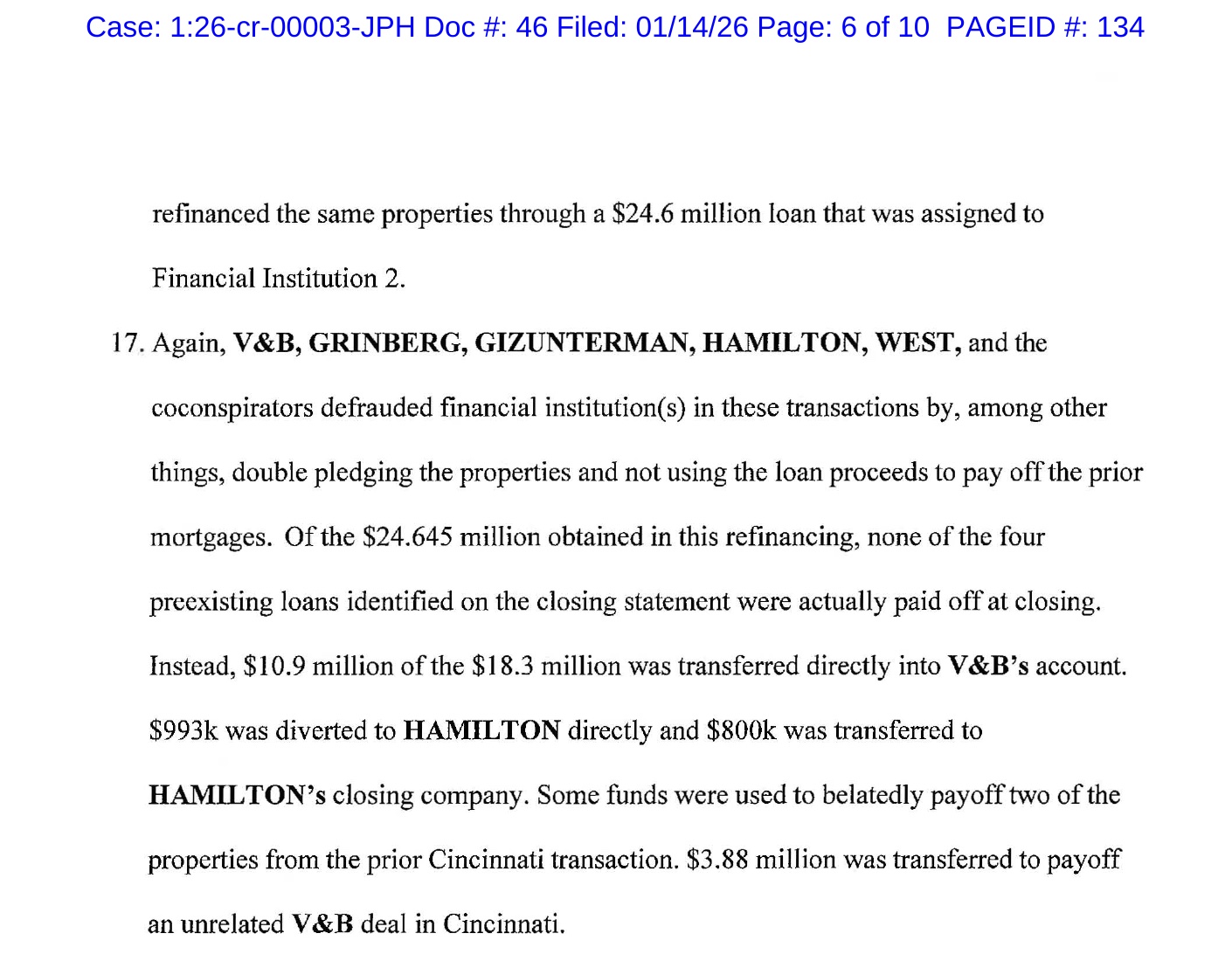
Paragraph 17 of the January 14 indictment: none of the four preexisting Lexington loans were paid off at closing. (U.S. v. Vision & Beyond Group LLC, S.D. Ohio, Doc. 46)
The indictment does not name the defrauded lenders, referring only to “Financial Institution 1” and “Financial Institution 2.” Whether the Bancorp Bank — the lender now foreclosing on the same four complexes over the same era of loans — is “Financial Institution 2” is not stated in any public record. Among the conspiracy’s general methods, the indictment alleges, were falsifying “closing statements and partial mortgage releases” and removing mortgages from title commitments so lenders could not see existing debt.
Bancorp’s own civil suit goes further. The trade publication The Promote reported in January 2025 that Bancorp’s Kentucky lawsuit alleges “an unknown person or entity” forged the signature of a Bancorp executive on satisfaction-of-mortgage documents recorded against Creekside North and Cambridge Homes — releasing, on paper, about $9.8 million of the bank’s liens. Those are the same two complexes where Bancorp is suing alone, and their judgment principals in the auction notices total $9,754,401.
The Lexington refinancing is described in the indictment as part of the charged conspiracy; it is not the subject of a separate count. An indictment contains only allegations, and all defendants are presumed innocent unless proven guilty. West pleaded not guilty at her January arraignment and was released; Grinberg has been in federal custody since his arrest in Houston in March 2025; no trial date appears in the public docket.
Four shell companies, all legally dead
On paper, the complexes are owned by four LLCs — Cambridge Lexington, Cambridge Homes Holdings, Creekside North Holdings, and Ashland Lexington — all four listing the same principal office in their Kentucky filings: 2100 Auburn Avenue in Cincinnati, the address Vision & Beyond used as its headquarters. Kentucky Secretary of State records name Gizunterman personally as a member or manager of all four, and Grinberg as a manager of two.
All four companies were administratively dissolved or revoked by the state on the same day — October 12, 2024 — for failing to file annual reports. One of them, Cambridge Lexington, filed five reinstatement applications in early 2025; the Department of Revenue denied every one. The buildings will go to auction owned by companies that have been legally dead in Kentucky for nearly two years.
The receiver fight
What happened inside the foreclosure case is a story The Lexington Times and the Herald-Leader have partly told already — without, until now, the Vision & Beyond connection.
In February 2025, Fayette Circuit Judge Julie Muth Goodman appointed James H. Frazier III — the Fayette County Master Commissioner and CEO of the McBrayer law firm — as receiver to take control of the properties, billing $550 an hour, fees Frazier says go back to the court system rather than his firm. As The Lexington Times reported in April, Frazier was simultaneously one of Goodman’s defense lawyers in her impeachment fight with the General Assembly — a relationship the bank’s lawyers said was never disclosed. Bancorp moved for Goodman’s recusal on March 30; Frazier offered his resignation as receiver the next day, calling the motion a “political diversion.”
At an April 17 hearing, the Herald-Leader’s Taylor Six reported, Goodman recused herself but left Frazier in place as receiver so repair work could continue; the case was reassigned to Judge Kimberly Bunnell. Whether a successor receiver has since been appointed is not reflected in any public record The Lexington Times could locate — leaving open the possibility that the officer conducting this month’s sale as Master Commissioner is, at the same time, still the court’s receiver over the properties being sold.
“A humanitarian crisis to the nth degree”
The condition of the buildings when the court stepped in was documented in detail by the Herald-Leader. Home Forward, a Lexington company brought in to manage the properties when the receiver was appointed, found buildings condemned by the fire marshal — no extinguishers, dead smoke detectors, no locks — plus black mold, sewage backups, and no hot water. Its director, Debbie Adams, told the paper officials found one tenant heating a unit with a charcoal grill, and parents boiling tap water to bathe their children. She called it “a humanitarian crisis to the nth degree.”
Working from rent receipts alone — “There was no money. We started with zero,” Adams told the Herald-Leader — Home Forward got 84 condemnation orders lifted in its first month, and cleared every occupied unit within about six months. But as of the April hearing, 57 units and three entire buildings remained condemned, with the receiver asking the lenders to fund repairs; the city’s lawyer told the court the banks had offered no plans for bringing the buildings into code compliance.
What Cincinnati got
Lexington’s auction is the second act of a collapse Cincinnati has been living through since late 2024. There, Vision & Beyond simply walked away from roughly 70 properties; the city counted $46.1 million of recorded debt against $23.8 million of appraised value across 88 properties. WVXU, Cincinnati’s public radio station, has documented collapsed ceilings, 16-day heat outages and sewage flooding; the receivership there has churned through a sequence of court-appointed managers, and the largest complex sold for about $28,000 a unit. In the coverage The Lexington Times reviewed, the Ohio reporting does not mention that the same firm owned more than 400 apartments in Lexington.
The neighborhood on the other side of the sale
Cardinal Valley is the center of Hispanic and immigrant Lexington. The census tract containing three of the four complexes is 30.5 percent Hispanic — more than three times the county share — with a median household income of about $42,000 and 80 percent of households renting, according to American Community Survey data. The adjacent tract, home to the Ashland buildings, is nearly half Hispanic — the highest share of any tract in Fayette County.
For scale: the $24.6 million loan the indictment describes on these four complexes is roughly five times the $5 million Lexington’s city government budgeted for its entire affordable-housing fund this fiscal year.
What the sale means for tenants
The auction itself evicts no one. Under the federal Protecting Tenants at Foreclosure Act, which covers judicial foreclosure sales, a buyer must honor bona fide leases through the end of their term, and month-to-month tenants are entitled to at least 90 days’ written notice before any eviction — protections that apply to subsidized tenancies as well. There is a catch: under the Sixth Circuit’s decision in Mik v. Federal Home Loan Mortgage Corp., a Kentucky case, tenants cannot sue in federal court under the act — it can only be raised in state court, typically as a defense to an eviction.
Lexington tenants have one more layer: the city adopted Kentucky’s Uniform Residential Landlord and Tenant Act, which requires any successor owner to disclose in writing who owns and manages the property — an obligation the law makes “enforceable against any successor landlord, owner, or manager.” Whoever wins the auction becomes the landlord, on the leases’ existing terms.
What to watch on August 26
Kentucky’s auctioneer law makes “absolute auction” a term of art. Under KRS 330.220, an auction may be advertised as absolute only if the property is free of liens, every lienholder has committed in writing to accept the highest bid unconditionally, or a financially responsible party has guaranteed that all liens will be satisfied. That chapter governs licensed auctioneers, and the listings name a licensed Kentucky auctioneer for the sale; how its rules apply to a court-ordered auction is its own legal question, and the sale proceeds under the court’s authority either way. What the statute states plainly: the seller may not bid at an absolute auction, while lienholders expressly may. Whether Bancorp or U.S. Bank shows up as a bidder — and whether anyone pays anything close to the $23.6 million appraisal — will determine how much of the allegedly fraud-tainted debt is ever recovered, and who the tenants of Cardinal Valley answer to next.
The Lexington Times will report the results of the sale.
This article extends The Lexington Times’ April 3 reporting on the receivership, and draws on Herald-Leader reporting by Taylor Six, WVXU reporting by Nick Swartsell, federal court records, Fayette County property records, and Kentucky Secretary of State filings. All criminal allegations are from the indictment; the defendants are presumed innocent.
Sources
- Master Commissioner of the Fayette Circuit Court — Upcoming Sales, Action No. 25-CI-00130
- United States v. Vision & Beyond Group LLC, No. 1:26-cr-00003-JPH (S.D. Ohio), indictment filed Jan. 14, 2026 (CourtListener/RECAP)
- U.S. Attorney's Office, S.D. Ohio — indictment press release, Jan. 14, 2026
- Ten-X/LoopNet auction listings: 1980-2016 Cambridge Dr; 2045 Cambridge Dr; 2223 Devonport Dr; 1328-1344 Devonport Dr (CBRE)
- Kentucky Secretary of State — Creekside North Holdings LLC, Cambridge Homes Holdings LLC, Cambridge Lexington LLC, Ashland Lexington LLC profiles
- Fayette County PVA parcel and sales records (parcels 12627701, 14932400, 16508550, 11467250, 13830200, 15122500, 11441650, 14177550, 14177555, 14177551)
- Taylor Six, "Bank: Lexington judge failed to disclose appointed receiver was her impeachment lawyer," Lexington Herald-Leader, Apr. 3, 2026
- Taylor Six, "'Humanitarian crisis' persists as Lexington judge recuses from property dispute," Lexington Herald-Leader, Apr. 29, 2026
- The Lexington Times, "One firm, many hats: McBrayer's James Frazier at the center of Lexington's legal web," Apr. 3, 2026
- The Lane Report, "Cincinnati-based international investor group purchases Lexington apartments," Mar. 5, 2021
- REJournals, "Vision & Beyond Capital Investments buys 146-unit apartment community in Lexington," Oct. 29, 2021
- Nick Swartsell, WVXU — Vision & Beyond coverage (lawsuits, tenant conditions, receivership), Jan. 2025–Aug. 2026
- The Promote, "Forged in (syndicator) fire," Jan. 22, 2025 — Bancorp's forged-satisfaction allegations
- OCC Comptroller's Handbook, "Protecting Tenants at Foreclosure Act"; Mik v. Federal Home Loan Mortgage Corp., 743 F.3d 149 (6th Cir. 2014)
- American Community Survey 2020-2024 5-year, Census Tracts 20.01 and 20.02, Fayette County, Ky. (Census Reporter)
- LFUCG, "Gorton's proposed budget includes $5 million for affordable housing," Apr. 21, 2026
- KRS 330.220 (absolute auctions); KRS 383.585 (URLTA successor-landlord disclosure, adopted in Lexington by Ordinance 98-84)