The Great Writ comes to Covington: why immigration detainees are flooding Kentucky's federal court with habeas petitions
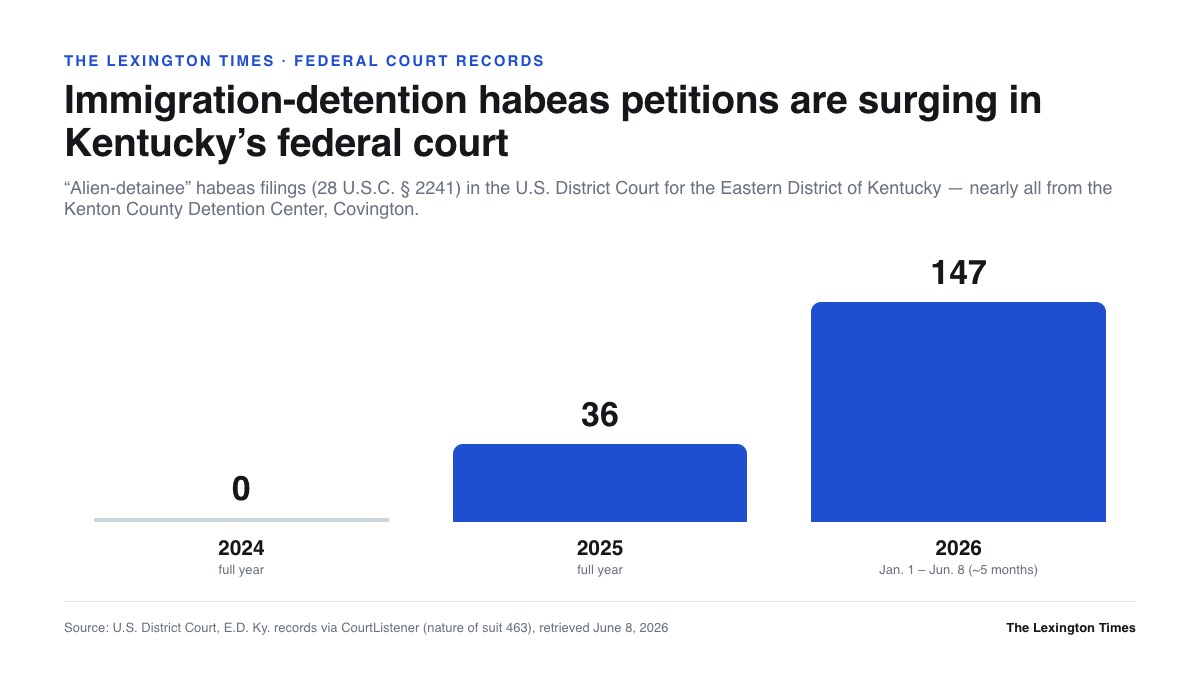
In 2024, the federal court that sits in Lexington recorded zero of them. In the first five months of 2026, it logged 147.
They are habeas corpus petitions — specifically, petitions under 28 U.S.C. § 2241 filed by people in immigration detention, asking a federal judge a single, ancient question: is the government allowed to keep holding me? A Lexington Times review of federal court records shows the U.S. District Court for the Eastern District of Kentucky went from none of these cases in 2024, to 36 in 2025, to 147 between January 1 and June 8 of 2026. Nearly every one was filed out of a single building: the Kenton County Detention Center, a county jail at 3000 Decker Crane Lane in Covington that now holds detainees for U.S. Immigration and Customs Enforcement.
The oldest check on the newest detention
Habeas corpus — roughly, “you shall have the body” — is the legal device by which a court orders whoever is holding a person to come to court and justify the detention, or release them. It is centuries older than the United States, and the Framers thought it important enough to protect by name. Article I, Section 9 of the Constitution provides: “The Privilege of the Writ of Habeas Corpus shall not be suspended, unless when in Cases of Rebellion or Invasion the public Safety may require it.” Because that sentence sits in Article I — the article that defines Congress’s powers — courts have long read it to mean that only Congress, not a president acting alone, may switch the writ off.
The most famous test of that principle came in 1861. Weeks into the Civil War, Abraham Lincoln suspended habeas corpus along the rail corridor between Washington and Philadelphia, and the Army arrested a Maryland man named John Merryman. Chief Justice Roger Taney, sitting as a circuit judge, ruled in Ex parte Merryman that the president had no power to suspend the writ on his own. Lincoln ignored the ruling; Congress later authorized the suspension by statute. The episode is taught as the archetype of a recurring American tension — executive detention against the judicial check that habeas provides. That same tension now runs through a county jail on Decker Crane Lane.
What these cases are — and what they are not
The petitions piling up in Covington are not appeals of deportation orders. By law, a challenge to a removal order itself goes to a federal court of appeals, not the district court. A § 2241 petition challenges the detention — the fact that someone is being held, or the length of time without a hearing. That is the historic core of the writ: testing the lawfulness of physical custody.
It is also why the cases carry the names they do. Under the Supreme Court’s Rumsfeld v. Padilla (2004), a petitioner challenging current confinement generally sues his “immediate custodian” — the official with day-to-day control of the jail — in the district where he is held. So the Eastern District’s docket fills with captions like Demir v. Warden of Kenton County and Rodriguez Sosa v. Kenton County Detention Center, alongside petitions naming ICE field-office officials. Many are filed pro se — by detainees writing for themselves, without a lawyer.
Why now: two changes in 2025
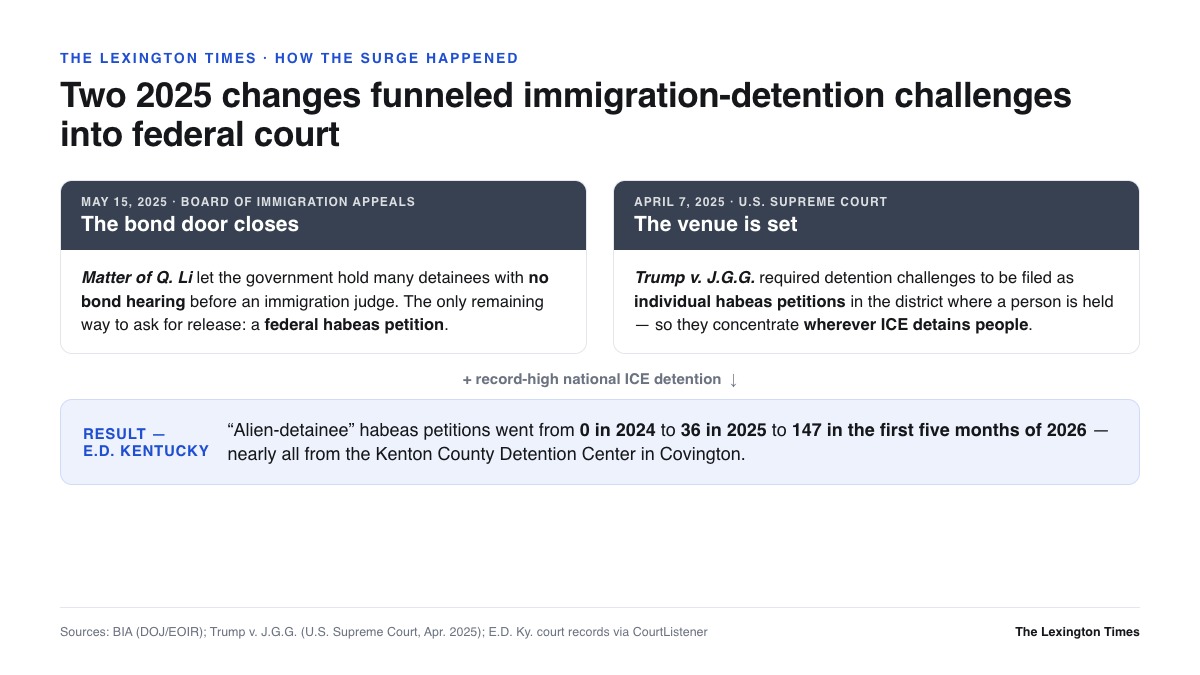
The surge is not random. Two changes in 2025 funneled a national wave of detention toward the federal courthouse door.
First, the path to release inside the immigration system narrowed. In Matter of Q. Li, decided May 15, 2025, the Justice Department’s Board of Immigration Appeals held that immigrants who entered without inspection are “applicants for admission” who may be detained without the possibility of a bond hearing before an immigration judge — a position it reinforced that September in Matter of Yajure Hurtado. For a large class of detainees, that left no administrative route to ask for release. The remaining route is a habeas petition in federal district court.
Second, the Supreme Court told detainees where to file. In Trump v. J.G.G. (April 2025), the Court held that people contesting removal under the Alien Enemies Act had to bring individual habeas petitions in the district where they were confined, rather than as a group elsewhere. Routing challenges to the place of confinement means petitions concentrate wherever ICE physically holds people.
And ICE is holding more people than at any point on record. By the Vera Institute’s analysis of federal data, the nationwide immigration-detention population topped 73,000 in mid-January 2026, the highest ever recorded; the Transactional Records Access Clearinghouse (TRAC) at Syracuse University reported that detainees with no criminal conviction made up roughly 70 percent of the population this spring. More people detained, no administrative bond, challenges filed where they’re held: the result is a flood of district-court habeas petitions. TRAC counted more than 31,000 nationally between October 2025 and March 2026 — an increase of more than 85-fold over the prior year — reaching 82 of the country’s 90 federal districts.
How Northern Kentucky became a detention hub
The Eastern District of Kentucky covers the northern tier of the state, including Covington and the Cincinnati-area suburbs — and that is where the detainees are. Three Northern Kentucky jails now hold immigration detainees under federal contracts: Boone County has since 2005, while Kenton and Campbell counties signed on under new U.S. Marshals Service arrangements in 2025. According to records obtained by Louisville Public Media and WVXU, Kenton County’s contract dates to March 2025 and pays the jail about $88 per federal detainee per day; the county also holds a 287(g) agreement deputizing local officers for immigration enforcement. By late January 2026, more than 130 people were being held there on federal immigration matters, most without criminal charges.
The growth is statewide. The Kentucky Center for Economic Policy, analyzing federal ICE data, found the number of detainees in Kentucky jails contracting with ICE rose 659 percent between January and August 2025. Because those Northern Kentucky jails all sit inside the Eastern District, the habeas petitions that follow the detainees land on the district’s judges — in these cases, mostly Judges David L. Bunning and S. Chad Meredith, in Covington.
The legal terrain
The petitions navigate a body of Supreme Court law that cuts both ways. In Zadvydas v. Davis (2001), the Court held that detention after a final removal order is not indefinite: after a presumptive six months, if there is no significant likelihood of removal in the reasonably foreseeable future, the person should generally be released. But in Jennings v. Rodriguez (2018), the Court held there is no statutory right to periodic bond hearings during proceedings, leaving prolonged-detention claims to be litigated one habeas case at a time. And in Department of Homeland Security v. Thuraissigiam (2020), the Court narrowed habeas at the border for people in expedited removal — though that ruling turned on the fact that the petitioner sought the right to stay in the country, not release from custody, which is the reverse of what the Covington petitions ask.
A public ledger of a quiet process
No agency issues a press release when someone is detained. There is no public hearing, no notice. The habeas docket is the closest thing to a public record — a running, searchable ledger of who is being held in a Covington jail and for how long, written in many cases in the detainees’ own words. The Lexington Times is now tracking these filings, and a dedicated feed of Eastern District habeas cases is in the works.
It is worth remembering what kind of cases these are. When John Merryman’s lawyer walked into a Baltimore courtroom in 1861, the question was whether the government could hold a man without answering to a judge. On Decker Crane Lane in 2026 — asked 147 times and counting — it is the same question.
Sources
- U.S. District Court, E.D. Ky. — alien-detainee habeas petitions (nature of suit 463), federal court records
- U.S. Constitution, Article I, Section 9, Clause 2 (Suspension Clause)
- 28 U.S.C. § 2241 (power to grant writ of habeas corpus)
- Rumsfeld v. Padilla, 542 U.S. 426 (2004) — immediate-custodian rule
- Zadvydas v. Davis, 533 U.S. 678 (2001); Jennings v. Rodriguez, 583 U.S. 281 (2018); DHS v. Thuraissigiam, 591 U.S. 103 (2020)
- Trump v. J.G.G., 604 U.S. ___ (per curiam, Apr. 7, 2025) — Alien Enemies Act detainees must file individual habeas in district of confinement
- Matter of Q. Li, 29 I&N Dec. 66 (BIA, May 15, 2025) — no bond hearing for applicants for admission
- TRAC (Syracuse University) — "Surge in Immigration Lawsuits Hits Record High in 2026" (May 11, 2026)
- Vera Institute of Justice — ICE Detention Trends (record detention population, 2026)
- ICE — Kenton County Detention Center facility page
- Kentucky Center for Economic Policy / Louisville Public Media — 659% rise in detainees at Kentucky jails contracting with ICE (Jan.–Aug. 2025)