Days after Kentucky's policy center urged cities to build opioid-money watchdogs, Lexington quietly abolished its own
On the night of May 28, the Urban County Council voted 15–0 to abolish the citizen commission that for the past three years had been charged with vetting how Lexington spends the roughly $30 million it is receiving from the national opioid settlements. There was no debate. The repeal was bundled with two unrelated ordinances — a children’s-museum board change and a routine budget amendment — and passed in a single roll-call vote. No one rose to speak.
Ordinance 037-2026 did one thing: it repealed Article LI of the city code and, in the law’s own word, “reserved” it — erasing the Opioid Abatement Commission. The ordinance names no replacement.
The timing is its own story. Six days earlier, on May 22, the Kentucky Center for Economic Policy — working with the national group Vital Strategies — had published a model ordinance urging Kentucky counties to do the opposite: to establish local opioid-abatement advisory councils, written into ordinance and aligned with national transparency principles, precisely so the public could see how this once-in-a-generation pot of money gets spent. Lexington already had one. Then it didn’t.
What the commission was
The city created the Opioid Abatement Commission in March 2023 (Ordinance 022-2023). It was a 13-member volunteer body, appointed by the mayor and confirmed by the council, required by code to meet at least quarterly under the Kentucky Open Meetings Act. Its charge, in the language of the city code: “recommending appropriate uses for proceeds received… in any settlement, judgement, bankruptcy, or other manner of resolution of the National Opioid Litigation, or other moneys received from gifts, grants or state or federal funds.” Chaired by Dr. Stephanie Raglin, it spent two years studying the need — work that helped Lexington earn the state’s “recovery ready community” designation — before delivering a set of spending recommendations to the mayor and council.
The official reason for dissolving it is brief. The repeal ordinance recites simply that “the Commission has made its recommendations and completed its purpose.” A one-page staff memo dated April 29, out of the mayor’s office, says the same: the body “has completed its recommendations and fulfilled its purpose.” Cost of abolishing it, the memo notes: “N/A.”
‘Completed its purpose’ — with $21 million still to come
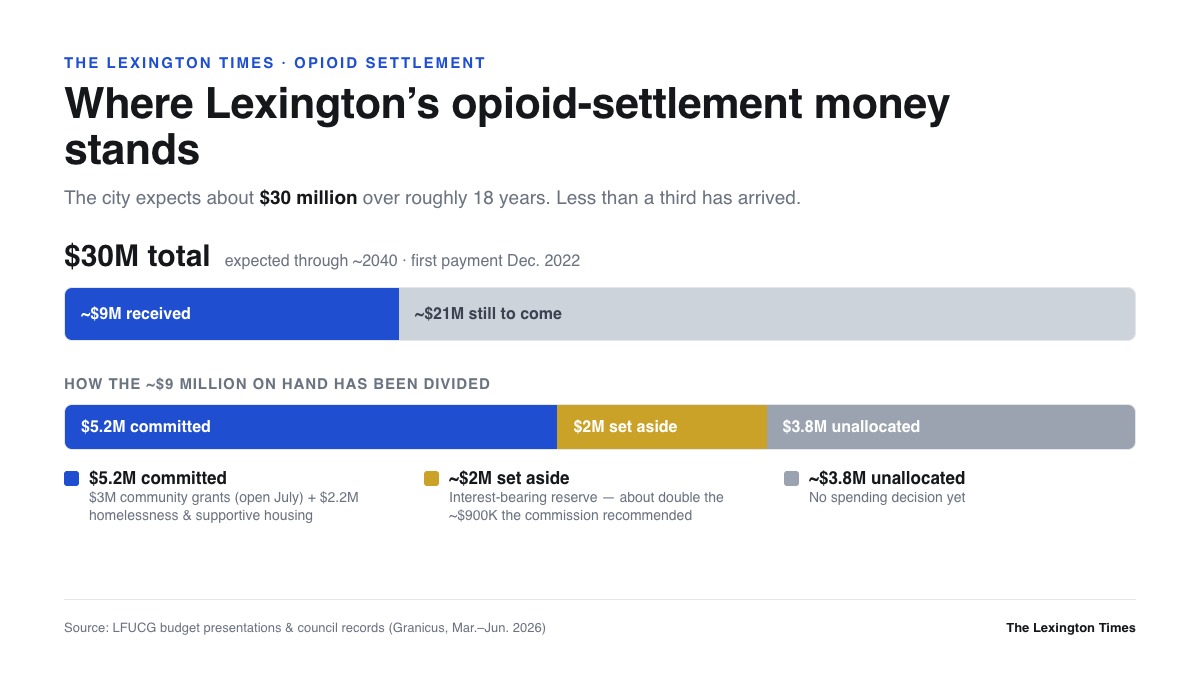
That framing sits awkwardly against the money. By the administration’s own accounting, presented to a budget committee in March, Lexington expects about $30 million from the settlements over roughly 18 years, the first payment having arrived in December 2022. It holds about $9 million now — which means roughly $21 million is still to come, in tranches arriving for another decade and more.
That is the question Vice Mayor Dan Wu put to the administration at a May 12 work session, before the repeal. “The opioid payments are still going to be coming to us for the next 12 years or so,” he said. “Say three, four years down the road, we have another $3, $4 million, $5 million. What is the approach there?” The answer, from the mayor’s chief of staff, Tyler Scott: the commission’s existing recommendations remain the guide, its work “has also been worked into the Mayor’s Substance Use Advisory Committee,” and future spending would be “an ongoing conversation” between the council and the administration. “We didn’t envision this being a volunteer commission that would last forever,” he said. “There was always going to be a clean separation where they hand over their recommendations and the Council and the Administration decide how they want to proceed.”
The body that does the work now answers to no ordinance
The body now described as the commission’s heir — the Mayor’s Substance Use Disorder Advisory Council — is not a successor in any formal sense. It is older than the commission (the mayor created it in 2020), it exists by the mayor’s hand rather than by ordinance, its members are not confirmed by the council, and its stated job, per the city’s own website, is to advise the mayor and guide two grant programs. Its public page makes no mention of opioid-settlement money. The Opioid Abatement Commission’s page on the city site now returns a “not found” error.
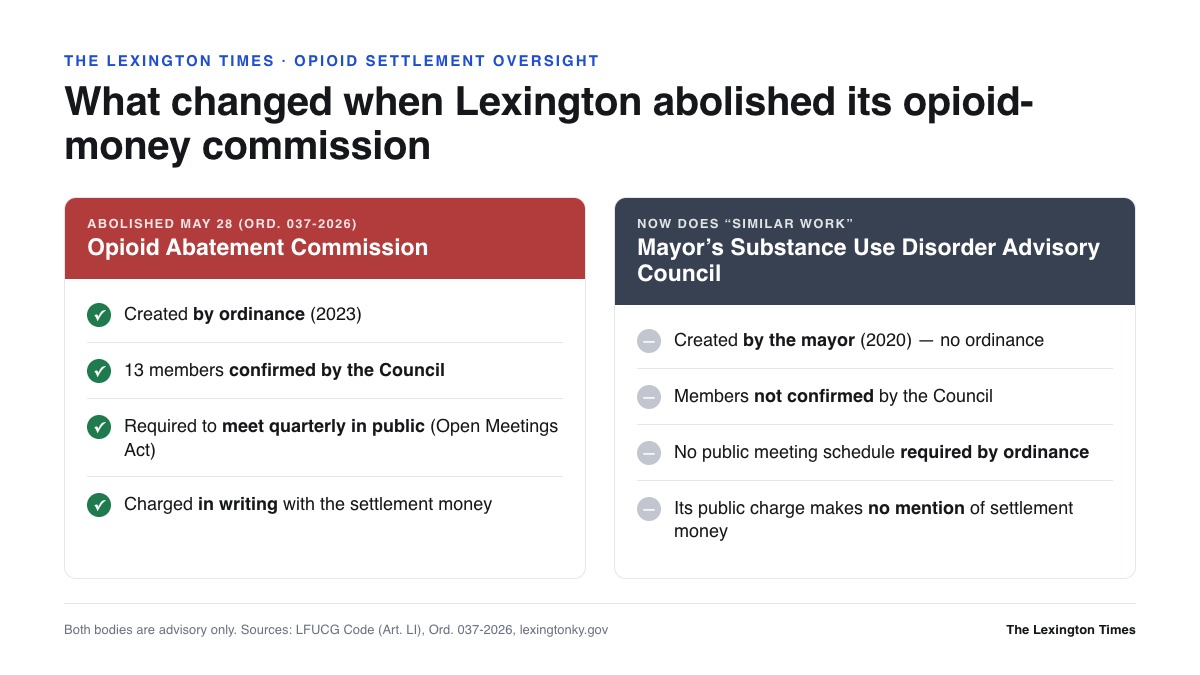
So the practical effect of Ordinance 037-2026 is this: the layer of citizen oversight that the council had to confirm, that had to meet in public on a fixed schedule, and that was charged in writing with the settlement money, is gone — and the decisions move to the mayor’s administration and the council.
Where the money is
Of the roughly $9 million on hand, the council in April committed $5.2 million: $3 million to a community-grant program, with applications opening in July, and $2.2 million toward the mayor’s homelessness task force and supportive housing. About $2 million was set aside in an interest-bearing account meant to make the money last; about $3.8 million remains unallocated.
That set-aside drew the sharpest public pushback. At the May 12 work session, resident Trevor Davis argued the $2 million reserve is more than double the roughly 10 percent — about $900,000 — that the commission itself had recommended holding back. “It undermines the idea that we have a crisis now,” he said, “and instead is over-planning for our future.” Residents returned in June to press the council to redirect some of the parked and unallocated money toward permanent supportive housing.
What we can’t see
Opioid-settlement money is unusually hard to track. There is no national requirement that governments report how they spend it; as the independent Opioid Settlement Tracker puts it, absent stronger local rules the public is largely left in the dark. Lexington’s now-abolished commission supplied some of that missing structure — council confirmation, open meetings, a written public charge. The Lexington Times has filed open-records requests for the figures that aren’t otherwise public: the current balance and accrued interest in the opioid fund, the executed grant agreements, Fayette County’s full allocation schedule, and the membership, meeting schedule and minutes of the body the city now says is doing the commission’s work. This article will be updated when those records are produced.
For now the record shows a city that, in a single wordless vote, retired the one public body built to watch a $30 million stream that is less than a third paid out — at the very moment the state’s own policy shop was urging every county to build exactly such a body.
Sources
- LFUCG Ordinance 037-2026 (file 0350-26) — repealing Article LI to abolish the Opioid Abatement Commission, enacted May 28, 2026
- LFUCG Urban County Council — May 28, 2026 (repeal vote, clip 6783)
- LFUCG Council Work Session — May 12, 2026 (Wu/administration exchange; Trevor Davis public comment, clip 6768)
- LFUCG Budget & Economic Development Committee — March 24, 2026 (opioid fund figures, clip 6727)
- LFUCG Council — April 21, 2026 ($5.2M allocation, clip 6750)
- LFUCG Code of Ordinances, Article LI (Opioid Abatement Commission; created by Ord. 022-2023)
- Kentucky Center for Economic Policy — "Model Kentucky Ordinance Establishing a County Opioid Abatement Advisory Council" (May 22, 2026)
- Mayor's Substance Use Disorder Advisory Council — City of Lexington
- Opioid Settlement Tracker (Christine Minhee) — on the absence of national reporting requirements