Lexington planners tighten data-center cap with an equestrian buffer; hearing pushed to June 11
→ Read the original on lexingtonky.news
A draft Lexington zoning code that would prohibit hyperscale data centers countywide got more restrictive at a May 21 Planning Commission work session, with the consultant team adding a 1,000-foot buffer between any future data center and Agricultural Rural land outside the city's Urban Service Boundary — a setback added at the suggestion of Planning Commissioner Judy Worth, who cited noise impacts on Fayette County's equestrian operations.
The same meeting also pushed the public hearing on the underlying Blue Sky Small Area Plan from May 28 to June 11, where it will be heard at the close of the Planning Commission's Subdivision Items meeting. Hal Bailey, the senior zoning planner overseeing the plan, told commissioners the delay was meant to give them more time to review the full redline of the Zoning Ordinance Text Amendment (ZOTA) that will follow plan adoption.
The 50,000-square-foot cap
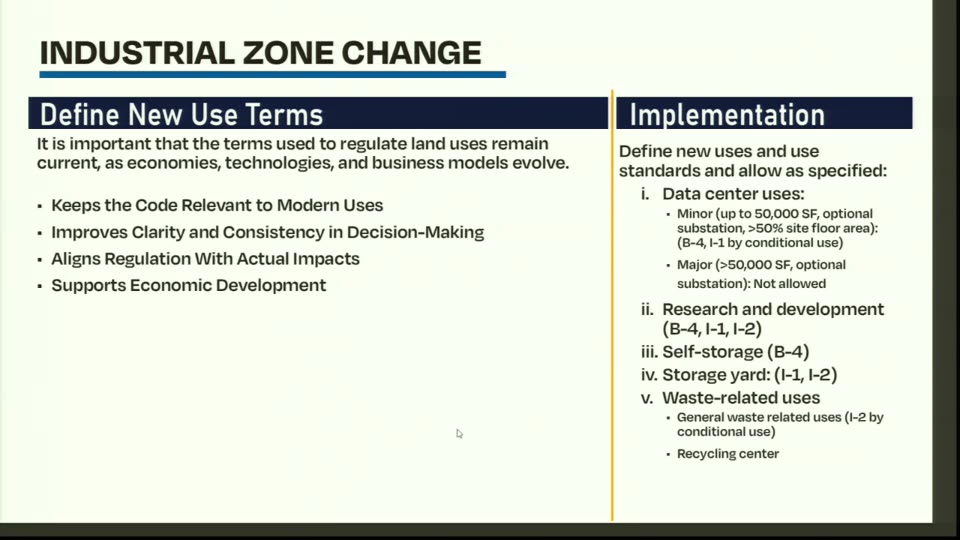
The data-center provisions remain the centerpiece of what would be one of the most aggressive municipal data-center policies in Kentucky. As The Lexington Times reported May 3, Caleb Rosico of Atlanta-based Tannel Spangler Walsh & Associates is preparing a ZOTA that would, for the first time, define “data center” in Lexington's zoning code and split the use into two categories:
- Minor data centers — up to 50,000 square feet, where the data-center use occupies more than 50% of a site's floor area — permitted in the B-4 (warehouse / wholesale business) and I-1 (light industrial) districts by conditional use permit only
- Major data centers — over 50,000 square feet — prohibited countywide
Rosico told commissioners May 21 that, after a question at the April 30 work session about whether the use should also be allowed in I-2 heavy industrial, staff and consultants concluded I-1 was the better fit. “There is very little I-2 in Fayette County that would meet the distance requirements from residential, and the lots tend to be smaller there,” he said. That language is now in the draft.
The equestrian buffer
The new 1,000-foot Agricultural Rural buffer is the more consequential refinement. Under the revised text, a data center proposed on industrial land within 1,000 feet of A-R zoning that sits outside the Urban Service Area would be barred — meaning the buildable footprint would have to sit at least 1,000 feet inside an industrial parcel's edge where that edge faces rural farmland.
Rosico credited the addition to “a wonderful comment by [Commissioner] Worth at the last meeting because of the impacts that noise can have on the equestrians.”
Commissioner Frank Penn pressed Rosico on the underlying cap itself. “Anything greater than 50,000 square feet would be prohibited period,” Penn asked. “Countywide,” Rosico confirmed. The cap counts a use as a “data center” only when it occupies more than half of a site's floor area, per the slide presented to the commission — a clarification meant to keep ordinary office buildings with small server rooms outside the new regulation.
Other refinements
Beyond data centers, the consultant team folded several other changes into the broader I-1 / I-2 / B-4 rewrite at the May 21 session:
- Outdoor storage in I-1 was clarified at up to 30% of lot area, subject to buffer and screening
- The “low impact” versus “high impact” manufacturing distinction was tightened, with low-impact uses defined by the absence of off-site dust, smoke, noise, vibration or visual impact — measured at the property line — rather than by the product being made
- Multi-parcel “campus” zoning compliance was loosened for businesses like the Elliott family of companies, which occupies several parcels in Blue Sky
- Eating-and-drinking producers would be allowed accessory restaurants up to 30% of floor area under the same logic that lets them sell the products they make
- A crosswalk table at the end of the ZOTA will map every existing I-1 and I-2 use to its new low- or high-impact category
Sam Castro of TSW Design told commissioners the plan also seeks to encourage what the consultant team calls “executive industrial campus” development — co-locating company offices with manufacturing and warehousing in a campus setting that current rules don't accommodate well.
What June 11 does — and doesn't do
Bailey told commissioners that the Blue Sky Small Area Plan adoption itself does not adopt the ZOTA text. “While the draft text will be part of this plan, it is not the adoption of it,” he said. “It will just move us on to the next stage, which will include public input and the full ZOTA review process.” That puts a Council vote on the actual zoning text amendment well into the back half of 2026.
State-level pressure mounts
The Lexington timeline is shifting as state-level scrutiny of data-center economics intensifies. A May 26 analysis by the Kentucky Center for Economic Policy noted that Kentucky's 2024 sales-tax exemption for qualified data centers — initially limited to Jefferson County, then expanded statewide in 2025 — can run for up to 50 years per project, and that none have yet been approved under the program, leaving the state's potential revenue exposure unknown.
The KCEP piece flagged two large Kentucky projects already moving: a 150-acre, 400-megawatt joint venture between Louisville's Poe Companies and Virginia-based PowerHouse Data Center, approved by Louisville Metro Council before its own data-center zoning ordinance was finalized; and a $14 billion TeraWulf proposal on the site of the former Century Aluminum smelter in Hancock County, which faces an active resident petition. Resident pushback has surfaced or defeated proposals in Mason, Simpson, Meade, Oldham and Mercer counties, per KCEP. Fayette County is one of seven counties named in the 2025 state incentive statute.
A separate May 22 piece syndicated by the Kentucky Lantern reported that the political fight has now reached Congress, where Sens. Josh Hawley (R-Mo.) and Richard Blumenthal (D-Conn.) have introduced legislation aimed at preventing data-center buildout from raising electricity rates for residential customers — a concern Lexington's draft does not directly address, since utility-rate decisions sit with the Kentucky Public Service Commission rather than the Urban County Council.
What's next
The Blue Sky Small Area Plan hearing is now set for Thursday, June 11, at the close of the Planning Commission's Subdivision Items meeting in Council Chambers. The ZOTA based on its data-center provisions will be filed separately in the weeks that follow, after which it goes through its own Planning Commission text-amendment process before reaching the Urban County Council for a vote.
This article was drafted with AI assistance (claude-opus-4-7) and finalized for publication by The Lexington Times. Reporting is grounded in the audio/video and machine-generated transcript of the LFUCG Planning Commission Work Session on May 21, 2026; the consultant team's “Industrial Zone Change” slides visible in that recording; and prior LFUCG meeting materials. State-level context draws on syndicated reporting from the Kentucky Center for Economic Policy (May 26, 2026) and the Kentucky Lantern (May 22, 2026). Direct quotations are reproduced from the auto-generated transcript with light copy-edits for readability; speaker attributions were cross-referenced against the May 21 attendance roster.
Sources
- LFUCG Planning Commission Work Session, May 21, 2026 (clip 6776)
- Granicus video of the May 21, 2026 work session (data-center discussion at ~00:29:00)
- LFUCG Planning Commission Work Session, April 30, 2026 (clip 6759) — original presentation of the data-center provisions
- As Kentucky chases data centers, a Lexington draft would tell hyperscalers no — The Lexington Times, May 3, 2026
- Questions Grow About Who Will Pay the Cost for Big Data Centers in Kentucky — Adam K. Raymond, Kentucky Center for Economic Policy, May 26, 2026
- Data center battles started in the states. Now it's Congress under siege. — David Lightman, Kentucky Lantern, May 22, 2026
- Blue Sky Small Area Plan — official LFUCG project page