LFUCG releases minutes from stormwater committee December meeting
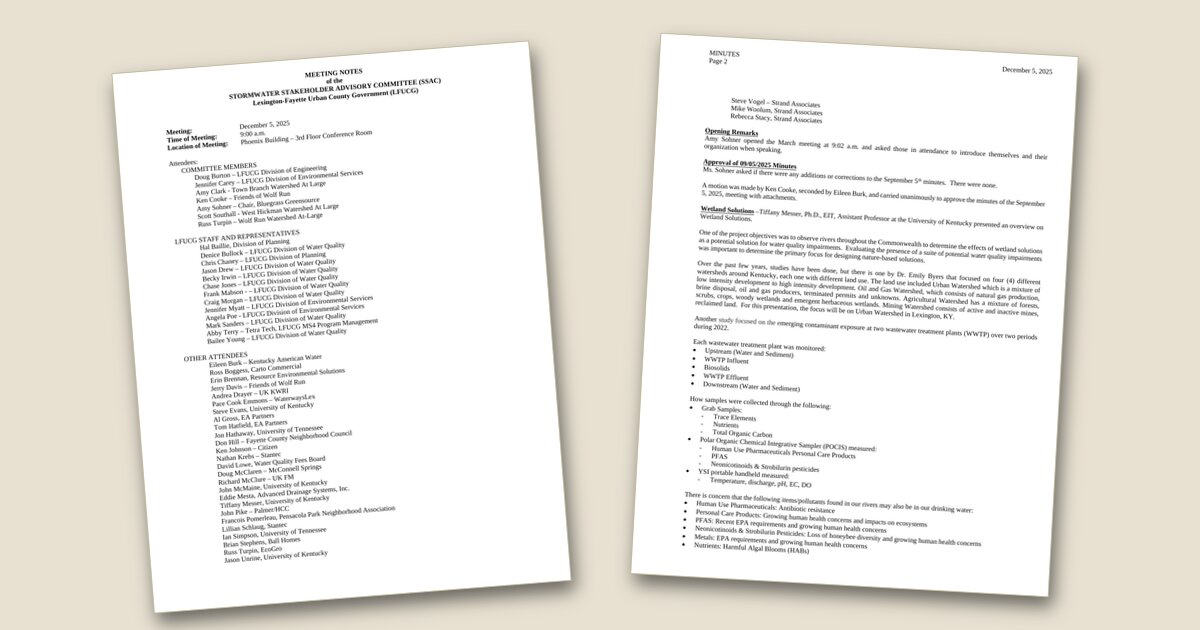
LEXINGTON, Ky. — The Lexington-Fayette Urban County Government released minutes from a December 5 meeting of its Stormwater Stakeholder Advisory Committee, in which a University of Kentucky researcher presented findings on water contamination across Kentucky watersheds and potential wetland-based solutions.
Dr. Tiffany Messer, an associate professor at UK's Martin-Gatton College of Agriculture, Food and Environment, shared preliminary research examining various contaminants found in state waterways. At the December 5 meeting, Messer outlined how urban, agricultural, mining and oil and gas watersheds each showed distinct pollution patterns, with urban areas showing particularly high levels of nutrients, caffeine from personal care products and insecticides like imidacloprid.
The research involved sampling at wastewater treatment plants upstream and downstream, monitoring for trace elements, pharmaceuticals, PFAS, and other emerging contaminants. Messer noted that some contaminant concentrations exceeded EPA drinking water standards and guidelines for protecting aquatic life. "About 95% of Kentucky's drinking water comes from surface water, meaning that whatever ends up in our rivers and streams will eventually make its way into our water treatment systems," Messer said.
The committee, which serves as "a sounding board to LFUCG and Water Quality staff on matters relating to the stormwater program and policies," heard about potential solutions using constructed wetlands. Messer's team is testing natural, low-cost treatments — particularly using constructed wetlands — to strip chemicals from the water before they become a threat to environmental or public health. Two primary designs are being evaluated: floating treatment wetlands with plants rooted in mats suspended over water, and free-water surface wetlands that combine soil, aquatic plants and open water.
The meeting minutes show that at the December gathering, researchers presented data on the effectiveness of these wetland designs in removing various contaminants over 10-day test periods, with different removal rates depending on the contaminant and wetland type. The committee approved minutes from its previous September 5 meeting without revision.
LFUCG volunteers are needed quarterly to collect water quality samples at 63 stream sites in Fayette County, with samples assessed for temperature, pH, dissolved oxygen, conductivity, chlorine, nutrients and total suspended solids. The MS4 program works to maintain and improve waterway quality across the county.