Off-Beat: The plows are innocent — what 218,307 GPS pings and three precinct canvasses say about the Gorton swing
→ Read the original on lexingtonky.news
This is Off-Beat: the column that reads the files everyone talks about and nobody opens. This week's files: a 6-megabyte JSON of GPS pings from 43 city snow plows, and the precinct-level returns of three Fayette County elections — one of which had to be recovered from the Wayback Machine, and one of which was sitting behind a state web endpoint that, as far as we can tell, nobody else has ever bothered to call.
At 1:17 p.m. on Saturday, January 24, a Lexington snow plow — vehicle 8393, if you're keeping score — pinged inside the Majestic View precinct on the city's north side. By the city's own GPS log it was the first plow ping recorded in that precinct since the storm window opened, 90.3 hours earlier.
Four months later, Majestic View gave Mayor Linda Gorton 40 percent of its mayoral primary vote, down from 75 percent in her 2022 general election. And if you spent any time on Lexington social media in late January, you know the folk theory that connects those two numbers: the streets didn't get plowed, and somebody's going to pay for it in May.
We built the dataset to test it. The plows, it turns out, have an alibi. What the precinct returns actually show is more interesting.
The files
Three artifacts, all public, none of them easy to get.
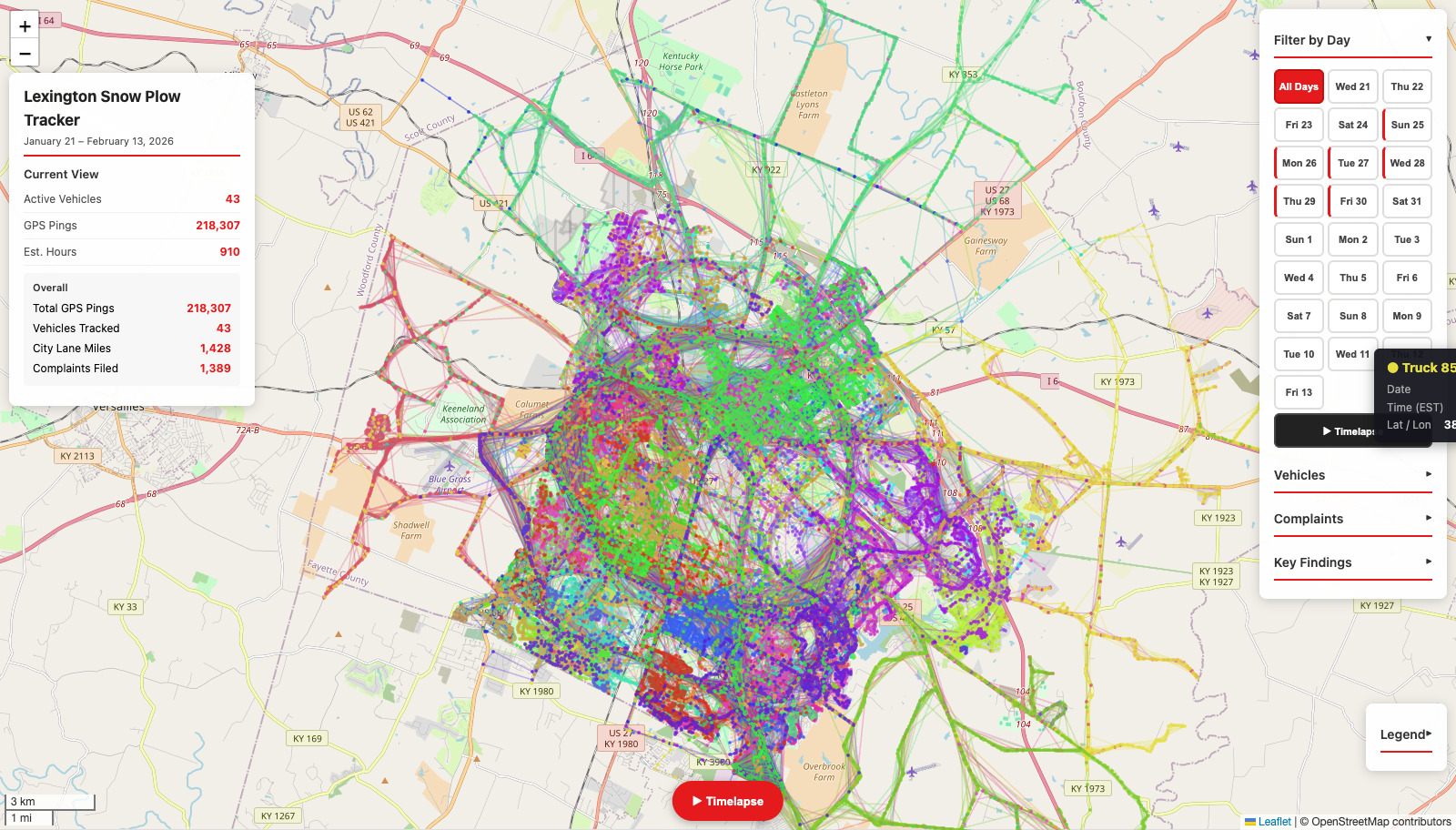
The plow log lives at plowmap.lexingtonky.news: 218,307 GPS pings from 43 LFUCG vehicles, January 21 through February 13, 2026, captured during the back-to-back winter storms. Each ping is a latitude, a longitude, and a timestamp. Laid over the county's 286 voting precincts, 97.4 percent of the pings land inside one.
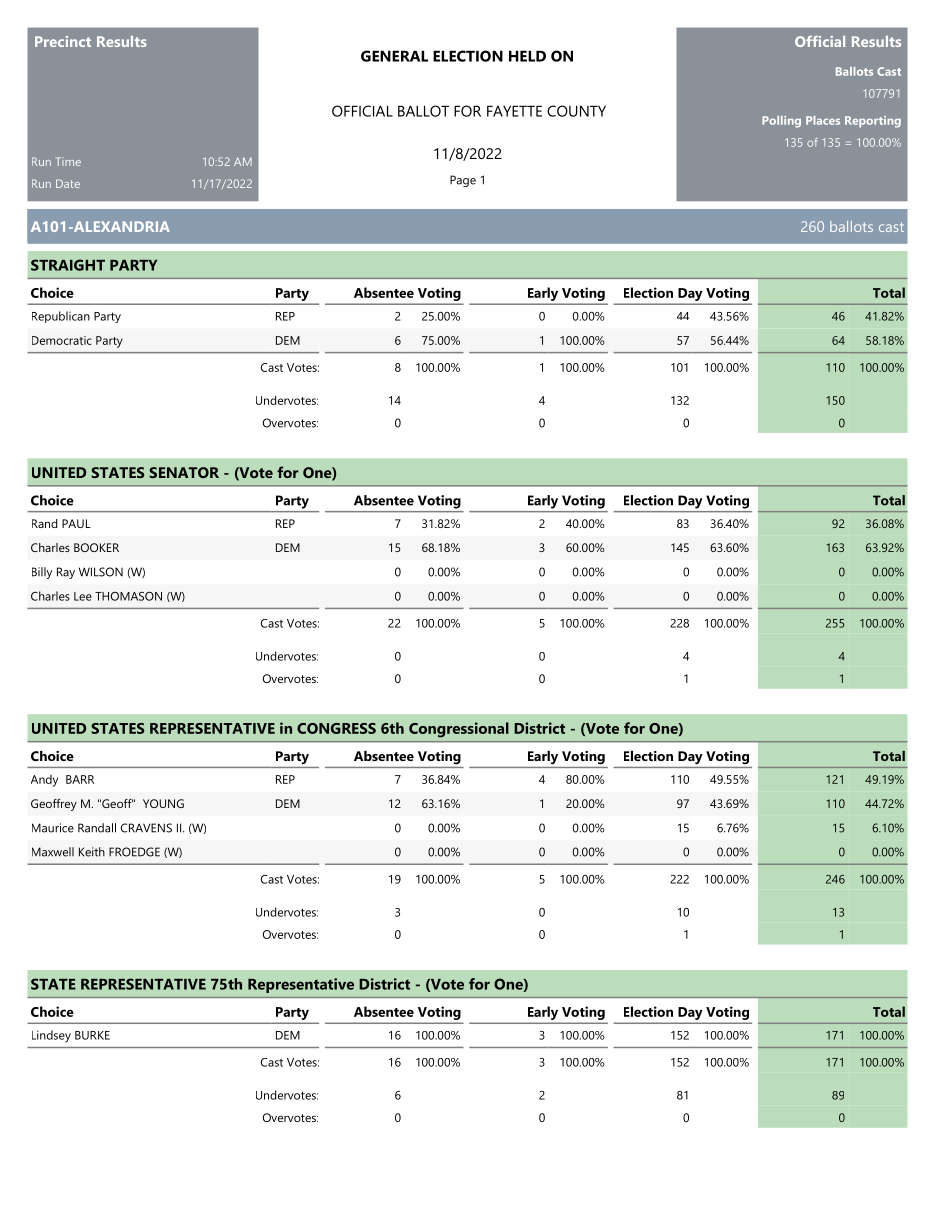
The 2022 general election precinct canvass — every contest, every precinct, 64 races — survives only as a PDF the old county clerk website used to host. The clerk's current site posts countywide cumulative totals only. We pulled the full precinct report from an October 2023 Wayback Machine capture of FayetteGeneral2022PrecinctResults.pdf. (A note for fellow travelers: the first capture of that file is truncated at exactly one megabyte. Use a later one.)
The 2026 primary has no precinct report posted anywhere. But the Kentucky Secretary of State's live-results site has a button labeled "Precinct Results," and behind that button is an endpoint — GetPrecinctsForContestAndCounty — that returns every precinct's votes for any contest, if you ask it politely with a contest ID and a county number. We asked it for all 16 contests on Fayette County's May ballot and archived the responses, because the live-results window closes when the next election cycle starts and the data goes wherever state web apps go when they die.
All of it — raw files, parsed tables, provenance notes — is now archived in the public repository behind precincts.lexingtonky.news, where the full three-election atlas is browsable by precinct.
The plow ledger
First, the artifact everyone wanted litigated. Measured from the start of the January 21 storm window, the median Lexington precinct saw its first city plow ping within 11 hours. The tail is where the grievances live:
- Ten precincts waited more than 80 hours for their first ping — Majestic View (90.3), Chetford (89.6), Charwood (89.3), River Oak (88.7), Spencer Park (87.3), Baffin Bay (87.1), Winding Oak (85.9), Valley Brook (84.8), Wolf Run (83.9), Robinwood (83.5).
- Three precincts — Laketower, Deer Crossing, Orchard Grass — recorded no city plow ping at all during the storm window. (Before anyone drafts the angry letter: plow GPS measures where city trucks went, not where snow got cleared. Private contractors, state routes on KYTC's plows, and HOA arrangements are all invisible to this file.)
So: did the slow streets punish the mayor?
No. The correlation between a precinct's first-plow time and Gorton's 2026 primary share is +0.05 — statistical static, and pointing the wrong way for the theory. Group the precincts by how long they waited and the numbers go flat: precincts plowed within six hours gave Gorton 41.0 percent on average — her worst bucket. Precincts that waited two to four days gave her 45 percent. The three never-pinged precincts swung against her by 26.5 points, almost exactly the citywide mean of 26.3. Pings-per-precinct in the first 72 hours: same nothing.
The plows are acquitted. Whatever moved 55,251 voters in May, it was not the memory of an unplowed cul-de-sac.
What the map actually shows
Here is the citywide arithmetic first. In November 2022, Gorton took 67,083 of 94,443 mayoral votes — 71 percent in a two-way race against David Kloiber. In May 2026, against six opponents, she took 25,298 of 55,251 — 45.8 percent. Raquel Carter took 15,615 (28.3 percent), Greg O'Neal 5,073 (9.2), C. E. Huffman 3,978 (7.2), and three others split the rest. A two-way general and a seven-way primary are different animals — incumbents routinely post primary numbers below their general ceiling — so the citywide drop is not itself the story.
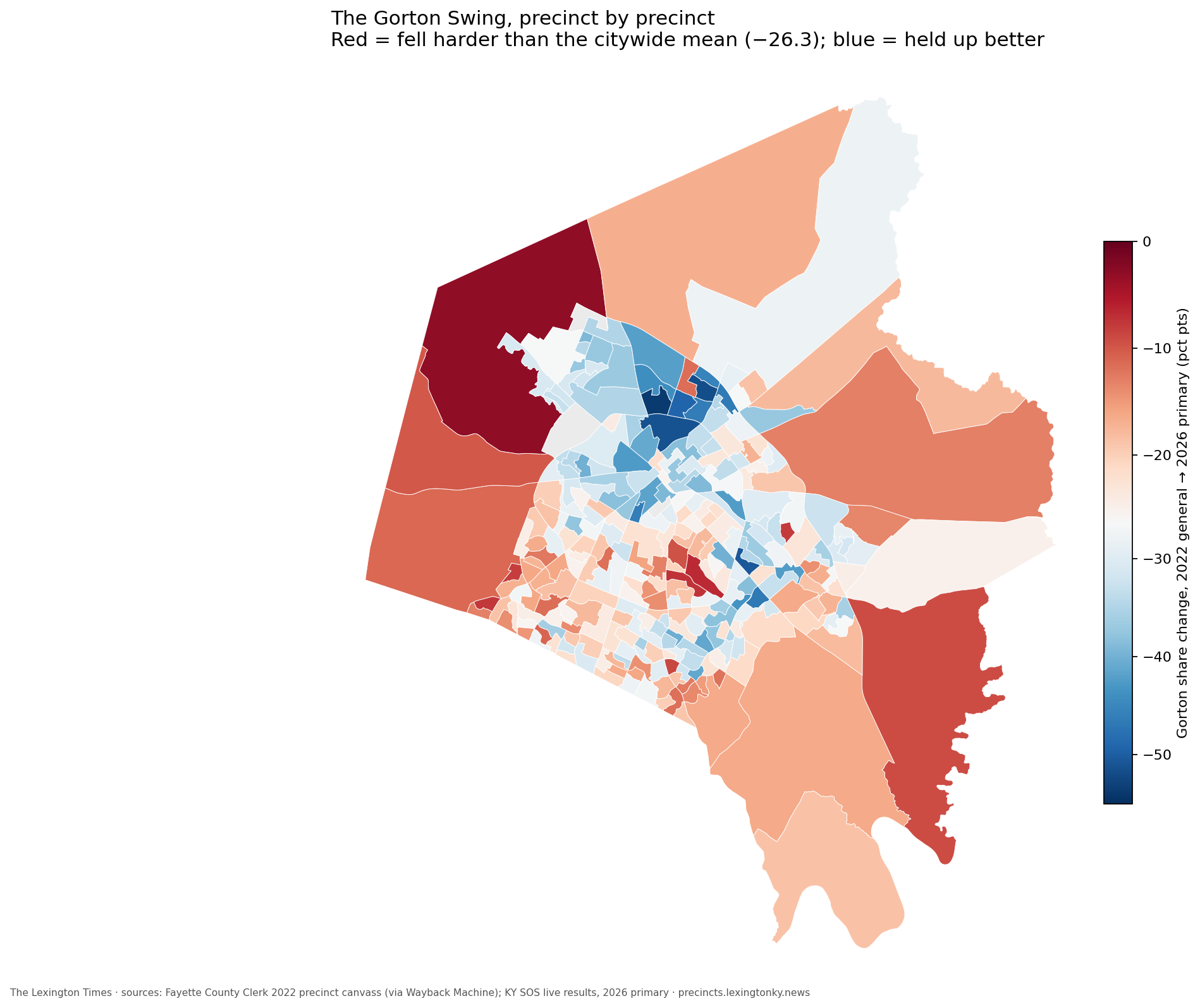
The story is where it dropped, because it did not drop evenly.
We ran Gorton's precinct-by-precinct change against every variable we could attach to a precinct: 2024 presidential lean, census race and population, housing occupancy, current crime-report exposure, investor home purchases per thousand units (from our Quiet Buyout dataset), and the plow file. One variable dominates everything else.
The share of a precinct's population that is Black correlates with the anti-Gorton swing at −0.70, and with Carter's vote share at +0.71. Nothing else comes close — not partisanship (Harris 2024 share: −0.63), not crime (−0.32), not investor buying (−0.16), and certainly not plows. The precincts where Carter ran strongest read as a roll call of Black Lexington: Julius Marks gave her 61 percent of the field — Gorton fell there from 75 percent in 2022 to 24. Oakwood: Carter 56, Gorton 78 → 24. Winburn: Carter 47, Gorton 74 → 22. Green Acres: 76 → 30. Hollow Creek: 83 → 34.
Carter, the owner and principal broker of Guide Realty, would be the first Black woman to hold the mayor's office. The precinct file says her primary coalition was anchored exactly where you would expect a historic candidacy to be anchored — and that it was not merely a protest swing. Turnout retention tells the second half: precincts that kept the most of their 2022 turnout in this low-turnout primary were disproportionately the Black and Democratic precincts (correlation +0.45 and +0.48). Carter's base did not just switch. It showed up.
And Gorton bled on the other flank simultaneously. O'Neal's 9 percent is the mirror image of Carter's coalition — his share correlates with the Harris 2024 vote at negative 0.74, meaning his votes came overwhelmingly from Lexington's most Republican precincts. The incumbent lost altitude on both wings at once: her most Democratic 2022 voters moved to Carter, and a slice of her most conservative ones parked with O'Neal and Huffman.
For the record, the investor-buyout geography we mapped earlier this week overlaps Carter's strongest precincts — Winburn, Oakwood, and the north side broadly — but it adds no independent explanatory power once race and partisanship are in the picture. The neighborhoods being bought are largely the neighborhoods that swung. The file can't tell you whether that's cause, symptom, or coincidence, and we won't pretend it can.
What's actually new
The honest answer: the underlying votes were always public. What did not exist until this week is the ability to look at them.
The 2026 primary's precinct returns existed only inside a state web app with a shelf life. The 2022 precinct canvass exists only in the Internet Archive. The clerk's current website posts cumulative county totals — fine for declaring winners, useless for understanding them. No local outlet precinct-mapped this primary; the only mayoral analysis published anywhere was the countywide topline.
As of today, all three canvasses — 2022 general, 2024 general, 2026 primary, 112 contests in all — are parsed, archived in a public repository, and browsable on the precinct atlas at precincts.lexingtonky.news, including a view that maps the Gorton 2022→2026 swing directly. The plow file is there too. Bring your own folk theory; the data will see you now.
The limits
Three honesty clauses. A share of a seven-way primary field is not a head-to-head number, and November — Gorton versus Carter, one on one — is the test of whether May's geography holds. Precinct-level correlation is not individual-level behavior; this is the ecology of the vote, not its psychology. And the plow file logs trucks, not outcomes — a precinct full of plowed arterials and unplowed side streets looks "served" in GPS and aggrieved in person.
But the central negative result survives all three caveats. Lexington spent a week in January convinced the snow response would be on the ballot. The ballot, read precinct by precinct, says it wasn't — and says the thing that was on it is the oldest force in American electoral geography, newly mobilized around the first candidacy of its kind in this city's history.
Off-Beat reads public records so you don't have to — though you can: the plow GPS tracker, the precinct atlas, the 2022 precinct canvass, and the Kentucky SOS live results are all open. Next time: whatever lands in the records request.
Sources
- Lexington Snow Plow GPS Tracker (43 vehicles, 218,307 pings, Jan 21–Feb 13 2026)
- Lexington Precinct Election Atlas (2022 · 2024 · 2026, all 286 precincts)
- 2022 General Election precinct canvass, Fayette County Clerk (Wayback Machine capture)
- KY Secretary of State live results, Fayette County (precinct endpoint: GetPrecinctsForContestAndCounty)
- Official Cumulative Report, 2026 Primary, Fayette County Clerk
- Fox 56: Raquel Carter announces 2026 Lexington mayoral run
- The Quiet Buyout (Lexington Times investor-purchase dataset referenced for covariates)
- Census 2020 race & occupancy by precinct (LFUCG open data, archived in the atlas repo)