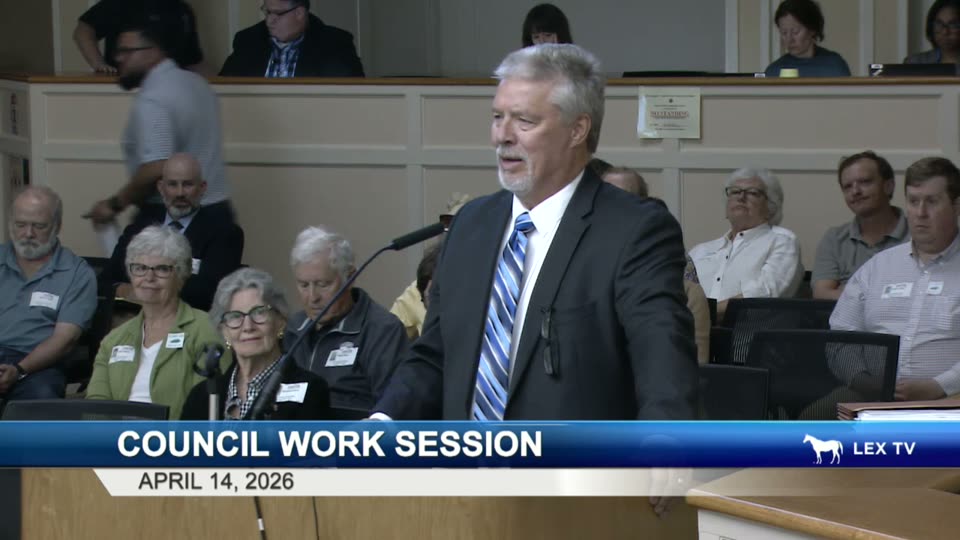
The Glaze: Charlie Martin, the man who saved Lexington from 'poop flowing in the streets'
The Glaze is a Lexington Times column highlighting people who quietly do the unsexy civic work that makes this city function. This week: the career civil engineer who has spent eighteen years executing the largest infrastructure consent decree in Lexington's history without a scandal, without a meaningful overrun, and — crucially — without sewage in the streets.
On the afternoon of January 15, 2008, the Urban County Council was debating whether to put a sanitary sewer fee increase on the docket for the 24th. The EPA consent decree hadn't been finalized yet. Some councilmembers wanted to wait. About forty-two minutes into the work session, Councilmember Don Blevins leaned into his microphone and said it plain:
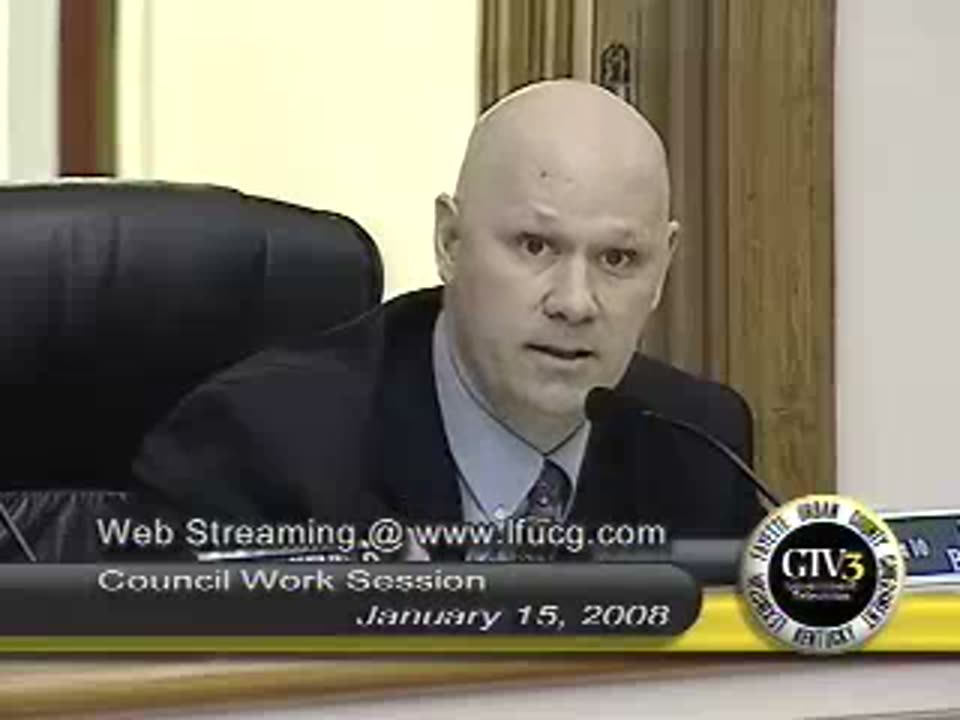
“Do we really want to wait further while poop flows on our streets? I don't think so.”
That sentence — and the political will behind it — is what put a generation of work in front of one career civil engineer. This is the story of the engineer.
Charlie Martin, P.E., is a career LFUCG employee who in early 2008 held the title Director of the Division of Water and Air Quality. By April 2026 he is Acting Public Works Commissioner. In between those two titles is the consent decree the council was debating that January afternoon — eighteen years of pump stations, sewer lines, change orders, federal court extensions, and quarterly reports. He hasn't run for office. He hasn't decamped to a richer city's water authority. He hasn't cashed out to a consulting firm. He just kept showing up.
The first promise (2008–2011)
The Blevins vote put the rate increase on the docket. The decree itself landed five weeks later. On February 19, 2008, in a special address to council, the mayor laid out the terms: a $425,000 federal fine (reduced from what would have been considerably worse, in exchange for $30 million in voluntary remediation), nine illegal interconnections between the sanitary and storm sewer systems to be eliminated within months, pump stations to be repaired on a four-year schedule at an estimated $135 million, and the entire program to be substantially complete in eleven to thirteen years.
The mayor named the people he was tasking with delivery. Environmental Quality Commissioner Cheryl Taylor, a mechanical engineer, would lead. And then this:
“Charlie Martin… is a career employee of LFUCG and a civil engineer.”
That's the entire job description, more or less. Career employee. Civil engineer. Make it happen.
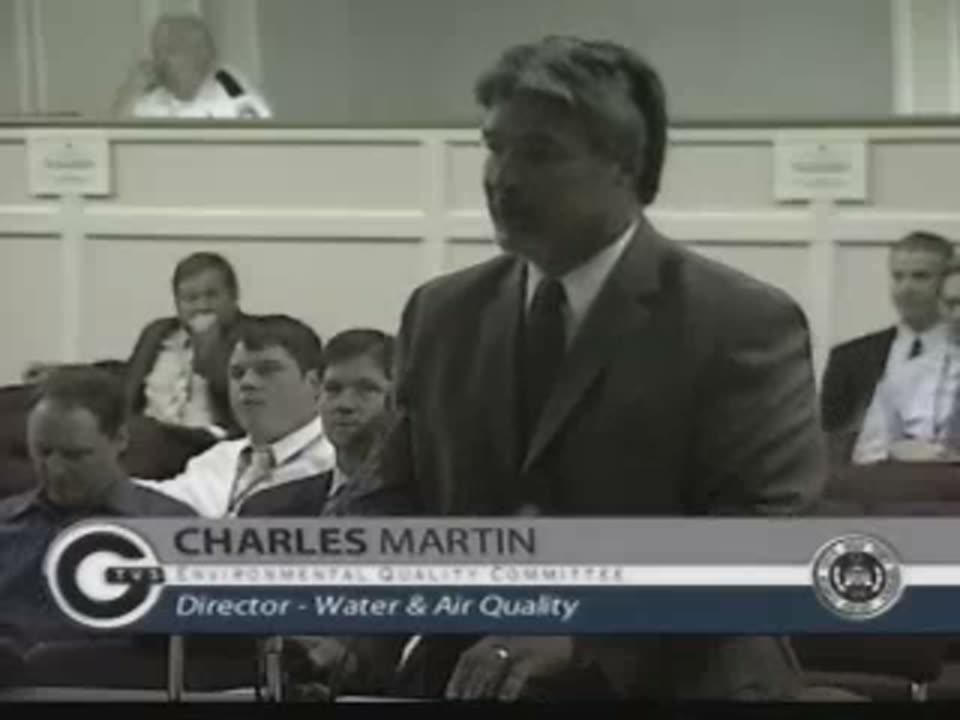
Three and a half years later, on August 23, 2011, Martin came back with the document that did most of the actual work: the Sanitary Sewer Consent Decree Implementation Ten-Year Financial Model and Remedial Measures Capital Improvement Plan. He delivered it alongside Ryan Barrow at a special Environmental Quality Committee meeting. It is, on the page, an unromantic spreadsheet. In practice it is the document that turned a federal court order into a project plan council could budget against, year by year, for the next decade.
The grind (2012–2020)
And then he just… did it.
Year after year, Martin came back to council with whatever was in front of him. May 2012: the Capacity Assurance Program, an EPA-required framework for showing that the city's sanitary sewer system can handle peak flow conditions without surcharging. December 2012: the sanitary sewer rate increase council had to actually pass to fund the work, with Martin patiently walking members through why the consent decree obligations required it. November 2014: a $650,000 change order on a single consent-decree project, the kind of routine thing that, multiplied across more than a hundred projects, is what compliance actually costs.
This is the texture of it. Not headlines. Pump stations and easements and change orders and rate hearings. Martin showed up to all of them. The archive is the receipt.
The home stretch (2022–2024)
By 2022 the consent decree was supposed to be on the runway. Then the world got harder. At a May 3, 2022 council work session, the Environmental Quality & Public Works Committee chair summarized Martin's annual update with the kind of dry list that says everything: easement disputes, supply chain disruptions, and escalating costs. The plan that had been drawn up in 2011 had not anticipated a global pandemic that would empty contractor labor pools and stretch lead times on a sanitary sewer pump from months to over a year.
In September 2024, the EPA went back to federal court and got the deadline pushed. Three months later, on December 6, 2024, Martin walked the Stormwater Stakeholder Advisory Committee through the new math:
“So in September of this year, EPA went back to court and federal judge approved an extension for the consent decree that extended our full compliance deadline to December 31st, 2030.”
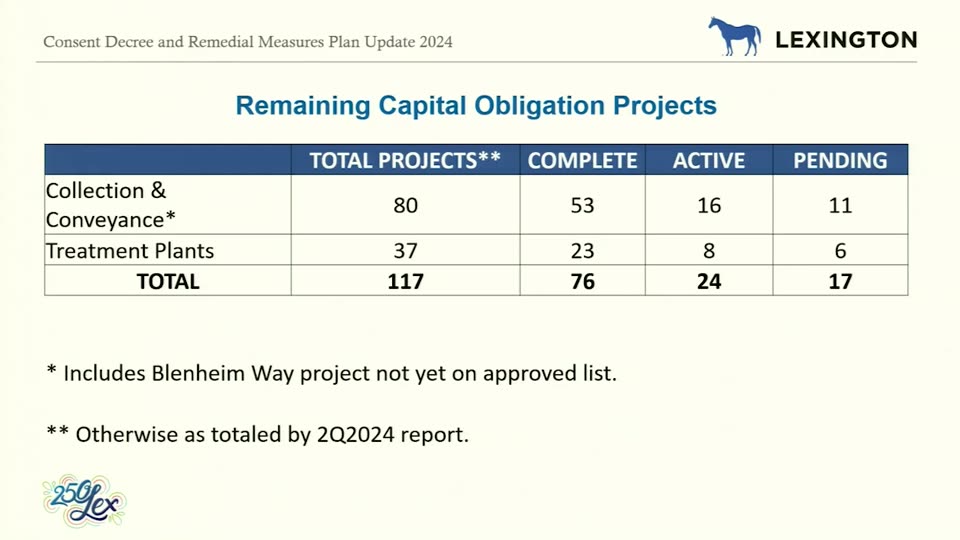
Then the headline number, delivered the way Martin delivers headline numbers — flat, almost bored:
“We had 117 projects to do, 76 of them are complete, in the can, 24 of them are underway, and that's kind of a broad thing there.”
And then the line that, if Lexington had a wall of fame for budget performance on federal infrastructure programs, ought to be carved on it:
“We're trending below what the original spend was estimated to be, which obviously for elected officials, they love that.”
One hundred and seventeen consent-decree projects. Three quarters of them done. The remaining quarter underway. Cost performance running below the original projection. The pandemic. The court extension. All of it.
Mint Lane and the Acting Commissioner (2026)
By the spring of 2026, Martin's title had changed again. He was now Acting Public Works Commissioner, sitting at the table on the most contentious sanitary-sewer decision council had faced in years: where to relocate the leaking Mint Lane Pump Station behind Paul Laurence Dunbar High School.
The options on the April 14, 2026 work session agenda ranged from $19.6 million (rebuild in place) to $48.4 million (relocate to a private farm outside the urban service boundary). One was geologically risky — karst limestone under the existing site — and one was politically risky, since extending sanitary sewer service to a farm outside the growth boundary set a precedent farmland advocates and equity advocates both opposed. Council was heated. The chambers were full. The room wanted somebody to advocate.
Martin, characteristically, refused to. Once introduced as “Acting Commissioner Charlie Martin” and asked to give the presentation, the first thing he said was a small joke about preferring it when people don't ask him a lot of questions about sewers. Then this:
“This is an engineering study, and we're trying very hard not to have any emotional bias in the whole matter, just presenting the facts.”
What followed was about an hour of pump-station capacities (3.6 million gallons a day, no matter where you build it), gravity-flow analyses, karst geology, and cost estimates. No advocacy. No verdict. Just the facts.
Earlier in the same meeting, before Martin had even taken the podium, a public commenter wrapped up her three minutes of testimony with what she called “one final quote from Director Martin” — the line that has, after eighteen years, become so identified with him that members of the public quote it back to council:
“The ideal place from a sewer standpoint, it should always be at the bottom of the hill.”
Two weeks later, on April 29, council voted 10–5 to take the cheap option: a $19.6 million rebuild of the existing Mint Lane site, with the geological risk and the karst floodplain both still on the table. The Lexington Times editorialized against that decision, on the grounds that “cheap now, expensive later” is exactly how the consent decree happened in the first place. That's a fair argument. But it's an argument with the council, not with Martin. The engineer presented the engineering. The decision is somebody else's job.
The big picture
By the time the federal compliance deadline arrives on December 31, 2030, Charlie Martin will have spent twenty-two years executing the largest infrastructure consent decree in Lexington's history. Across that span: every Lexington mayor from Newberry to Gray to Gorton has gotten to treat the consent decree as background hum, something the city was — demonstrably, year after year — making progress on. Council has gotten to debate the politically interesting stuff — rate hikes, pump-station siting, urban service boundaries — without ever having to relitigate whether the underlying obligation was being met. The press has gotten to mostly leave the topic alone, because nothing was on fire.
The reason all of that has been true is because Charlie Martin made sure it stayed true. Year after year. Quarterly report after quarterly report. One hundred and seventeen projects in. Below original projected cost. No federal sanctions. No sewage rivers.
You can argue with any specific decision council has made along the way. You can argue that the rate increases were too steep, or not steep enough. You can argue that the Mint Lane vote was the wrong call. That's all fair game — that's what democracy is for. The thing you cannot really argue with is that an entire generation of Lexingtonians has been able to forget that there was ever a question.
That doesn't happen by accident. It happens because somebody spent eighteen years showing up to committee meetings and not letting the issue die.
Don Blevins asked, in 2008, whether Lexington really wanted to wait further while poop flowed on its streets. The answer was no. The reason the answer has stayed no for the next eighteen years has a name.
The Lexington Times will continue covering the run-up to the December 31, 2030 federal compliance deadline, including the Mint Lane pump station rebuild and the remaining sanitary sewer Remedial Measures Plan projects. Source meetings cited in this piece are available via the LFUCG Meetings Archive.
Sources
- Council Work Session — January 15, 2008 (Don Blevins, ~42:07)
- Mayor's EPA Address — February 19, 2008 (Charlie Martin tasked with implementation)
- Special Environmental Quality Committee — August 23, 2011 (10-year financial model + remedial measures CIP)
- Council Environmental Quality Committee — May 15, 2012 (Capacity Assurance Program)
- Urban County Council Work Session — December 11, 2012 (sanitary sewer rate increase)
- Council Work Session — November 11, 2014 ($650K consent-decree change order)
- Council Work Session — May 3, 2022 (annual update; supply chain + easement challenges)
- Stormwater Stakeholder Advisory Committee — December 6, 2024 (2030 deadline + 117/76/24 projects)
- Council Work Session — April 14, 2026 (Mint Lane Pump Station three-site study)
- Editorial: the Mint Lane cheap vote (Lexington Times, April 29, 2026)
- LFUCG Meetings Archive