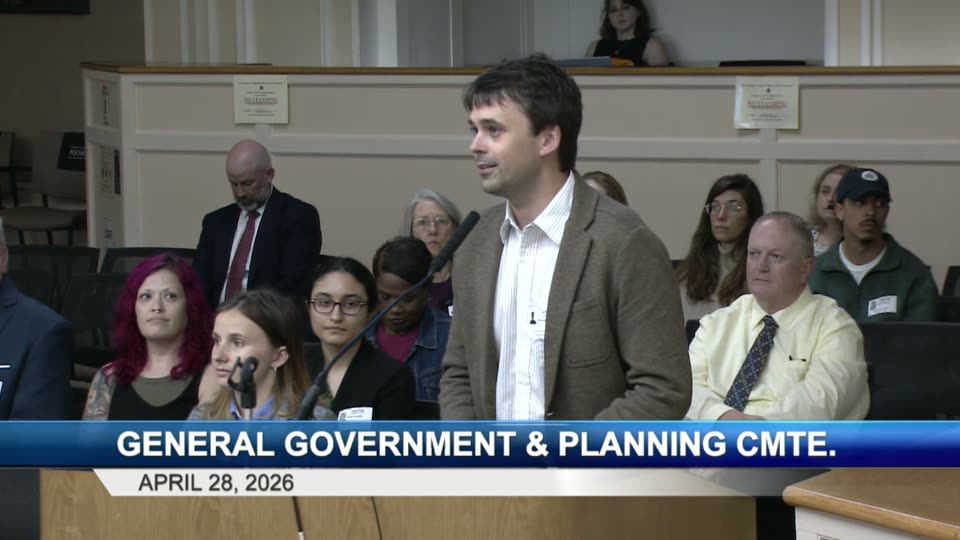
The Glaze: Richard Young, the man who built Lexington's civic infrastructure
The Glaze is a Lexington Times column highlighting people who quietly do the unsexy civic work that makes this city function. First up: the guy who spent three years convincing City Hall to let regular Lexingtonians have a real say in how Lexington is governed.
If you've been to a Lexington council meeting in the last eight years, you've probably seen Richard Young. He's the guy in the back of chambers with a laptop, or at the podium walking a committee through some thick stack of survey data, or — most recently — handing 30 randomly selected Lexingtonians a microphone and telling council to listen.
Young is the founder and executive director of CivicLex, the local nonprofit that's spent the better part of a decade trying to make Lexington's government legible to the people it serves. He started the organization, by his own telling, "with me and my laptop at a desk at the Plantory." Today CivicLex has eight staff, a national reputation, and a track record at LFUCG that — if we're being honest — is one of the most consequential non-governmental influences on local democracy in recent memory.
The civic infrastructure builder
Young's earliest archive footprint at LFUCG dates back to the June 7, 2018 budget reading, where his work with CivicLex was already being referenced in the context of public-space initiatives. By February 2020, council was thanking him publicly for helping LFUCG build a new public-facing website — the kind of unglamorous infrastructure work that nobody campaigns on but that everyone benefits from.
Then came the project that would consume the next four years of his professional life: figuring out why nobody talks at city council meetings, and what to do about it.
Public Input Research: 2020–2024
In 2020, CivicLex partnered with the University of Kentucky and Transylvania University to launch a multi-year study on how the public actually participates in Lexington-Fayette Urban County Government. They surveyed residents. They surveyed LFUCG staff — and got 78 responses. They cross-referenced demographics. They looked at fairness perceptions broken down by race, gender, and political affiliation.
The findings were not subtle. Black respondents rated the fairness of LFUCG's public input process .3 points lower than white respondents on average. Nonbinary respondents rated it .42 points lower. The whole apparatus, in other words, wasn't working equally for everyone.
Young brought the final recommendations to a February 14, 2023 Council Work Session and the same-day General Government & Planning Committee. The asks were concrete and uncomfortable for an institution used to doing public comment its own way:
- Move public comment periods on agenda items to the beginning of meetings.
- Allow public comment on agenda items in all council committees, work sessions, and Committee of the Whole meetings — not just the formal council meeting.
- Hold separate, designated public input meetings outside of City Hall.
- Add a monthly public meeting specifically to surface upcoming agenda items and collect public input.
- Move work sessions to weekday evenings to enable working people to actually show up.
- Implement technology and education to lower the barrier to participation.
Council didn't adopt every recommendation overnight, but they did the next-most-important thing: they established a Public Comment Work Group, chaired by Council Member Hannah LeGris, to actually figure out implementation. Young and CivicLex Deputy Director Kit Anderson kept showing up to the Public Input Subcommittee through August 2023 and June 2024, helping rewrite public comment guidelines. By the time council updated its public-engagement policies in December 2024, members were openly tracing the changes back to CivicLex's 2022 report.
This is what slow, durable civic work actually looks like. No viral moment. No press conference. Just four years of showing up to committee meetings and not letting the issue die.
Reapportionment Commissioner
In May 2023, council passed Resolution 0536-23, formally appointing Young as a Reapportionment Commissioner alongside Barbara Jane Sutherland, William H. Wilson, and Fayette County Clerk Susan Lamb. That's a quietly significant role: Reapportionment Commissioners help redraw the council district lines that determine who represents whom for the next decade. The fact that council asked the head of the city's leading civic-engagement nonprofit to help draw the map says something about how seriously they take his judgment.
CivicLex Day
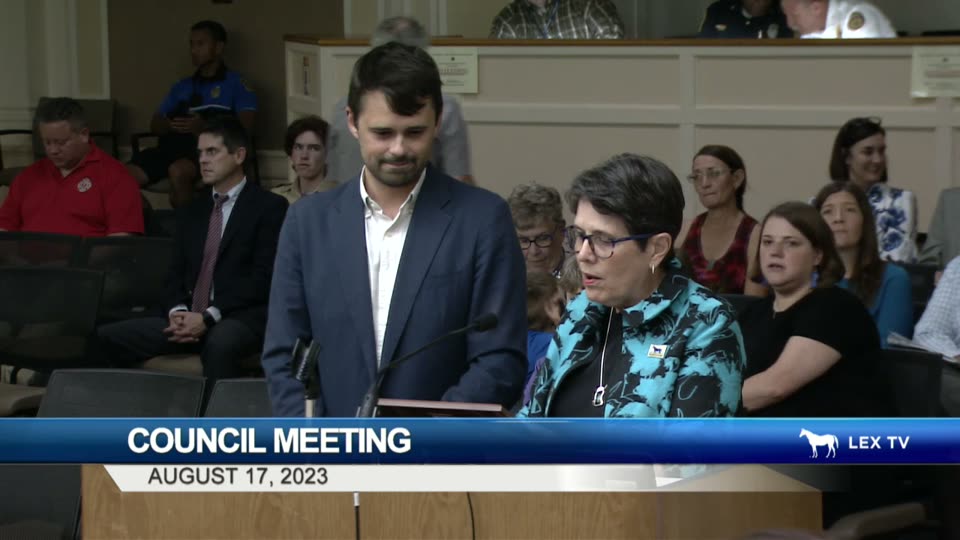
On August 17, 2023, Mayor Linda Gorton and Council Member Whitney Baxter Reynolds presented Young with a proclamation declaring the date "CivicLex Day in Lexington" to mark the organization's fifth anniversary. The mayor called CivicLex "an outstanding organization that connects our people with the government and the workings of government with the people."
Young, characteristically, used most of his acceptance speech to describe what CivicLex is not: "We wanted to build something that wasn't to advocate for any particular outcome or any particular policy, but to help everyone in Lexington be their own best advocate with local government, no matter what they think, no matter what they feel, no matter what their perspective is." He added, with a small grin: "I know we sometimes might get on y'all's nerves a little bit. Maybe frequently."
The Civic Assembly: 2025–2026
And then there's the project Young will probably be remembered for: Lexington's first-ever Civic Assembly.
Civic assemblies are an internationally recognized model of participatory democracy — a randomly selected, demographically representative group of everyday residents convened to study an issue in depth and pass formal recommendations. They've been used in Ireland (where one paved the way for the abortion referendum), in France, in cities across Europe. They have rarely been used in the United States. Lexington just did one.
CivicLex first introduced the concept to council in March 2025 and brought a full plan back in July 2025. The methodology, developed with the University of Kentucky's Martin School of Public Policy:
- Mail 10,000 postcards to 10,000 randomly selected Fayette County addresses.
- Take applications from anyone interested.
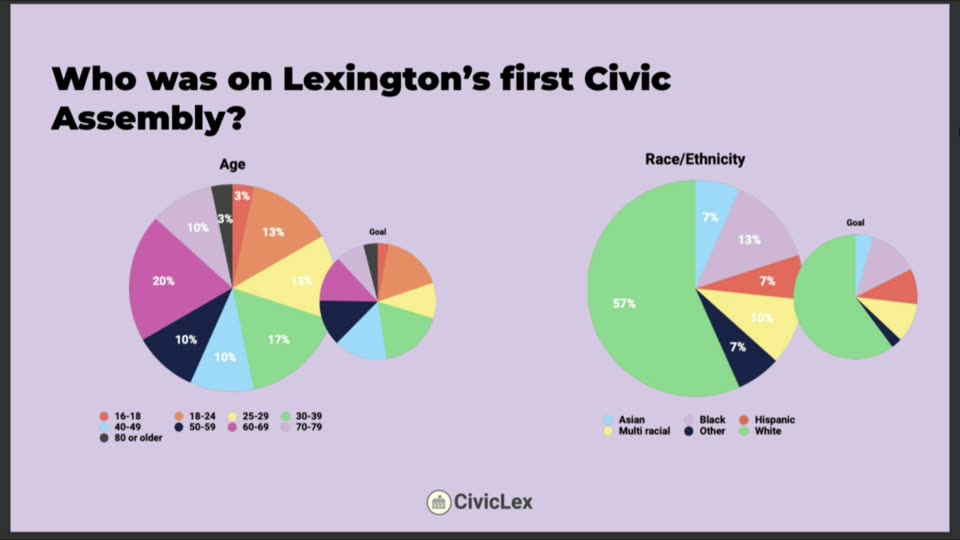
- Use a stratified civic lottery to assemble a panel of roughly 30 people who match Lexington's demographics across nine separate dimensions — age, race, gender, council district, political registration, housing status, and more.
- Bring them together for an intensive month of expert testimony, deliberation, and structured voting.
The whole thing was funded by $220,000 in national and international philanthropic grants — not a dime of local government money. As Anderson noted at the final presentation, the planning took three years; the assembly itself was "a complete whirlwind of a month this March."
Of the 387 applicants, the final panel included at least one resident from every one of Lexington's 12 council districts. Demographic representation was within 5% of census data on every measure they tracked. Vice Mayor Dan Wu, who is normally not easily impressed, called the panel composition "almost overlaid nearly perfectly" with the city itself.
The recommendations
On April 28, 2026, Young, Anderson, and four assembly members brought the final recommendations to the General Government & Planning Committee. Each one would require a charter amendment — meaning each one would have to go on the November 2026 ballot for Lexington voters to approve.
- Council compensation. Raise the cap on council pay to $59,987 — the average annual income in Lexington — and index it to CPI annually thereafter. Effective 2030. Passed the assembly with an 84.6% supermajority.
- Council accountability. Mandate that council create an ordinance establishing publicly viewable attendance and accountability standards. Passed with 88.8%.
- Mandatory charter review. Convene a randomly selected, demographically representative assembly to review the charter every eight years, with a 12-month time limit. Passed with 88.8%.
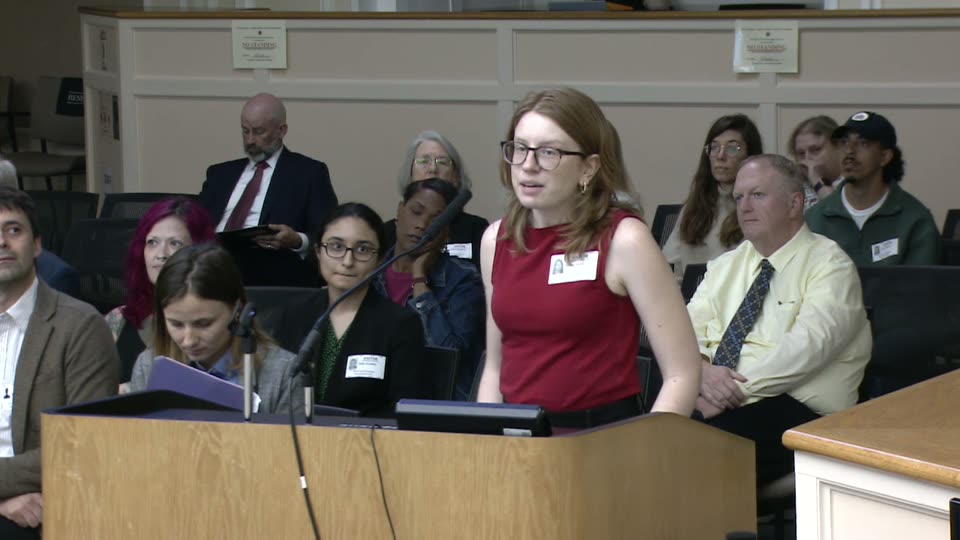
The first recommendation — council pay — is the politically loaded one. The current charter sets council salary at $6,000. The proposal would raise that nearly tenfold, tied to the city's average wage. Assembly member Haley Small, presenting the recommendation, framed the case directly: too many council seats run unopposed, the most effective members work full-time hours for a part-time wage, and tying pay to the average Lexington income would let council "feel what it's like to be like an average citizen in terms of your compensation."
Bob Smith, an assembly member from District 5, presented the dissenting view: he worried a 50% raise would be hard to pass at the ballot and didn't want council seats to become "a lifetime position." His preferred fix wasn't on the table — he wanted to extend council terms from two years to four, but the assembly's charge didn't allow it.
Vice Mayor Wu moved to accept the assembly's recommendations and refer the proposed amendments to full council. The motion passed by voice vote. If the language clears the Department of Law and council passes it by three-fifths majority before the August 4 ballot deadline, all three measures could be in front of Lexington voters in November.
Wu, who is not generally a man given to hyperbole, called it "historic, honestly."
The big picture
Across the LFUCG meeting archive, Young's contributions cluster into three roles. There's the civic infrastructure builder — the public input research, the LFUCG website, the "On the Table" public engagement series CivicLex ran in 2022. There's the appointed civic servant — the Reapportionment Commissioner role, the running commission membership, the constant committee testimony. And then there's the democratic-innovation architect — the Civic Assembly, which has no real precedent in Kentucky and few precedents in the United States.
You can argue with any of CivicLex's specific recommendations. You can think the council pay number is too high or too low. You can think the eight-year charter review cycle is too long or too short. That's all fair game — that's what democracy is for. The thing you cannot really argue with is that 30 randomly selected Lexingtonians, who would otherwise never have set foot in council chambers, just spent a month of their lives studying the city charter, deliberated in good faith, and produced recommendations that an entire committee of elected officials thanked them for. That doesn't happen by accident. It happens because somebody spent three years building the apparatus to make it happen.
If those amendments make the November ballot — and especially if any of them pass — Young will have authored what would arguably be the most significant change to LFUCG governance since the 1974 merger charter itself.
Not bad for a guy who started with a laptop at a desk at the Plantory.
The Lexington Times will cover the council's June 2 work session, where the proposed charter amendments are expected to receive their first formal review. Source meetings cited in this piece are available via the LFUCG Meetings Archive; CivicLex's research and the full Civic Assembly methodology are available at civiclex.org.
Sources
- CivicLex
- LFUCG GGP Committee — April 28, 2026 (Civic Assembly recommendations)
- Council Work Session — February 14, 2023 (Public Input Research)
- GGP Committee — February 14, 2023 (Public Input subcommittee formed)
- Urban County Council — August 17, 2023 (CivicLex Day proclamation)
- Resolution 0536-23 — Reapportionment Commissioner appointment, May 2023
- Public Input Subcommittee — August 2023
- Public Input Subcommittee — June 2024
- Council public-engagement policy update — December 2024
- Civic Assembly concept introduction — March 2025
- Civic Assembly full plan — July 2025
- On the Table — 2022 public engagement series
- LFUCG Meetings Archive