Royal Springs has a watchdog. Lexington’s data-center rules never mention it.
→ Read the original on lexingtonky.news
In February 2024, Lexington’s Planning Commission heard exactly where the Royal Springs Aquifer Water Supply Protection Committee stood on the fuel center planned for the new Kroger Marketplace on Newtown Pike. “We have never and will never approve a plan for a fuel center, fuel station anywhere over the aquifer,” the committee’s position ran, as it was relayed at the hearing. “You have a great project but that’s our position on fuel stations.”
The commission approved the plan unanimously. The Kroger Marketplace at 760 Newtown Springs Drive opened in August 2025. Its 18-pump fuel center has been selling gas over the aquifer ever since.
That arc — objection, override, ribbon-cutting — is the system working as designed. A Lexington Times review of nearly two decades of LFUCG meeting records shows that the joint Fayette–Scott County committee charged with protecting the drinking water of Georgetown and Scott County holds one formal power in Lexington’s development process: a recommendation. In the records we reviewed, the committee lodged six outright objections to projects or designs — all since 2020, in a record of substantive actions reaching back to 2008. Three ended the committee’s way: one denial backed by city engineering, one developer withdrawal, one conditional accommodation. Three were overridden. The pattern is consistent: the committee prevailed when city staff agreed with it, and was overridden when staff sided with the applicant.
The question of what that recommendation is worth is about to get its biggest test. On Tuesday, August 25, the Urban County Council takes up the data-center zoning rules the Planning Commission approved on July 30 — rules written, amended, and voted on across a roughly five-hour hearing in which, according to the hearing’s closed-caption transcript of some 39,000 words, the words “Royal Springs” were never spoken. The only mention of an aquifer all day came from a public commenter invoking water scarcity in the West.
The water under north Lexington
Royal Spring, which surfaces in downtown Georgetown, is the primary water source for Georgetown Municipal Water and Sewer Service, which a 2025 peer-reviewed study reports served 33,075 people as of 2020. The spring is fed by a karst basin that drains parts of Fayette and Scott counties, and the basin’s recharge zone is the upper Cane Run watershed — the Lexington end of the creek, where at normal flows Cane Run seeps underground through cracks and crevices in its limestone bed and recharges the aquifer that feeds the spring. Lexington’s own watershed page puts it plainly: “The Royal Spring karst basin serves as the water supply for Georgetown.”
Ben Krebs, an engineer for the Georgetown-Scott County Planning Commission who has served on the aquifer committee since 2004, described the relationship to Lexington’s Stormwater Stakeholder Advisory Committee last September: “this is where runoff, stormwater runoff, becomes drinking water.” Contamination events, the committee heard, have in the past forced Georgetown to shut down its water plant “and… wait for that contamination to pass over days, weeks, or months.” PFAS has now been detected in Royal Spring, with mitigation projects funded.
Karst is why the stakes are what they are. The Kentucky Geological Survey notes that “sewage, paint, motor oil, pesticides, and other pollutants are not filtered from water entering a karst aquifer.” The same 2025 study reports contaminant transport in such systems at velocities of up to hundreds of meters per hour.
What the watchdog can actually do
The Royal Springs committee — its members drawn from both counties’ governments and utilities, chaired by Georgetown’s water utility general manager, Chase Azevedo — grew out of a Wellhead Protection Plan adopted by the planning commissions of both counties and approved by the Kentucky Division of Water on August 28, 2003. Kentucky’s water-supply planning regulation, 401 KAR 4:220, requires county water-supply plans to “formulate recommendations for local regulatory and nonregulatory measures” to protect drinking-water sources — but nothing in it compels a local government to adopt any of them. Implementation is a local choice.
In practice, the committee’s positions are blanket and well known. “Every time they recommend no gas stations and no underground detention,” planning staff told commissioners at a July 2 subdivision committee meeting. At a January 2024 subcommittee meeting, commissioners were told the committee has “recommended against [a gas facility] on every development that’s gone before them in the aquifer” — a concern staff illustrated with a Georgetown gas-station leak “that took them years to discover the source” — and reminded that “that’s all you are getting from the committee is a recommendation.”
Scott County, the record notes, handles the same aquifer differently: at the Kroger hearing, commissioners heard that Scott has “a blanket prohibition… on any kind of gas station in the aquifer.” Fayette County has no equivalent rule. Commissioner Judy Worth raised the committee’s objection to the Kroger fuel center “to get this on the record” before the vote, and a committee member present confirmed the committee “did in fact recommend against the gas station on this location.” The plan passed anyway, on staff’s assessment that Kroger’s tank-monitoring track record was strong.
The committee’s durable wins in the record are quieter and structural: conditional-zoning packages on industrial rezonings along the Georgetown Road corridor that prohibit underground fuel and liquid storage, oil-water separators and signage written onto development plans, a requirement since January 2025 that stormwater-grant applicants in the recharge area obtain a committee letter of support. When the committee’s objection prevailed on a live project, it was because city engineering staff agreed (a gravel lot at 1760 North Broadway, disapproved 7–0 in 2020) — or because the developer gave up.
“There aren’t any written protections” — almost
The exchange that frames the data-center question came at the Planning Commission’s April 30 work session. A commissioner — identified in The Lexington Times’ contemporaneous report as Frank Penn, the commission’s senior member — asked what protections exist for groundwater over the aquifer. “We currently have recommendations that are made by the Royal Springs Wellhead Protection Committee,” planning staff answered; our report identified the speaker as senior planner Eve Miller (the work-session transcript carries no speaker labels). “There aren’t any written protections at this point. However, that is something that we wrote in our comprehensive plan to look at.” Miller, according to the roster the committee’s chair presented last September, is herself one of Lexington’s members on the aquifer committee.
The record is somewhat better than that answer suggests — and the gap matters, because what is written down is exactly what will govern data centers. Two written mechanisms exist.
First, parcel by parcel: when land in the recharge area is rezoned, the city has attached use prohibitions under Article 6-7 of the zoning ordinance. Ordinance 032-2023 barred above-ground and underground storage tanks, hazardous-waste disposal and mining at 1793 Atoma Drive, reciting the Wellhead Protection Plan’s purpose — to “ensure a continual source of potable groundwater from Royal Spring for Georgetown and Scott County” — and staff said the same restrictions were recommended “for every industrial property within that area.” Ordinance 075-2023 did the same at 763 Newtown Pike, prohibiting service stations and all storage tanks to “preserve the integrity of the Royal Springs Aquifer Recharge Area.”
Second, and only since June 2025: the HB 443-era overhaul of Lexington’s development-plan rules (Ordinance 036-2025) wrote the committee into the zoning ordinance for the first time. Section 21-4(d)(2)(a) provides that additional recommendations may be required from bodies “such as, but not limited to, the Royal Springs Aquifer Wellhead Protection Committee,” and then: “Such recommendations and conditions shall be incorporated into the development plan. Relief from such recommendations and conditions may be granted by the Planning Commission at a public meeting.”
That is a real, written, procedural protection: a development plan that deviates from a committee recommendation can no longer be approved administratively — it must go up to the Planning Commission, in public. It is also, precisely, a protection with an off switch. There is no Royal Springs overlay district, no recharge-area boundary mapped in the zoning code, and no use prohibited countywide because of the aquifer.
The override, live
Three weeks before the data-center hearing, the new mechanism ran start to finish. Lexmark proposed a 28,915-square-foot building, per staff’s July 9 presentation, at 985 Freight Boulevard, with underground stormwater detention — a design the aquifer committee recommends against everywhere in the recharge area, because buried systems are hard to inspect and can carry petroleum-bearing runoff toward groundwater. Because the plan deviated from the committee’s recommendation, it could not be approved at staff level. “Anytime we deviate from what the royal springs aquifer committee recommends it’s coming to the commission to override that,” staff explained at the July 2 meeting.
On July 9, the commission heard from the applicant’s engineer that city engineering favored the proposed chambered detention system — a point Engineering’s own representative did not dispute — and approved the plan unanimously. The override worked exactly as written: the committee spoke, the commission said no thank you, in public, on the record.
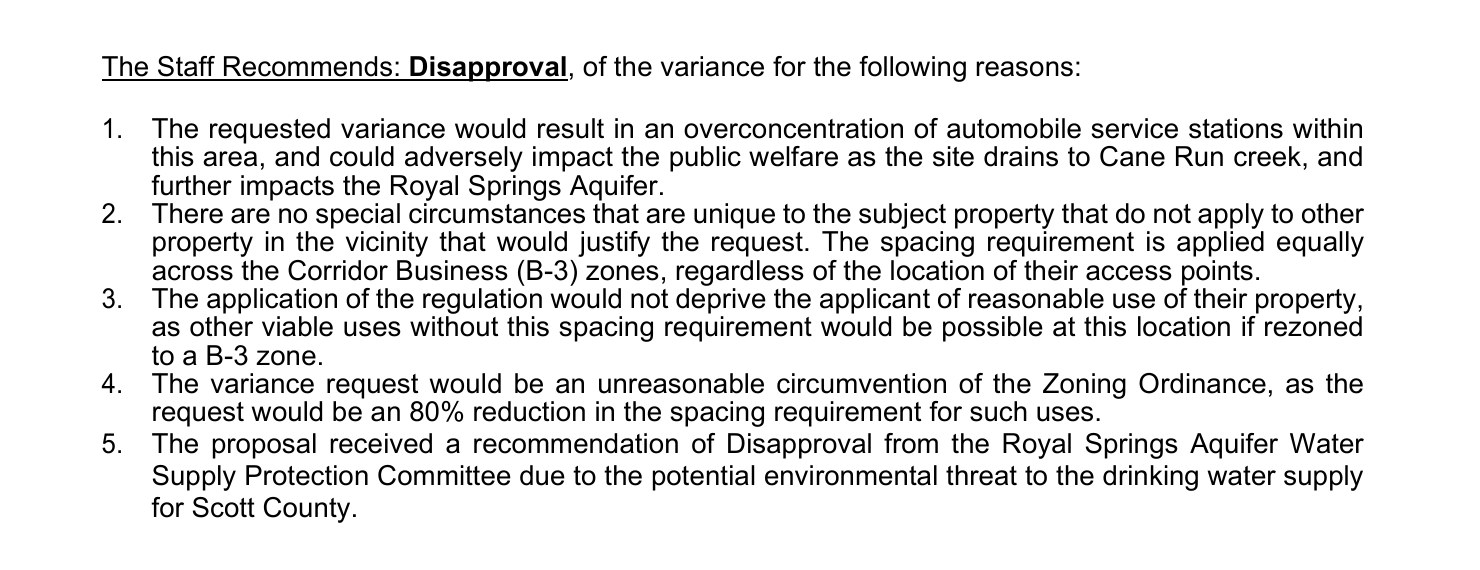
The committee’s clearest recent win ended differently — without a vote. A proposed gas station and hotel at 1170 Newtown Pike drew a staff recommendation of disapproval last winter on multiple grounds, among them that the project “received a recommendation of Disapproval from the Royal Springs Aquifer Water Supply Protection Committee due to the potential environmental threat to the drinking water supply for Scott County,” according to the January 29 agenda. After months of postponements, the applicant, Legacy Trail, LLC, withdrew both applications on April 23, according to the commission’s official minutes. The rezoning never reached the council, and the land remains in its agricultural-urban (A-U) zone. The committee did not stop the project single-handedly; the developer folded while facing a half-dozen staff objections, of which the aquifer was one.
Now come the data centers
The rules headed to council on Tuesday would ban major data centers countywide and allow minor ones only in the B-4 and I-1 industrial zones by conditional use permit, with required noise, energy and water-conservation plans. The staff draft drew the major/minor line at 50,000 square feet; the commission’s July 30 amendments lowered it to 40,000, added a 25-megawatt capacity cap, raised setbacks to 1,500 feet — from residential and agricultural zones, schools, and other sensitive uses — and, as the amendment was read into the record, required that “all data centers shall be cooled using a closed loop water system or other available cooling system excluding any that are evaporation based.” A motion to send the text to council without a recommendation failed 2–7; the main package passed 7–2, with further amendments — including the closed-loop cooling requirement — adopted unanimously afterward.
The water stakes are not hypothetical. A Congressional Research Service report published July 31, citing the International Energy Agency, notes that a 100-megawatt data center may directly consume roughly as much water per day as 2,600 households; a study it cites estimates U.S. data centers’ direct water use roughly tripled between 2014 and 2023, from 5.6 billion to about 17 billion gallons a year. Google has disclosed that its average data center consumed about 450,000 gallons a day in 2021. The commission’s evaporative-cooling ban trades water for electricity — air-cooled and closed-loop systems consume far less water but more energy, as the CRS report details.
There is also a wrinkle Frankfort wrote into the recruiting pitch. House Bill 775, the 2025 statute that opened Kentucky’s data-center sales-tax exemption to Fayette County — $450 million minimum investment here, with the exemption running up to 50 years — expressly lists cooling towers and adiabatic cooling systems among the “data center equipment” the state subsidizes. The state is offering tax breaks on the exact equipment Lexington’s draft would prohibit.
What the draft does not contain is any groundwater or recharge-area provision. Nothing in the rules treats a data center over the Royal Springs recharge area differently from one anywhere else in the county — this in a city that has spent the past several years rezoning that same Georgetown Road–Coldstream corridor for exactly the kind of light-industrial land where minor data centers would be conditionally permitted. The aquifer-driven restriction packages on those parcels ban buried fuel tanks. They say nothing about water-intensive uses, because in 2003 nobody was planning to evaporate a creek’s worth of water to cool servers.
And there is a structural squeeze. HB 443, the 2024 state law that forced the 2025 rewrite of Lexington’s development rules, requires zoning standards to be objective and ministerially applied — it “limits the circumstances in which the Lexington Planning Commission is allowed to use discretion,” as the city’s own summary puts it. The aquifer committee’s case-by-case recommendations are the opposite of an objective standard. If council wants Royal Springs protection that binds a data-center applicant — or any applicant — the direction of state law is that it must be written down: a mapped boundary, defined uses, stated requirements. The comprehensive plan already promises to look at strengthening groundwater protection. The data-center text amendment is the first zoning vehicle to come along since that promise, and as drafted it does not do so.
The calendar
The council work session is set for 3 p.m. on August 25. A special Committee of the Whole for public input follows on October 6 at 5:30 p.m., and the moratorium on data-center applications — enacted June 9 — expires October 31. The Lexington Times will cover the work session.
This investigation is built on The Lexington Times’ LFUCG meeting archive (2007–2026) at meetings.lexingtonky.news, enacted ordinances and minutes via Lexington’s Legistar and Municode records, Kentucky statutes and administrative regulations, and the federal and academic sources linked above. The archive is transcript-based and incomplete for 2010–2015, and the aquifer committee’s own quarterly meetings are not recorded in it; counts of committee actions are counts of what appears in LFUCG records.
Sources
- LFUCG Planning Commission, Feb. 8, 2024 (Kroger fuel center hearing) — LFUCG Meeting Archive clip 6038
- LFUCG Planning Commission Subdivision Committee, July 2, 2026 — clip 6820
- LFUCG Planning Commission data-center ZOTA hearing, July 30, 2026 — clip 6843
- Stormwater Stakeholder Advisory Committee, Sept. 5, 2025 (Royal Springs overview) — clip 6565
- Planning Commission Zoning Items agenda, Jan. 29, 2026 (Legacy Trail staff report)
- Planning Commission official minutes, April 23, 2026 (withdrawal)
- LFUCG Ordinance 032-2023 (1793 Atoma Drive conditional zoning restrictions)
- Lexington Zoning Ordinance § 21-4(d)(2)(a) (development plan procedures)
- 401 KAR 4:220 (Kentucky water supply planning)
- KRS 154.20-220 as amended by HB 775 (2025)
- City of Lexington — Data Centers public engagement page
- Congressional Research Service, “Data Centers and Water: Frequently Asked Questions” (R49057), July 31, 2026
- Kentucky Geological Survey — Karst groundwater, Fayette County
- UK Cooperative Extension — Cane Run Watershed
- Water (MDPI), 2025 — peer-reviewed study of Royal Spring karst basin
- The Lexington Times, May 3, 2026 — data-center work session report