The Glaze: Bruce Simpson, the land-use attorney who keeps showing up for the side without lawyers
This is The Glaze: a Lexington Times column for the people who quietly do the unsexy civic work that makes the city function. We don't write about the loudest voice in chambers. We write about the ones who keep showing up after the cameras leave. This week: Bruce Simpson.
If you've watched a Lexington land-use hearing in the last 38 years, you've seen Bruce Simpson at the podium. He's been before the Planning Commission, the Board of Adjustment, and the Urban County Council since 1988 — long enough that two generations of staff planners have worked across from him, and long enough that he's read every comprehensive plan Lexington has adopted. There aren't many practicing zoning attorneys in this city with a longer continuous run.
What makes Simpson worth a column isn't the longevity. It's what he chooses to do with it.
The default career arc for a successful land-use attorney in a growing city is to settle into developer retainers. The work is steady, the clients pay on time, and the procedural mastery you accumulate over decades makes you very, very good at getting zone changes approved. Simpson does that work too — Bayer Properties, the Hamburg Kroger zone change, a Dutch Bros expansion, Speedway/7-Eleven on Versailles Road, and dozens of subdivision applications you've never heard of. He's good at it.
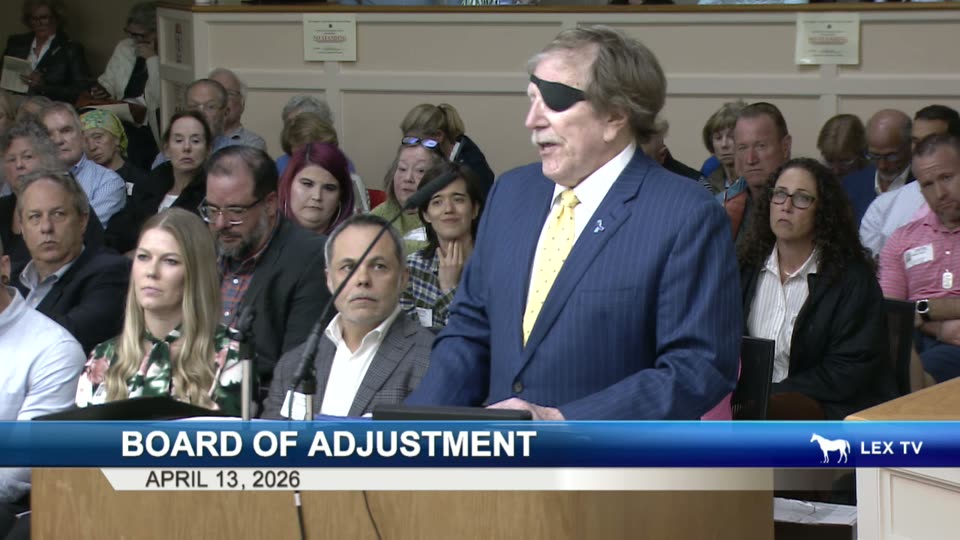
He has also, since 1995, represented the Old Richmond Road Neighborhood Association without interruption. He has represented St. Martin's Village, the historically Black neighborhood founded in 1955 when Black Lexingtonians weren't allowed to live anywhere else, against subdivision-connectivity demands that erode small communities. He has represented Pralltown — what's left of it — against student-housing developers picking off the Civil-War-era African-American neighborhood block by block. And in April of this year, he stood at the Board of Adjustment podium where he's been arguing zoning cases since the Reagan administration and told the board he was committed for four days to Eastern State Hospital.
This is the part of his practice nobody pays for, and it's the part that makes him a Glaze.
Old Richmond Road, since 1995
The first chapter is the long one. Simpson has represented Old Richmond Road for 31 consecutive years. They were instrumentally involved — his word — in the 1996 Comprehensive Plan, which he calls “probably the most expensive and well-researched comprehensive plan in the history of Lexington.” When Charlie Siemon was hired out of Florida to redesign the way Lexington plans for growth, Old Richmond Road residents were in the room for years of meetings. Simpson was with them.
That participation is the kind of thing nobody notices until it's load-bearing. In October 2023, when a developer brought a zone change for property in the Hamburg expansion area that residents said violated the Expansion Area Master Plan they'd helped draft, Simpson stood up at council and walked the body through 700 pages of comprehensive-plan language. He cited the 1996 plan, the 2001 readoption, the 2006 readoption, the 2013 readoption, and the 2018 readoption — all without changing a single word about the property in question.
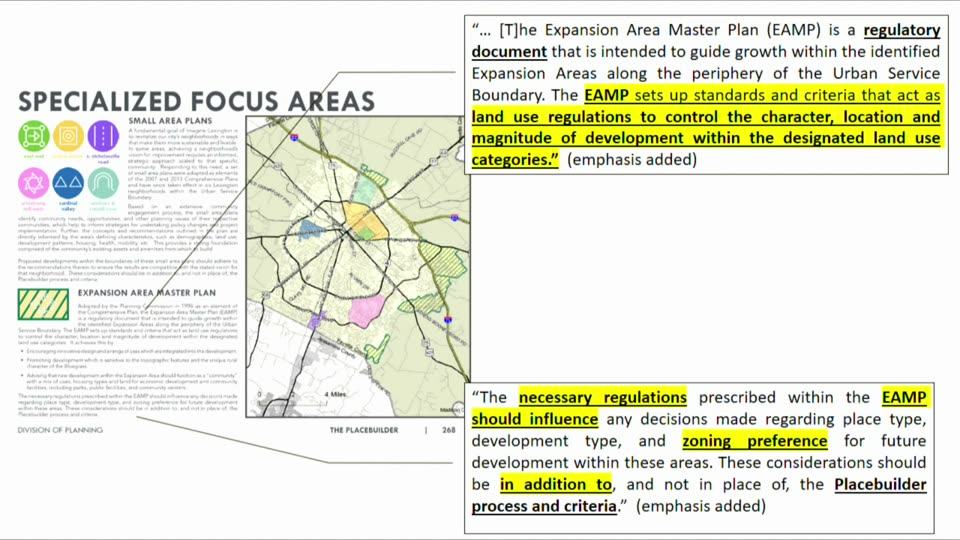
And then he said the line. As a zoning lawyer who represents developers, he said, “I am looking for you all to violate the plan so I can come in here with the next zone change that's not in compliance with the plan.” Translation: if you cut a corner here, I will use it against you next month on behalf of someone with a much bigger checkbook than these residents have. That's one of the rare moments at council when an attorney pulls back the curtain on his own profession to keep the rules from quietly bending.
St. Martin's Village
St. Martin's Village sits off Old Richmond Road. It is, as Simpson put it to the Planning Commission in August 2024, a neighborhood that exists because of a wrong: Black Lexingtonians in 1955 weren't allowed to live anywhere else. In spite of segregation and Jim Crow laws, the neighborhood thrived across multiple generations.
The case was nominally technical: whether a developer would be required to extend three stub streets into St. Martin's Village. To people who don't live there, that reads as a connectivity question. To the people who do, it reads as a question about whether the neighborhood survives the next twenty years intact.
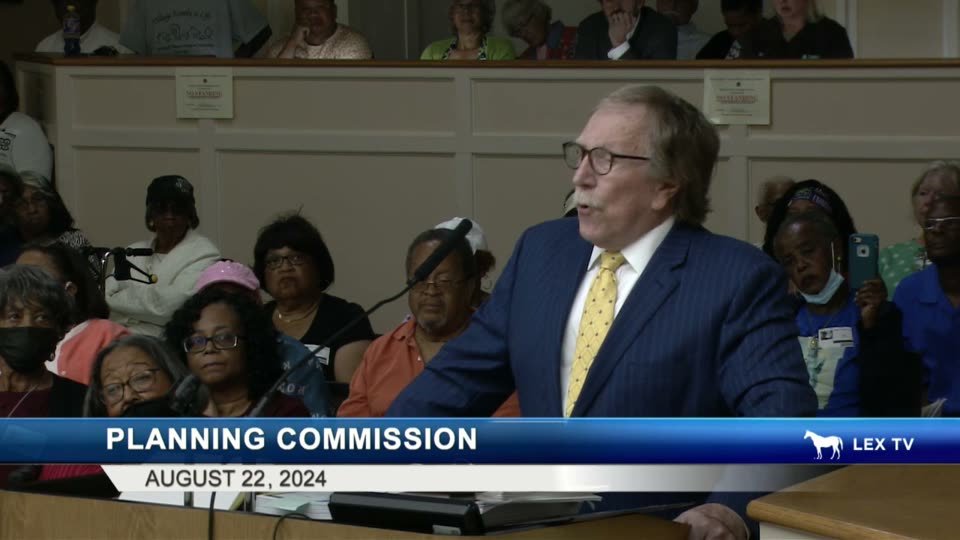
Simpson made the procedural argument — not in compliance with the comprehensive plan, the Mobile Home Park zone not a recommended zone in the Enhanced Neighborhood Place-Type, the notice late, the connections unwanted. And then he made the argument the procedural argument was hiding: “all African American neighborhoods like St. Martin's Village need protection.” Commissioner Bruce Nicol, who is normally not easily impressed, put on the record that “St. Martin's Village has had some of the best representation that he has ever seen.” Simpson is back on the case in February 2026 for the Suburban Point subdivision expansion, holding the same line.
Pralltown vs. Subtext
Pralltown is what's left of an African-American neighborhood founded in the middle of the Civil War. Founded, as Simpson put it, by people who “didn't want to be there. They had to be there, because they couldn't live elsewhere in Lexington.” It sits across from UK in what Simpson calls “a target-rich environment” — UK refuses to put student housing on its own land, so private developers take over the small neighborhoods on its edges instead.
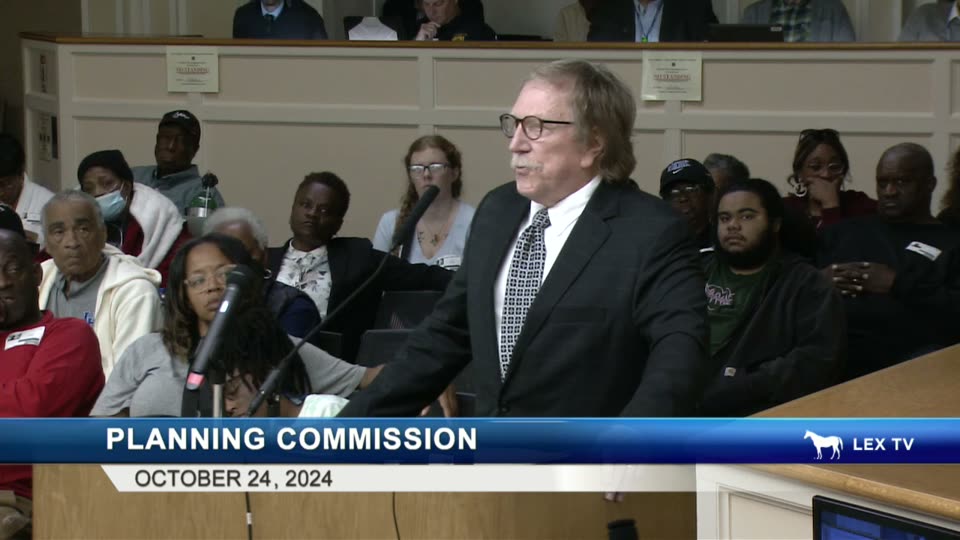
In October 2024, Subtext Acquisitions came to the Planning Commission with a zone change for an 82-foot tall, 557-foot long student-housing building — “almost two football fields long,” Simpson told the commission. The application included $1.5 million in offered cash and a $150,000 donation. Simpson, who has read every Lexington comprehensive plan since 1988, told the commission what those numbers actually were: “As big as our comprehensive plan is, and as many as I've read since 1988, I have never seen one sentence say, if you come in with a check for $1.5 million, or make a donation for $150,000, that is a valid consideration for a legal zone change.” His judgment on the record: the application was tainted and void as a matter of law.
The argument that landed harder was about what was happening to the neighborhood while everyone wasn't looking. Pralltown, Simpson said, “has been a target-rich environment for a long time, and incrementally the Pralltown folks have been displaced and students have taken over.” The Mayor's Commission for Racial Justice and Equality had warned about it four years prior. No action had been taken. “What's wrong is we're doing the same old thing we've been doing to African-American communities for decades. We are making them extinct. And if you approve this, you're advancing Pralltown's extinction.”
The chair, after he sat down: “Thank you, Mr. Simpson, for speaking on behalf of the neighborhood and Pralltown.”
Roaring Brook, Chevy Chase, and a podium confession
On April 13, 2026, the Board of Adjustment held a hearing on a residential mental-health treatment home at 319 Duke Road, in the heart of Chevy Chase. The opposition organization called itself Friends of Chevy Chase. They came with a real-estate appraiser, a registered nurse, hundreds of form-letter emails, and a YouTube video that had racked up 56,000 views.
Simpson was at the podium for the applicant. About forty minutes in, he said something the Whisper transcripts didn't catch but the closed-caption stenographer did — and that the room caught most of all.
He started with a literature review. Fifteen to twenty percent of the population, he told the board, experiences periodic to ongoing serious mental-health issues that need treatment. In Lexington that's about 45,000 people. “Some of them are in this room.” And then:
“The truth of the matter is, I have been suffering from a mental illness for most of my life. I'm much better now after I got treatment. Doing better and functioning better as a human being and as a lawyer than any time in my life... Folks like me — some folks in this room — suffer in silence because of shame. Humiliation. Because of the stigma associated with mental illness... I made fun of Eastern State Hospital for most of my life. And three years ago, police came to my home, put me in handcuffs, escorted me in front of my family and neighbors, put me in the back of a police car, and forced me to go to Eastern State Hospital when I was an involuntary commitment for almost four days. But it saved my life. Saved my life. So this is an unusual application for me as a lawyer because I have a personal appreciation.”
He then went back to walking through Tab 3 of his exhibit book.
The closing was the other unusual move. Simpson said he had never quoted scripture in a hearing before. He named his church — Calvary Baptist — and read Matthew. “Blessed are the poor in spirit, for theirs is the kingdom of heaven.” Then Matthew 25, on what was done for the least of these. Then he tied it back to the staff recommendation: “I've been before this body since 1988, and there's one question that's not in dispute. They're here to advocate for the least of these, and they've done so today, recommending approval.”
Two board members thanked him on the record for his “candor” and “honesty in dealing with this situation.” That phrase — “honesty in dealing with this situation” — is what a board member says when the speaker has stepped outside what's expected of an advocate. Simpson had.
The big picture
Most attorneys with 38 years of practice in a single city ossify. They get heavier on the developer side, and quieter when the cause isn't going to win. The work calcifies into something that pays well and disappears into the agenda packet.
Simpson does the opposite. He still has the developer book — that's how he can afford the rest. But he uses the procedural fluency he built on the Krogers and the Speedways to make residents and stigmatized uses sound like they had a fair shot at the same standard, instead of the muffled, mispronounced, hand-raised version of the argument that small neighborhoods usually get when they have to do it themselves. He pulls back the curtain on his own profession's tactics when those tactics are about to bend the rules. And in April, he showed his city what 38 years of practice was actually for.
None of this gets you elected to anything. None of it ends up in a Yoast SEO description. The cases are decided one by one and most don't make the news. But the cumulative shape of a 38-year practice is the shape of how a city protects what's quiet — or doesn't. Simpson's shape is unusual.
Bruce Simpson has stood at that Lexington podium since 1988. Last month, in a Board of Adjustment hearing about a 24-bed residential treatment home in Chevy Chase, he showed everyone what 38 years of practice was actually for.
The Suburban Point / St. Martin's Village expansion case is back in front of the Planning Commission this winter. The Lexington Times is following it. Browse the LFUCG meeting archive at meetings.lexingtonky.news.
Sources
- LFUCG Board of Adjustment — April 13, 2026 (Roaring Brook / 319 Duke Road)
- LFUCG Urban County Council — October 17, 2023 (Old Richmond Road zone change)
- LFUCG Planning Commission — August 22, 2024 (St. Martin's Village / Suburban Point)
- LFUCG Planning Commission — October 24, 2024 (Pralltown / Subtext Acquisitions)
- LFUCG Planning Commission — February 12, 2026 (Suburban Point Subdivision Expansion)
- LFUCG meeting archive