Analysis: The Democratic Party's civil war is on Lexington's ballot — and you can vote for both sides
→ Read the original on lexingtonky.news
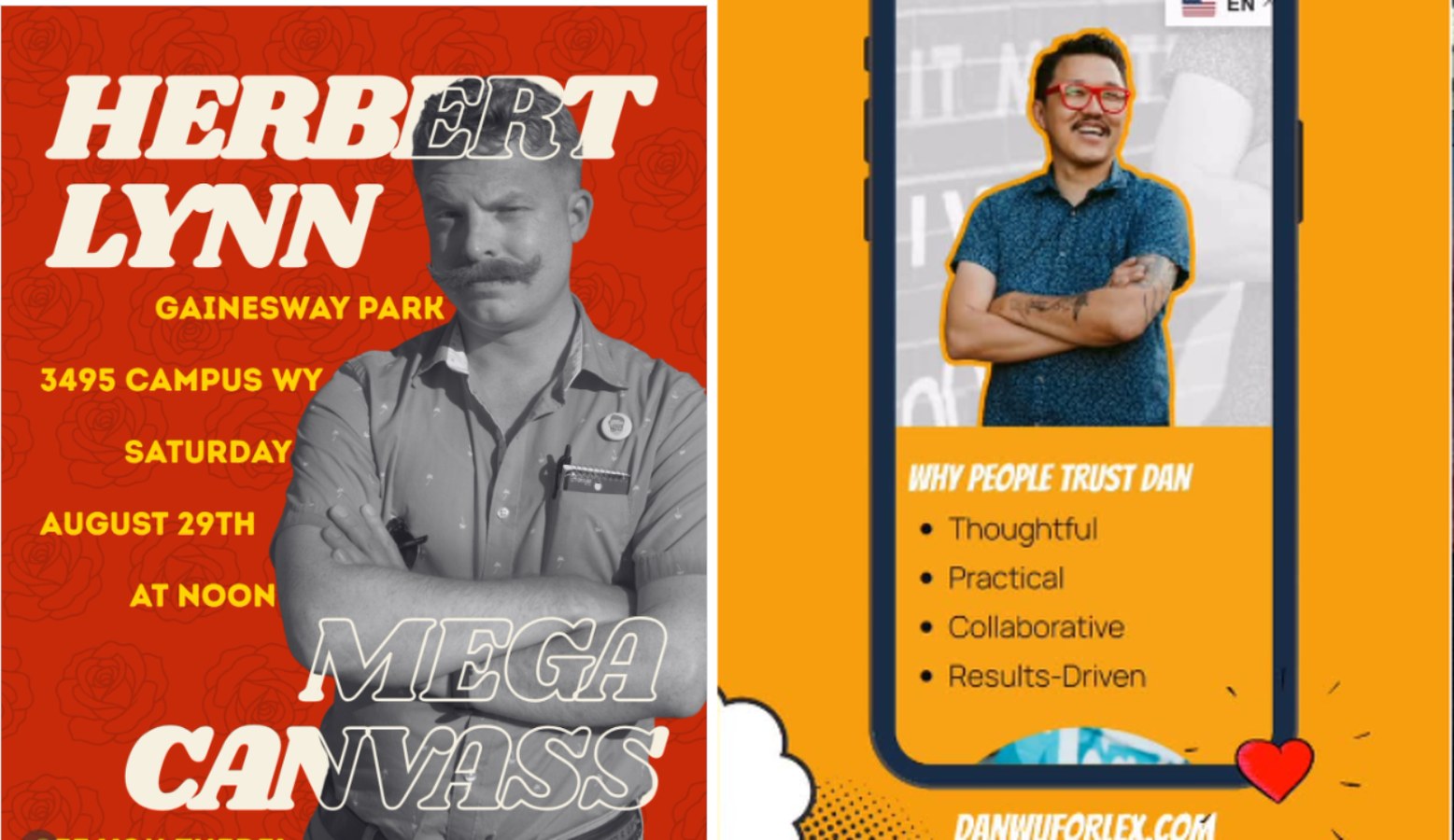
Two campaign flyers went up on Instagram this summer, advertising two candidacies for the same office.
One is printed in socialist red, patterned with roses — the emblem the international left has worn since the 1880s — and shows a mustachioed man in a work shirt, arms crossed, above the words MEGA CANVASS. It announces that volunteers for Herbert Lynn will gather in Gainesway Park on August 29 to knock doors. Lynn's campaign has also run a drag-brunch fundraiser, a Reddit AMA, and a video that opens, in the style of a famous Bernie Sanders meme, "I am once again asking for your financial support."
The other is bright and sunny, framed like a smartphone screen, and lists four bullet points under the heading WHY PEOPLE TRUST DAN: Thoughtful. Practical. Collaborative. Results-Driven. It belongs to Vice Mayor Dan Wu, whose re-election site promises "a collaborative mindset, and a focus on real results," and declares that "leadership is not about being the loudest voice in the room."
Both men are running for Urban County Council at-large, on the same November 3 ballot, for the same three seats. And between them, without either one saying so, they have imported into Lexington the argument that is currently tearing the national Democratic Party in half.
The argument
Since the 2024 election, the party's internal fight has organized itself around two poles.
On one side is the movement that answers to the word abundance — named for Ezra Klein and Derek Thompson's book Abundance, a No. 1 New York Times bestseller published in March 2025, which argues that Democrats fail because they have made it too hard to build things, and that the fix is to strip away process, permitting and procedure until government can deliver. The book became a network. Leaked internal documents published by The American Prospect in June itemize the Abundance Network's hoped-for "capital stack": $120 million from former Enron trader John Arnold's philanthropy, $40 million from Facebook co-founder Dustin Moskovitz, $30 million scaling toward $100 million from former Microsoft CEO Steve Ballmer — roughly $200 million a year by the memo's own math. (Network co-founder Zack Rosen confirmed the documents are real while disputing the math — he called the Arnold figure incorrect and said active grants are "probably closer to $40M.")
On the other side is the resurgent socialist left. Zohran Mamdani, a Democratic Socialists of America member, won the New York City mayoralty in November 2025 with 1,114,184 votes — the first candidate to clear a million since 1969 — while a super PAC stocked with roughly $28 million, including about $13 million from Michael Bloomberg across the cycle, tried to stop him. DSA's national membership, about 50,700 when Mamdani launched his campaign in October 2024, nearly doubled to 92,912 by December 2025, and this July the organization said it had passed 120,000 — larger, by its own accounting, than American socialism's previous high-water mark in 1912. Bernie Sanders and Alexandria Ocasio-Cortez's Fighting Oligarchy tour put up crowds the party's official apparatus could not match — organizers counted more than 260,000 cumulative attendees by late 2025.
The two camps are not shy about what they think of each other. Sen. Elizabeth Warren, in a January speech at the National Press Club, said of the abundance movement: "It looks like the corporate tycoons have found one more way to try to stop the Democratic Party from tackling a rigged system with too much energy." The leaked Abundance Network manifesto returned the compliment in advance, sneering that "small dollar internet fundraising makes politics dumber" and comparing grassroots donors to "amateurs yanking the handles of ActBlue slot machines."
This fight is mostly narrated as a Washington story, a 2028-primary story. But its actual battlefields are municipal — San Francisco's party committee, Minneapolis's council, where DSA members now hold four of thirteen seats, New York's boroughs. And, it turns out, Lexington's at-large race.
The socialist
Herbert Lynn is not coy about where he stands. "I'm a democratic socialist and a member of the Bluegrass chapter of the Democratic Socialists of America," his campaign site's About page says, in the first person. The chapter's endorsement of him was listed in DSA's national May Day roundup of races to watch. On Bluesky, he introduces himself as "a Democratic Socialist, an HVAC dispatcher, and a local organizer," and describes the race as a fight against "monied interests" and "wealthy opponents."
His platform reads like the national left's municipal agenda translated into Fayette County terms. He wants a public power utility — "If LG&E-KU cannot provide affordable energy, it is time to take back our energy infrastructure" — the same municipalization lineage Mamdani campaigned on in New York. He wants to "outlaw the construction of massive data centers in our county." He wants tenant unions empowered, "affordable and socialized housing developments," a permanent homeless shelter, and enforcement of the Housing-First policy council has already passed. His campaign's printed zine adds a plank his website doesn't carry: a vacancy tax on rental properties, including short-term rentals. His self-description is built in opposition to property: "I don't run a business that's going to profit off of my candidacy. I don't own real estate investments or rental properties."
The money matches the message. Lynn has reported $14,455.54 in itemized individual contributions across 303 separate gifts — nominally the most gifts in the field, though that edge carries an asterisk: Lynn kept filing through mid-July, while Wu's reports stop in late May, at 299. What no reporting window changes is the size of the checks. Lynn's average gift is $47.71, and 136 of his gifts come from 19 donors giving month after month — typical recurring gift, $20 — the ActBlue-style small-dollar model the abundance memo mocked. His development-industry money, by our accounting of every itemized contribution: zero dollars.
And the campaign is running the DSA electoral playbook — the volunteer canvass as the core ritual. His campaign says its volunteers have knocked roughly 12,000 to 13,000 doors, according to Bluegrass DSA, which co-organizes the campaign’s canvasses, and the campaign is aiming, per an August post, at "15,000 more doors in these next 74 days." That post — the red, rose-printed MegaCanvass flyer that could have been designed in Queens — was published to Instagram as a joint post by the Lynn campaign and Bluegrass DSA itself. "Our opponents may have more money and connections," it reads, "but we have people power."
The abundance fellow
Dan Wu's national affiliation is quieter — it appears nowhere on his campaign site — but it is just as real. Wu is one of exactly 20 inaugural fellows of Abundance Elected, the Abundance Network's program for local officials, launched in September 2025 with, per Axios, more than 120 elected members across 31 states and a fellowship funded by Arnold Ventures. His official city biography goes further, calling him "a founding member of the Abundance Elected Network." The fellowship is an 18-month program, per Axios, designed by former Oakland Mayor Libby Schaaf, with a curriculum — "Abundance 101," "Winning: Political Skills for Getting Hard Things Done" — built in part on the same Marshall Ganz organizing frameworks the left has used for decades. Members get a WhatsApp group and a webinar with Derek Thompson.
We have written about Wu's abundance ties in detail — the network's billionaire funders, and the remaking of his campaign persona from the activist who posed before a Black Lives Matter mural in 2022 to the consensus manager of 2026. The short version: Wu was speaking the movement's language before the movement found him. In a committee meeting in August 2025 — fifteen days before Axios broke the news of the network's launch, three months before the fellowship's first training weekend — he was asking whether the city was "putting too many potential barriers towards development" and calling for "denser housing, missing middle housing."
His money is the mirror image of Lynn's. Wu has raised more than any candidate in the field — $75,662.38 in itemized individual gifts — from 299 contributions averaging $253.05 each, more than five times Lynn's average. Six donors gave him the $2,200 legal maximum. About 16 percent of his itemized money comes from donors in development, real estate and construction. Even the network came through, modestly: the Abundance Network's own director of membership, Kait Saier, gave his campaign $750 across two contributions — the only money from any Abundance Network employee to any candidate in this race.
His brand, meanwhile, is the abundance movement's theory of politics made flesh: outcomes over ideology, collaboration over conflict, "doing the most good for the most people." Where Lynn's aesthetic is the picket line, Wu's is the deliverable.
What the tidy version gets wrong
If this were a parable, it would end there. It shouldn't, because the local facts are messier than the national frame — and the mess is the interesting part.
Start with the obvious objection: Wu is a strange avatar for build-baby-build. When council set the direction on expanding the Urban Service Boundary in June 2023, Wu was one of three votes against expansion; he then backed a motion to cap the expansion at 2,700 acres, which failed, before he joined the lopsided final vote to adopt the plan. His 2026 site talks about protecting "our delicate urban-rural balance." On the growth question that actually divides Lexington — the boundary — the abundance fellow votes like a preservationist. And the socialist agrees with him: "I am not in favor of boundary expansion," Lynn wrote in his AMA. "I would rather focus my efforts on improving land use within the urban service boundary rather than expand into agricultural land." Nor is Wu the developer industry's favorite: that would be fellow incumbent James Brown, whose development-and-construction donor share, at over 35 percent when construction is included, roughly doubles Wu's, and who took the race's only sizable industry PAC checks — $1,000 each from the homebuilders' and the Realtors' political action committees. (A $500 homebuilders'-PAC gift to Stephanie Spires is the only other PAC money in the field.)
Then notice what the two supposed opposites agree on. Lynn's housing plank begins: "Reform zoning laws to allow for denser and more affordable housing in Lexington." That is, word for word, the YIMBY position — the abundance movement's founding cause. The Lexington version of the national fight is not density versus preservation. Both men want more housing built. The split is over who should own it, who should pay for it, and who should be feared: Lynn wants public power, socialized housing and tenant unions because he believes concentrated wealth is the problem; Wu wants barriers lowered and processes streamlined because he believes friction is the problem. It is the same disagreement Warren and Klein are having, conducted at the scale of a zoning text amendment.
Even labor refuses to pick a side cleanly. LiUNA Local 189, the laborers' union, appears on Lynn's endorsements page — and in April, Wu posted that he was "super proud to be endorsed by" the same local. In a race where voters choose three, a union can hedge, and this one apparently did. (Neither campaign's claim has been announced by the union itself, which has published nothing either way.)
And the two men have yet to appear together, so far as the public record shows. The nearest thing this race has had to a shared stage was a June community forum on data centers at the Lyric Theatre, where Lynn and Stephanie Spires spoke; nothing in the record puts Wu there, and no at-large debate sits on any public calendar we can find. The liveliest venue the race has found instead is r/lexington, where Lynn's January AMA drew more than 700 upvotes. The civil war, such as it is, is being conducted almost entirely in parallel — two campaigns, two donor universes, two aesthetics, no contact.
Where it stops being abstract
Two live local fights give the frame its teeth.
The first is surveillance. Bluegrass DSA — the organization Lynn belongs to and is endorsed by — has made its flagship priority a campaign called DEFLOCK, demanding Lexington cancel its Flock automated license-plate-reader network: "Our public funds currently pay for more than 125 Flock cameras throughout Fayette County," the chapter's campaign page says, warning the vendor "can do whatever they want with it, including hand it over to ICE." Wu voted to approve that Flock contract in April 2024, on a 14–1 roll call, without a word of recorded comment in the minutes — a silence we have documented at length. Lynn has no such silence. "I do not support the Flock camera program or any mass surveillance programs at the local, state, or federal level," he wrote in a Reddit AMA in January — the single most-upvoted comment in the thread — adding that he "would vote against expanding it." His January posts called for ICE's abolition outright, and he joined a courthouse protest against the agency. Surveillance, deportation, municipal complicity: the national argument, on one contract, with the two candidates on opposite sides of it — one by vote, one by pledge.
The second is data centers — the issue on which the establishment process and the socialist demand are converging with almost comic precision. Lynn's plank says outlaw massive data centers. Council, meanwhile, enacted a data-center moratorium in June that expires October 31 — three days before the election — and the replacement rules are moving now: the Planning Commission voted July 30 to recommend prohibiting data centers larger than 40,000 square feet, council takes up those recommendations at its August 25 work session, the ordinance is set for first reading on the August 27 agenda, and a special Committee of the Whole for public comment is set for October 6. When the Herald-Leader surveyed all six at-large candidates this month, the two men even converged on the bottom line — and split, characteristically, on the register. Wu answered in two moves — a flat no, then a carve-out: "Do we want AI-centric hyperscale data centers in Lexington that raise our electric bills and cause harm to our communities? My answer to that is a clear and emphatic NO," paired with a call to "craft smart policies" that let local businesses keep the small-scale data centers they already run. Lynn, at that June forum at the Lyric, answered like an organizer: "When something comes in and takes and takes and takes and gives nothing back and damages its host, what is it called? It's a parasite." However the ordinance lands, the campaign's final month will be spent litigating, in public, whether Lexington should ban the things Herbert Lynn's platform wants banned — with Dan Wu presiding over the process.
The ballot doesn't make you choose. The result will still count the sides.
Here is the twist that makes Lexington's version of the fight stranger than New York's: structurally, it isn't a fight. Six candidates are running for three at-large seats — too few to trigger a primary — and every voter may mark up to three names. Nothing stops a Lexingtonian from voting for Herbert Lynn and Dan Wu, and given the overlap in their housing politics, plenty of people may do exactly that.
But the at-large race has a scoreboard the national factions will be able to read anyway. The top vote-getter becomes vice mayor. In 2022, that was Wu, with 42,435 votes. If Wu tops the ticket again, Lexington will have re-crowned the abundance movement's only Kentucky fellow on council. If Lynn — outraised five to one, with zero development money and a treasury built on recurring gifts of $10 and $20 — merely wins a seat, the Bluegrass chapter of DSA will have done in Lexington what its comrades did in Minneapolis and New York: proven the small-dollar canvass model works outside the big coastal metros. If he tops the ticket, the story writes itself nationally.
Kentucky's Democratic Party is running this same experiment at every scale this November — Charles Booker, whose statewide Senate campaign runs on a "Working People's Bill of Rights," is testing the populist thesis against Andy Barr while the party's national donors debate whether the future looks more like Gov. Andy Beshear's studied moderation. The at-large race is the smallest, purest version of the test. Two men, one ballot, three seats, and the whole argument about what the Democratic Party is for — conducted politely, in a race where nobody has to lose for one side to win.
The Lexington Times' at-large election coverage will continue through November 3. Campaign-finance figures in this analysis reflect Kentucky Registry of Election Finance filings re-verified against the live registry on August 23; Lynn's reports run through mid-July 2026, while Wu's most recent filing covers receipts through late May, and no candidate's general-election committee had reported new activity as of that date. The next full picture arrives with the 60-day pre-general reports, which cover activity through September 4 and are due September 16.
Correction (2026-08-31): An earlier version of this article said the Lynn campaign had knocked 1,500 doors, citing a pinned campaign Instagram post. That milestone was outdated: Bluegrass DSA, which co-organizes the campaign’s canvasses, says volunteers have knocked roughly 12,000 to 13,000 doors, with the "15,000 more doors" figure the campaign’s goal on top of that. The article has been updated.
Sources
- Herbert Lynn for Lexington — campaign site, platform and About page
- Lynn campaign Platform Zine (vacancy tax, mixed-use planks)
- Dan Wu for Lex — 2026 campaign site
- Democratic Left (DSA national), "More Than 170 Chapters Take May Day Action," May 5, 2026 — Bluegrass chapter endorsement of Lynn
- Bluegrass DSA — DEFLOCK priority campaign
- Abundance Elected — 2026 inaugural fellows roster
- Vice Mayor Dan Wu — official LFUCG biography ("founding member of the Abundance Elected Network")
- Axios, "Scoop: 'Abundance' movement launches lawmaker group," Sept. 3, 2025
- The American Prospect, "New Documents Detail Nine-Figure, Silicon Valley-Funded Abundance Movement," June 12, 2026
- Elizabeth Warren, "The Big Tent" speech, National Press Club, Jan. 12, 2026
- City & State New York, "DSA's membership nearly doubled since the start of Mamdani's mayoral campaign," Jan. 27, 2026
- New York City Board of Elections — certified 2025 general election results
- Wikipedia — Fighting Oligarchy Tour (organizer-reported cumulative attendance)
- Wikipedia — 2025 Minneapolis City Council election (DSA members holding four of 13 seats)
- Fayette County Clerk, Official Precinct Results, 2022 General Election — Wu 42,435 votes, top at-large vote-getter (the Clerk no longer posts the file; The Lexington Times retains an archived copy)
- Kentucky Registry of Election Finance — itemized contribution filings, 2026 council at-large committees (re-verified Aug. 23, 2026)
- LFUCG Legistar — Ordinance 0711-26, data center regulations (first reading Aug. 27, 2026); Resolutions R-235-2026 (moratorium) and R-236-2026 (ZOTA initiation)
- Urban County Council press release, Aug. 19, 2026 — Special Committee of the Whole on data-center regulations, Oct. 6, 2026; public feedback portal at Engage Lexington
- CivicLex, "Who is running for LFUCG offices in 2026?", Jan. 11, 2026
- Dan Wu campaign Instagram, April 24, 2026 — LiUNA Local 189 endorsement post
- Lynn campaign and Bluegrass DSA joint Instagram post, Aug. 21, 2026 — MegaCanvass announcement ("15,000 more doors in these next 74 days")
- Herbert Lynn on Bluesky — self-description and campaign posts
- Herbert Lynn AMA, r/lexington, Jan. 18, 2026 — Flock, boundary and housing answers
- Lexington Herald-Leader, "What each of Lexington's at-large council candidates thinks about data centers," Adrian Paul Bryant, Aug. 12, 2026
- The Lexington Times, "Commentary: The sentence Dan Wu never finished," Aug. 9, 2026
- The Lexington Times, "'The rebellion against elites': Meet the billionaires behind Dan Wu's abundance network," Aug. 21, 2026
- Wikipedia — 2025 New York City mayoral election (background on the Fix the City super PAC and campaign spending)