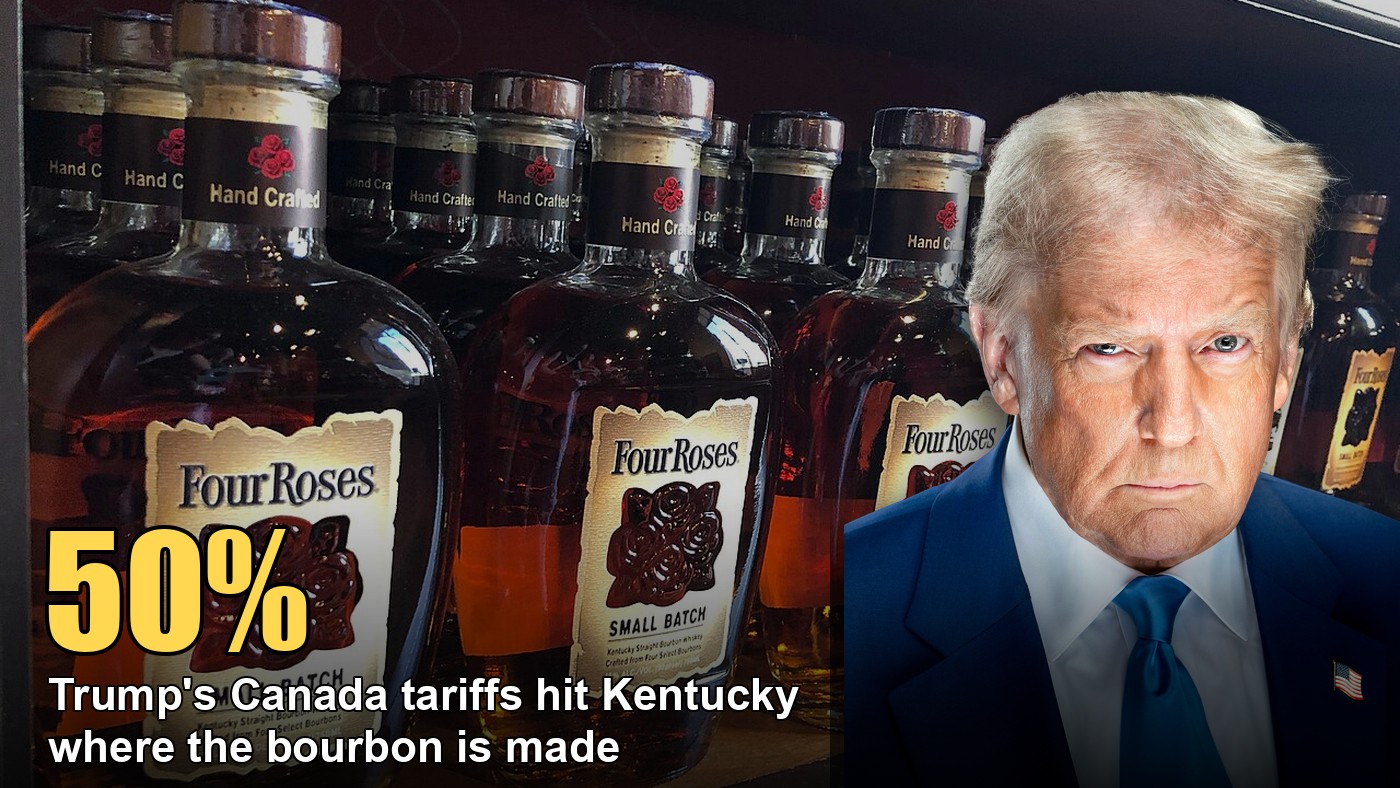
Commentary: Bourbon country voted for the trade war. Now it is paying for it.
At 12:01 a.m. Saturday, a 50 percent tariff landed on roughly $20 billion of Canadian goods after three days of talks in Washington ended without a deal. By Saturday afternoon, Prime Minister Mark Carney had promised to match it "dollar for dollar" starting Sept. 8, with $25 billion in support for Canadian workers. The trade war Kentucky's bourbon industry has spent a year and a half trying to climb out of is back, and this time the federal government has put the reason in writing.
Proclamation 11046, signed July 20 and published in the Federal Register three days later, is the alcohol leg of the new tariffs. Paragraph 4 explains why it exists: "Beginning in March 2025, all Canadian provinces and territories halted the purchase, distribution, or retailing of U.S. alcoholic beverages." It names the Liquor Control Board of Ontario and Quebec's SAQ by name, and notes that only Alberta and Saskatchewan ever put American bottles back. Paragraph 5 gives the damage: Canadian imports of U.S. alcoholic beverages fell "by approximately 81 percent (from approximately $718 million to approximately $137 million)" between March 2025 and February 2026. Annex II lists what gets hit in return. Tariff line 2208.30.60, "Whiskies, other than Irish and Scotch whiskies," is Canadian whisky.
Read that sequence plainly. The provinces pulled bourbon off their shelves because of the first round of Trump tariffs. The White House then tariffed Canadian whisky at 50 percent because the provinces pulled bourbon. The United States is now escalating a fight whose stated cause is that American spirits lost what had been their second-largest foreign market — and the escalation guarantees that market stays lost.
It was almost over
The part of this story that should sting most in Bardstown and Lawrenceburg is how close the shelves came to being restocked.
On Aug. 20, with the tariff clock paused for three days, Carney asked the premiers to lift the liquor bans as a concession. Manitoba Premier Wab Kinew told reporters the prime minister "wants us to put the booze back on the shelves," adding: "I wouldn't say he was begging us, but what is a step before begging?" Quebec's Christine Fréchette said restocking the SAQ was "possible" if the deal was good for Quebec. Yukon told consumers to expect American brands back "in the coming weeks" if a deal was signed. Trade Minister Dominic LeBlanc said the two sides were "very close."
Then the deal died. In his Aug. 22 remarks, Carney said the United States "proposed new terms that were uneconomic, unfair, and undermined the net benefits for Canada," and that Canada would not compromise "on the protection of the French language and our culture." His summary: "In short, they asked too much and offered too little." U.S. Trade Representative Jamieson Greer called it "a missed opportunity for Canada."
Even in defeat, Carney kept the bourbon offer on the table — "we would encourage the provinces to return U.S. alcohol to the shelves," he said Saturday. The premiers no longer have any reason to listen. British Columbia's David Eby had already said in July that "there is not a chance in hell that U.S. alcohol is going back on the shelf in British Columbia." Kinew's advice to Manitobans if the bottles ever do return: "leave it there."
What Kentucky loses
The numbers were bad before Saturday. The Distilled Spirits Council's export report for 2025 shows U.S. spirits shipments to Canada falling from $238 million in 2024 to $89 million — a 63 percent drop that knocked Canada from the second-largest export market for American spirits to sixth. The Kentucky Distillers' Association's own economic report, published in February, found Kentucky whiskey exports to Canada down 42 percent through the first ten months of 2025.
That whiskey did not disappear. It stayed in Kentucky rickhouses, where it is taxed every year it sits. The KDA counts a record 17.1 million barrels aging in the state, 16.1 million of them bourbon, with the assessed value of that inventory at an all-time high of $10 billion and state and local governments collecting $75 million in barrel taxes in 2025 — most of it, 68 percent, going to school districts. The General Assembly voted in 2023 to phase that tax out, but the phase-out only begins this year and runs to 2043. "With tariffs and sales and exports going down, that whiskey is staying at home here in Kentucky and it's being taxed heavily," KDA President Eric Gregory said.
Distillers have responded the only way they can. Beam Suntory shut down distilling at its main Jim Beam plant in Clermont for all of 2026. MGP Ingredients idled Limestone Branch in Lebanon and Lux Row in Bardstown for at least a year starting May 1, affecting 33 workers. Be careful about what those shutdowns prove. Beam's own announcement cited consumer demand, not tariffs; the glut is mostly bourbon's own doing, a decade of expansion that outran a market where younger drinkers are buying less. The cleanest tariff number comes from Brown-Forman, maker of Woodford Reserve and Old Forester, which told investors in December that its Canada sales were down 62 percent. Canada did not cause the glut. Canada was the market that was supposed to help drain it, and the industry's trade group has spent two years asking Washington for one thing. "We need the certainty of tariff-free trade for America's only native spirit to flourish," Gregory said in February.
The stakes are not confined to bourbon country. Canada is Kentucky's largest export market. The state sold Canada $9.3 billion in goods in 2024 and $8.4 billion in 2025, according to figures the governor's office draws from Census Bureau trade data; Canada's share of Kentucky's exports slipped from 19.5 percent to 16.6 percent in a single year, and the slide began well before Saturday's tariff. Lexington has skin in the game too: the KDA lists nine distilling companies licensed in Fayette County, from Town Branch and James E. Pepper to Fresh Bourbon and RD1, and Fayette is one of the eight counties that together hold nearly 60 percent of the state's distilleries.
Who voted for this
Kentucky gave Donald Trump 64.47 percent of its vote in November 2024, according to the Secretary of State's certified returns — 1,337,494 votes, a 30-point margin. Bourbon country did better than that. Nelson County, home to Bardstown and Heaven Hill, went 70.2 percent for Trump. Anderson County, where Wild Turkey and Four Roses are made, went 73.7 percent. Marion County, home to Maker's Mark, 71.1 percent. Bullitt County, where Jim Beam's idled Clermont plant sits, 74.8 percent. Take the seven core distilling counties outside Louisville together and they voted for Trump at 66 percent, above the state average. Even Franklin County, home to Buffalo Trace and the state capital, went to Trump — by 4.85 points, the narrowest of the 118 counties he won. Fayette County, which went 57.9 percent for Kamala Harris, is one of two counties in the state that did not, and is the outlier in this story, not the rule.
Nobody in those counties was tricked. Tariffs were the centerpiece of the 2024 campaign, and Kentucky had already lived through the 2018 round, when the KDA's own figures show the state's whiskey exports dropped 26 percent after the European Union retaliated against American whiskey. Kentuckians voted for the policy with the receipts from the last one in hand.
The state's Republican leadership knew exactly what was coming. On April 2, 2025, Sen. Mitch McConnell joined Sen. Rand Paul and two other Republicans in a 51-48 Senate vote to end the emergency declaration behind the first Canada tariffs. "Consider our state's 69,000 family farms that sell their crops around the globe, or the hardworking Kentuckians who craft 95 percent of the world's bourbon," McConnell said that day. "Goods made in America will be more expensive to manufacture and, ultimately, for consumers to purchase, with higher broad-based tariffs." The Senate passed a second resolution in October, and the House passed its own in February 2026. None became law; the president's veto was assured.
This round is different in a way that matters for Congress. The Supreme Court struck down the president's emergency tariffs in February, so the administration switched to Section 338 of the Tariff Act of 1930, which caps duties at 50 percent and requires 30 days' notice — which is why the number is 50 and the date was Aug. 19. Because Section 338 is not an emergency power, the fast-track resolution McConnell and Paul used last year is not available. Stopping these tariffs would take an ordinary act of Congress, and that would take Kentucky's delegation saying something.
Since Saturday, no Kentucky Republican in Congress has said anything on the record about the tariffs. Rep. Andy Barr, who co-chairs the Congressional Bourbon Caucus and is the Republican nominee for the Senate seat McConnell is leaving, has issued no tariff-related statement through his office in 2026. McConnell's last word on tariffs, on April 30, praised the president for a whiskey deal with Britain; his office has released nothing since Aug. 6 while he recovers from a fall and pneumonia. Rep. Thomas Massie's contribution in July was that the president "should probably litigate all the tariffs he's put in place already without congressional approval" — an objection to the paperwork, not the policy. In the race to replace Barr in the 6th District, Democrat Zach Dembo told WKYT the tariff "is going to crush whatever progress they had trying to come back." The Republican nominee, Ralph Alvarado, was "unable to do an interview or provide a statement Saturday evening," his campaign told the station.
Gov. Andy Beshear, the one statewide official who has been consistently on the record, put it this way to CBC News: "Canada is Kentucky's number one trading partner. They've been a good trading partner. But because [Trump] has demeaned them, because he has questioned their sovereignty, they've taken Kentucky bourbon off their shelves, which hurts our economy."
The honest counterargument
The strongest case for the tariffs is the one the proclamation makes: the provincial bans are discriminatory. Canada did not pull French cognac or Scotch when it pulled bourbon, and the proclamation notes that imports of alcohol from Chile, Japan, Ireland and Australia rose to fill the gap. A country that uses its state liquor monopolies as a trade weapon should expect a response, and Section 338 of the Tariff Act of 1930 exists for exactly that.
But a response is supposed to change behavior. This one did the opposite. The one thing the United States wanted on alcohol — bottles back on shelves — was being offered in the final week of talks, and the administration walked away over other demands. Now the bans are permanent politics in Canada: an Angus Reid poll found 48 percent of Canadians do not want American alcohol back in provincial stores at all, Nanos found roughly seven in ten say they would keep boycotting it even if it returned, and Ontario's finance minister said this month that "our resolve is firm" while the province sits on a $79 million stockpile of American liquor it will not sell. Canadian whisky, which is legally required to be made in Canada, will get more expensive in American bars. Kentucky bourbon will not get any cheaper in Toronto, because it will not be for sale there.
It is also fair to note what Canada's announced Sept. 8 retaliation does not target: bourbon, and automobiles. Carney named steel, dairy, appliances, farm equipment, pulp and paper and electronics; Ottawa has not published the itemized list. Kentucky's largest export to Canada is transportation equipment, and its most famous is whiskey, and neither is on it. Ottawa dropped its own federal tariff on American spirits a year ago. The pain for bourbon has never come from a customs duty. It comes from eleven of Canada's thirteen provincial and territorial liquor boards refusing to buy it — a purchasing decision no American tariff can reverse — and from a White House that just made sure they have no reason to relent.
What should happen
The fix is not complicated. The administration should take the deal that was on the table on Aug. 20 — the one that put bourbon back on Canadian shelves — and drop the demands that killed it. If it will not, Kentucky's congressional delegation should stop treating tariff votes as a matter of legal procedure and start treating them as what McConnell said they were sixteen months ago: a direct tax on the people who craft 95 percent of the world's bourbon.
Kentucky joined 24 other states this month in suing over a different set of replacement tariffs, imposed under the Trade Act of 1974 after the Supreme Court struck down the president's emergency tariffs in February. Beshear called tariffs "the worst economic policy in my lifetime." The state's voters disagreed with him by 30 points. Bourbon country disagreed with him by 40. They will find out over the next year, in idle stills and warehoused barrels, how much that vote cost.
This commentary was researched and drafted with AI assistance by The Lexington Times newsroom agent team and finalized by the editor. Sources: Proclamation 11046 (91 FR 46639); White House fact sheet, July 20, 2026; Prime Minister Carney's remarks, Aug. 22, 2026; Kentucky Secretary of State certified 2024 returns; KDA "Economic and Fiscal Impacts" report, Feb. 2026; DISCUS 2025 exports report; CBC, WKYT, Spectrum News 1, WUKY, The Hill.
Sources
- Proclamation 11046 of July 20, 2026 — Imposing Additional Duties To Offset Canadian Discrimination ... With Respect to Alcoholic Beverages (91 FR 46639)
- White House fact sheet: President Trump Imposes Additional Tariffs on Canada (July 20, 2026)
- Prime Minister Carney delivers remarks on Canada-U.S. trade negotiations (Aug. 22, 2026)
- Al Jazeera: US imposes 50 percent tariffs on $20bn in Canadian goods after talks fail (Aug. 22, 2026)
- CBC News: Will Canadians buy U.S. booze again? (Aug. 20, 2026)
- CBC News: As Canadian booze bans dominate tariff talks (Aug. 21, 2026)
- Kentucky Secretary of State, Official 2024 General Election Results (certification as amended Dec. 9, 2024)
- Kentucky Distillers' Association, The Economic and Fiscal Impacts of Kentucky's Distilled Spirits Industry, 2024-2025 (Feb. 2026)
- DISCUS 2025 American Spirits Exports Report (March 2026)
- WKYT: New Canada tariff draws reaction in Kentucky's Sixth District race (Aug. 23, 2026)
- WKYT: Kentucky bourbon industry still managing record inventory (July 22, 2026)
- Spectrum News 1: Whiskey industry warns against new tariffs on Canada (July 21, 2026)
- WUKY: New tariffs again place Kentucky bourbon in the crosshairs (July 24, 2026)
- WUKY: Kentucky, 24 other states take Trump administration to court over fresh round of tariffs (Aug. 5, 2026)
- The Hill: McConnell statement on vote to undo Canada tariffs (April 2, 2025)
- CBS News: Jim Beam to pause production at main Kentucky distillery in 2026
- The Spirits Business: MGP halts production at Kentucky distilleries (April 2026)
- Kentucky Cabinet for Economic Development: 2025 export figures
- The Lexington Times: Tariffs threaten Kentucky bourbon exports amid trade tensions (July 24, 2026)
- The Lexington Times: Kentucky joins 25 states in lawsuit against Trump tariffs (Aug. 5, 2026)