Maker's Mark, a shuttered Mercantile, and the word 'serve': Inside the Keeneland ZOTA
→ Read the original on lexingtonky.news
Today in “why Lexington’s zoning code suddenly cares about gift-shop bourbon”: a one-word change to Article 8-1, an unanimous recommendation, and a structural objection from a Lexington resident that nobody on the dais wanted to take up.
If you read the agenda for the May 7 LFUCG Planning Commission Zoning Subcommittee and squinted, item PLN ZOTA 26-3 looked like routine zoning housekeeping — one of those text amendments that fixes a comma somewhere in Article 8 and gets approved without comment. It was not that. The applicant was Keeneland. The change was about alcohol. And the backstory, told from the podium by Keeneland’s lawyer, involved a closed gift shop in City Center, a stranded liquor license, and a stack of unsold commemorative Maker’s Mark bottles.
The subcommittee voted unanimously to recommend approval. It now goes to the full Planning Commission, then to Council.
What the change actually does
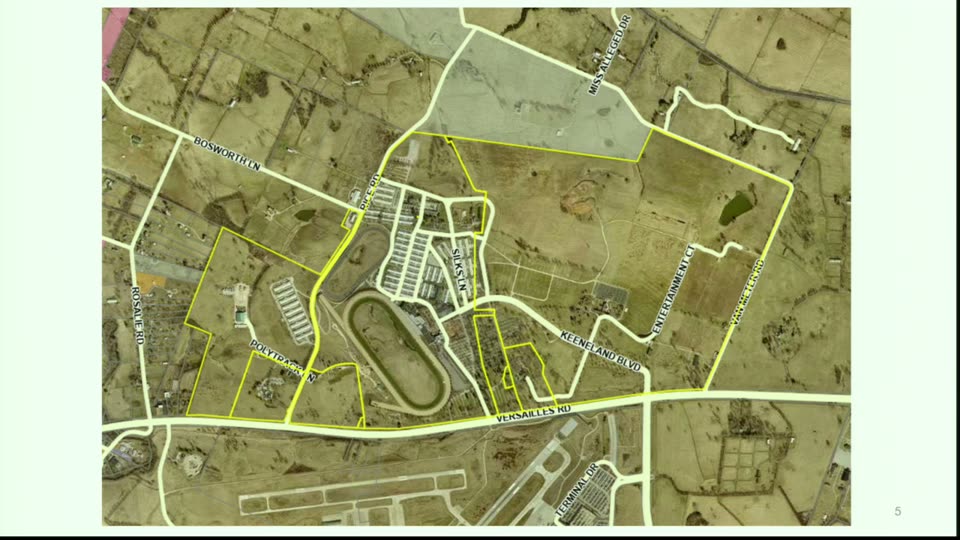
Article 8-1(D)(1) of Lexington’s Zoning Ordinance regulates horse race tracks in the Agricultural Rural (AR) zone. There is exactly one of those in Fayette County, and it’s on Versailles Road. The current language allows Keeneland (or any future racetrack in the AR zone) to serve alcoholic beverages on the premises as part of the conditional use.
The applicant wants to add “retail sale” to the “serving” language. That’s the whole amendment. Planning staff’s Jeremy Young framed it carefully:
“The key word here is serve. And Mr. Nicholson did meet with us, and I think our consensus was that the word ‘serve’ did limit that to buy-the-drink sales and did not allow them to sell packaged liquor. So the applicant has indicated that they would like to, as part of their gift shop on site at Keeneland, sell their commemorative bottles as an added amenity to the other items that they sell.”
In other words: under existing code, Keeneland can pour you a julep at the paddock, but it can’t sell you a sealed bottle to take home. The ZOTA closes that gap.
Why now: a closed gift shop in City Center
The interesting part is why this is being asked at all in 2026. The answer, from Keeneland Association attorney Nick Nicholson, is real-estate logistics rather than expansion strategy.
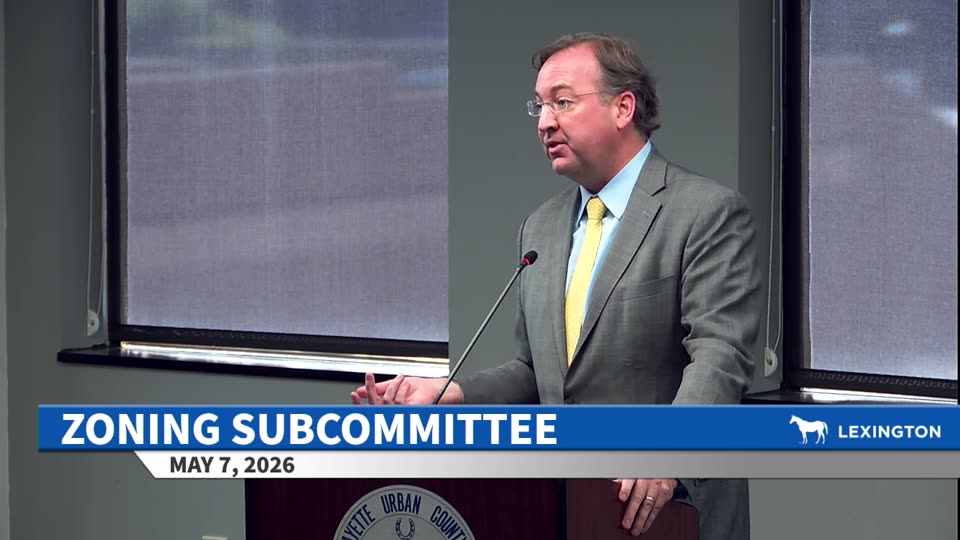
“The Keeneland Mercantile store in City Center had to shut down. And as part of that shutdown, they had been selling the Maker’s Mark commemorative bottles there and doing quite well. And with that store closing, you had to transfer a packaged liquor license to a specific address, or you had to abandon that license. And so we were wanting to transfer it to the other property that we own in town, which would be the racetrack itself.”
Kentucky packaged-liquor licenses are address-bound. When the address goes away, the license either follows you somewhere new or it dies. Keeneland already operates a retail gift shop at the track and a planned visitor’s center, so on paper it’s a clean transfer — except that Article 8-1 is written around “serving,” not selling. Hence the ZOTA.
Nicholson, by his own description, is uncomfortable with the loose ends. He volunteered, at the podium, the kind of self-imposed limit that lawyers usually only mention under questioning:
“We’re not going to set up a situation where someone can walk into the gift store in the middle of a race day and then walk into the paddock and have a bottle of whiskey. And more importantly, we’re definitely not going to allow them to take that bottle and then go tailgate after eight races and have a very, very long and fun day. That is something that the lawyer in me is very, very nervous about.”
One commissioner suggested duty-free-style sealed bottles. Nicholson did not disagree.
Staff’s case for it
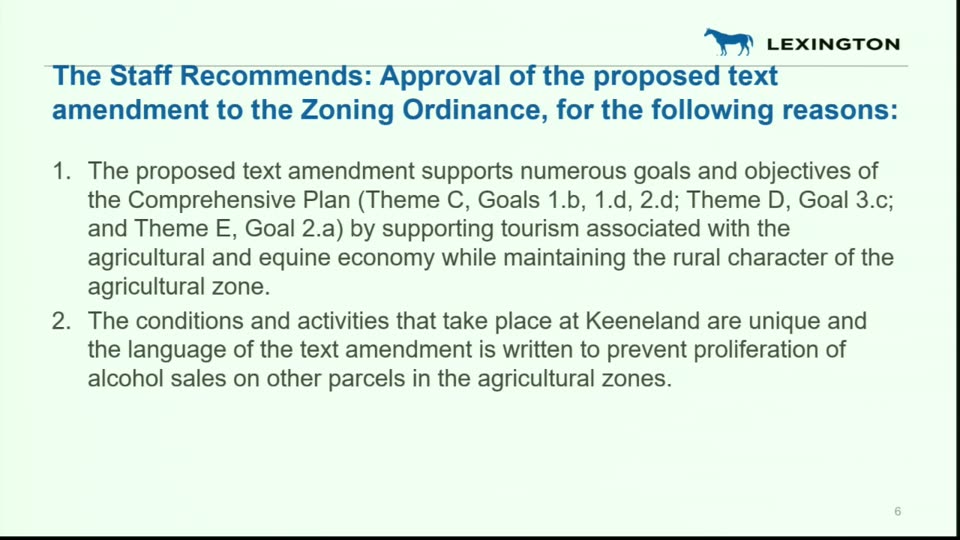
The staff report leans on the Comprehensive Plan and what staff calls “the unique conditions and activities at Keeneland.” Specifically: tourism associated with the equine industry (Themes C, D, and E of the comp plan), and a stated intent that the language is written narrowly enough not to crack open packaged-liquor sales for some hypothetical second AR-zone racetrack.
The “uniqueness” argument is doing most of the work. Nicholson volunteered a small civic detail to underline it: Keeneland is required, by deed, to be open 24 hours a day, seven days a week to the public, and if it ever stops being a horse racetrack, the property reverts to the city as a public park. It is, in his words, “a very interesting little piece of property.” A commissioner’s response: “How interesting is that?”
The structural objection nobody really took up
The only person who used the public-comment slot was Amy Clark, and her objection wasn’t about Keeneland. It was about how Lexington writes zoning law in the first place.
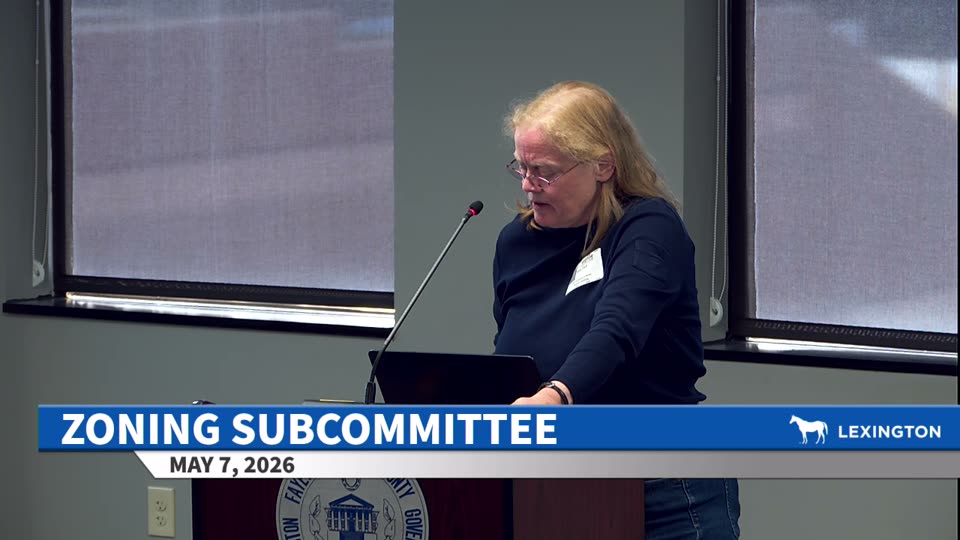
Clark walked through a discrepancy between Kentucky state statute and Lexington’s ordinance. The state, she noted, says a Zoning Ordinance Text Amendment “may originate with the planning commission of the unit or with any fiscal court or legislative body.” Lexington’s ordinance, in Section 6-2, says a ZOTA may originate with “any person or governmental body.” The difference matters: under the local rule, a private applicant can ask the city to amend the zoning code to suit a single property. Under the state rule, that initiation power belongs to elected and appointed officials.
“It happens to be a use of which there is one instance, and there’s only likely to be one instance … I’d be happier seeing every ZOTA either initiated by the commission itself or by the council.”
She also flagged that the zoning code’s definition of “accessory use” is increasingly stretched, and suggested mail-order as a workaround that wouldn’t require any text amendment at all. Her closing line: “The tail is not wagging the dog.”
Nicholson responded that the question of who can initiate a ZOTA had already been debated and dropped from a previous text amendment, and that legislative bodies are entitled to delegate their power — the same way the Planning Commission delegates minor-plat review to staff. He told the commissioners they were “in complete compliance” with state statute as currently written.
Nobody on the dais picked up the thread. The discussion moved on.
The reasonable question that didn’t make it into the code
Commissioner Molly Davis asked the most useful follow-up of the afternoon. Nicholson had said, in passing, that he would counsel his client not to sell packaged bottles during racing hours. Davis wanted to know whether that could be written into the deal:
“You suggested that they not do it, and then not doing it aren’t the same thing.”
Nicholson agreed it was a fair question, and then explained why the answer was no: hours-of-operation conditions aren’t typically embedded in the zoning ordinance itself. Keeneland already has the right to serve alcohol year-round but, in practice, only does so during the spring and fall meets and special events. Liability concerns, dram-shop exposure, and the conditional-use-permit review at the Board of Adjustment, he argued, were enough to keep the operation in line.
That left the proposed amendment as it had arrived: a one-word addition, no race-day carve-out, no codified hours, no codified product list, with after-the-fact enforcement living at the Board of Adjustment.
The vote
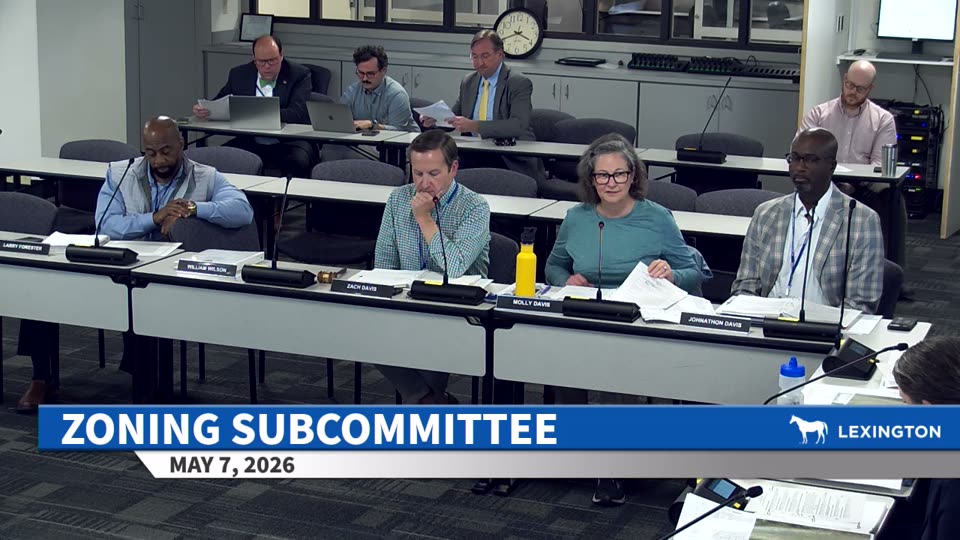
Davis made the motion (“to recommend approval of PLN ZOTA 26-0003, accessory uses to horse racetrack, specifically as in the information given to us today by the staff”). Larry Forrester had already seconded earlier in the discussion. The chair called for any further debate, got none, and asked for a show of hands. The recommendation carried unanimously.
What happens next
The subcommittee’s recommendation goes to the full Planning Commission for a public hearing, and from there to the Urban County Council, which has the final say on amending the Zoning Ordinance. Both of those steps will take a separate vote. Neither is currently expected to be controversial.
If the change is adopted, Article 8-1(D)(1) will read “serve and retail sale” instead of “serve.” Keeneland will transfer the packaged-liquor license to the racetrack address. The Mercantile’s commemorative-bottle program will reappear in the gift shop on Versailles Road. None of it will be visible to a Lexingtonian who isn’t actively trying to buy a Maker’s Mark bottle from Keeneland, which is the whole point.
The thing that will still be visible — assuming Amy Clark keeps showing up — is the question she asked and didn’t get an answer to: whether Lexington should be in the business of running site-specific text amendments through its zoning code on behalf of single applicants, when the state statute that authorizes the whole apparatus envisions that the city itself, not the applicant, would do the initiating.
One word in Article 8-1 is a small thing. Whether the architecture that lets a private party initiate that one word is a small thing is a different question, and it’s still on the table.
The May 7, 2026 Zoning Subcommittee meeting is archived in full at meetings.lexingtonky.news/meeting/6765. The Keeneland ZOTA discussion runs from approximately 1:51:30 to 2:10:10 of the clip.