The Glaze: Walt Gaffield, the volunteer who keeps showing up for the side without lawyers
This is The Glaze: a Lexington Times column for the people who quietly do the unsexy civic work that makes the city function. We don't write about the loudest voice in chambers. We write about the ones who keep showing up after the cameras leave. This week: Walt Gaffield.
On February 9, 2017, a man stepped to the podium at an Urban County Council zone-change hearing and started by admitting he was new at this. "This is really the first time in that capacity I've ever presented for a neighborhood at a zoning hearing," he said — the capacity being president of the Fayette County Neighborhood Council. "But the neighborhood asked me to do it." Then, having confessed his inexperience, Walt Gaffield proceeded to walk the council through the complete zoning history of one piece of land going back to 1994.
If you've sat through a Lexington land-use hearing in the last decade, you've seen some version of this: a soft-spoken volunteer who gives his name, declines to grandstand, and then quietly produces the one fact the room was hoping nobody remembered.
Gaffield is the president of the Fayette County Neighborhood Council — FCNC, an umbrella group founded in the 1990s by the late Emma Tibbs, a neighborhood organizer President George H.W. Bush honored with a Point of Light Award in 2000. It is, in the most literal sense, an organization of volunteers: no paid staff, no lobbyists on retainer, no billable hours. Its members are the neighborhood and homeowner associations that figured out a city full of small neighborhoods gets outvoted one at a time but stands a chance together. Gaffield is the guy who shows up to say so, again and again, to whichever board happens to be meeting that week. Call him the neighborhoods' lawyer without a law degree.
First, they sued over the sewage
Before Gaffield was the face of FCNC, the council did something neighborhood groups almost never do: it went to federal court. In 2006, by its own account, FCNC "filed a lawsuit against the U.S. Environmental Protection Agency and the Urban County Government… for failure to comply with the requirements of the U.S. Clean Water Act."
The problem was raw sewage. Lexington's aging sanitary system was overflowing into creeks and basements, and the city had been slow to fix it. A Clean Water Act citizen suit is the legal lever ordinary residents can pull when regulators won't — and CivicLex's own history of the episode credits "a group of concerned citizens" who threatened to sue if the EPA didn't move first.
It moved. In March 2008, the EPA, the Commonwealth of Kentucky, and LFUCG signed a consent decree committing the city to roughly $590 million in sewer repairs — the largest infrastructure obligation in Lexington's modern history, and the project Charlie Martin has spent the last eighteen years quietly executing.
Here is the part that tells you who Gaffield is. The cleanup had to be paid for, and paying for it meant raising everyone's sewer bill — 48% in 2008, another 30% the next year. On January 24, 2008, weeks before the decree was even lodged, Gaffield stood at the council podium and spoke in favor of the increase. Standing with him, backing the same fee, was Knox Van Nagell of the Fayette Alliance.
Read that again. The neighborhood council sued the city to force a sewer cleanup, then told the city to charge its own members more to pay for it. That is the precise opposite of the reflex everyone expects from a "neighborhood group."
Then he became the institutional memory
That 2017 hearing was Gaffield's debut as FCNC president, and it doubled as a demonstration of what he'd be useful for. The neighborhood hadn't asked him to speak because he was a lawyer or an engineer. They asked him because he'd sat through the November 2016 hearing, "observed it," and "really didn't like what happened."
So he came back with the receipts. He took the council through the 1994 hearing on the same land — Ball Homes had proposed R-1D zoning; the developer dropped out over a hazardous-waste question. He walked them through an August 27, 2015 hearing where the Planning Commission had turned down a nearly identical proposal 8-1. He reconstructed, from the record, the exact exchange between commissioners and staff over whether lot sizes could be restricted under R-3 zoning, and why staff had said no.
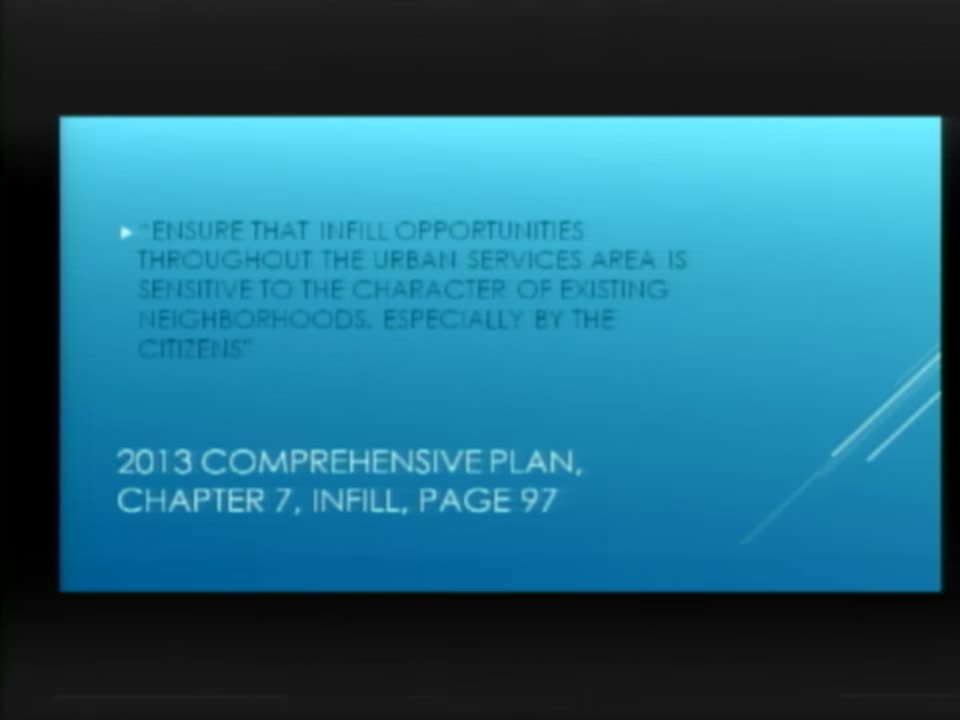
This is the unglamorous superpower of a good neighborhood advocate: not passion, but memory. A developer's attorney is paid to treat every hearing as a blank slate. Gaffield's whole function is to remember that it isn't — that the commission said no to this once before, and here is the transcript.
The grind nobody live-tweets
Most of what Gaffield does will never make the news, because most land-use policy is tedious on purpose. He shows up anyway.
When the city floated an accessory-dwelling-unit ordinance in September 2019, his objection wasn't to backyard cottages as such — it was to a single missing clause. The draft had no owner-occupancy requirement, which meant, he warned, that ADUs could quietly become investor rentals instead of the in-law suites they were being sold as. When short-term-rental rules came up — first in 2020, then again in late 2024 — he was back with specific, line-edited requests to keep residential blocks from turning into de facto hotels.
None of these are heroic stands. They are the legislative equivalent of proofreading: catching the one word in an ordinance that will matter in five years. It is exactly the work nobody is paid to do on the neighborhoods' side, which is why a volunteer ends up doing it.
Frankfort comes for the toolkit
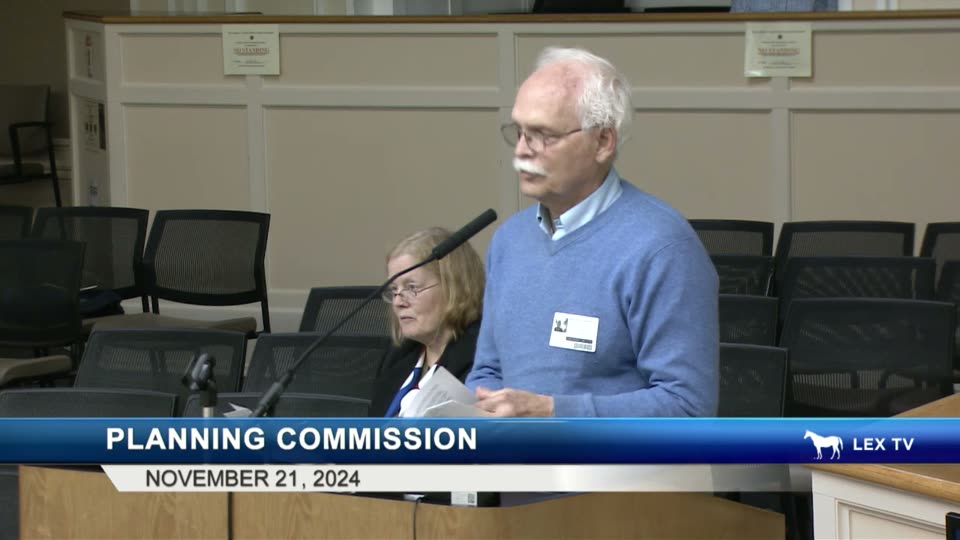
By 2024, Gaffield had graduated to auditing the city's own homework. At a November 21, 2024 zoning hearing over a 400-square-foot digital billboard that could sit 150 feet from homes, he flagged the absurdity of the setback — "150 feet is hardly any distance" for a screen that size — then pivoted to draw the commission's attention to a traffic study that, as he put it, "cost the city 150,000" dollars and hadn't done much to protect anyone.
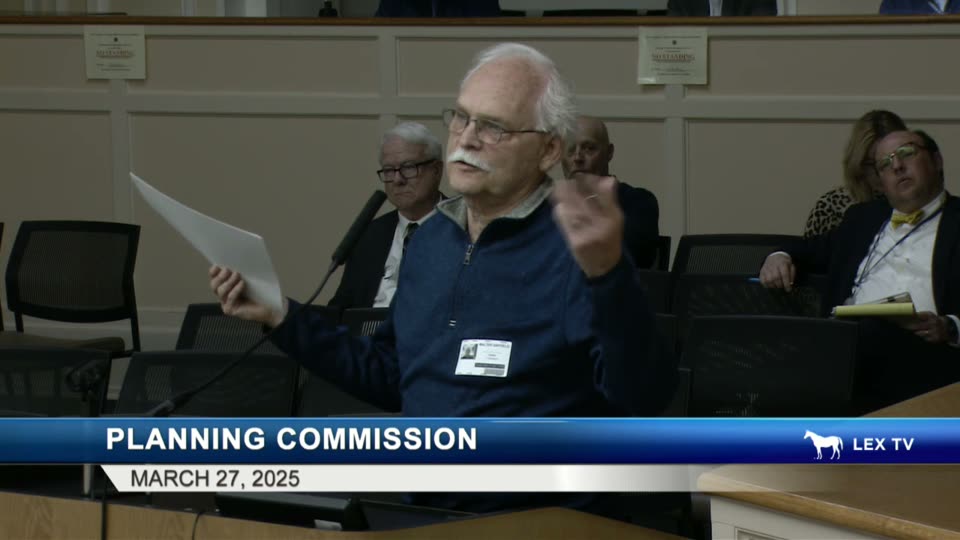
But the real threat came from Frankfort. In 2025 the General Assembly passed House Bill 443, which forces local governments to treat more development approvals as "ministerial" — rubber-stamp decisions with the discretion, and the public hearing, engineered out. On March 27, 2025, Gaffield opened the public-comment period on the city's required response, warning about exactly that: the removal of discretion from final development plans.
It's a quietly existential fight for him. Gaffield has spent two decades working inside a system that gives neighborhoods a seat — a hearing, a comment period, a chance to bring the 1994 transcript. HB 443 is the state telling Lexington to take some of those seats away. The man who mastered the process is now defending the process itself.
The big picture
It is easy to caricature neighborhood associations as the NIMBY reflex in organized form — the people who turn out to say no. Gaffield's record complicates that. The same council that sued to clean up the sewers volunteered to pay more for them. The same man who scrutinizes density on his own street can recite, chapter and verse, the difference between a discretionary and a ministerial review.
What FCNC actually defends is duller and more important than any single project: the idea that a city of small neighborhoods should get to be heard before the bulldozers, and that someone should remember what was promised last time. There's no budget line for that. There's no billable hour. There's an all-volunteer email list, a P.O. box, and a man who keeps driving downtown to sit in a folding chair until his name is called.
Developers bring lawyers. The neighborhoods bring Walt Gaffield. It is not a fair fight, and the fact that he keeps showing up — and loses some of them anyway, and comes back — is exactly the point.
In 2008, Walt Gaffield asked the city to charge him more. In 2025, he's asking Frankfort to leave the city alone. Both times he was at the same podium, on his own time, speaking for the people who couldn't afford to send anyone else.
The city's response to House Bill 443 is still working its way through the Planning Commission this year, and FCNC is still showing up for it. The Lexington Times is following it. Browse the LFUCG meeting archive at meetings.lexingtonky.news, or find the Fayette County Neighborhood Council at fcnc.org.
Sources
- LFUCG Urban County Council — January 24, 2008 (sanitary sewer fee increase)
- LFUCG Urban County Council — February 9, 2017 (zone change; FCNC's first appearance)
- LFUCG Planning Commission — September 26, 2019 (accessory dwelling units)
- LFUCG Planning and Public Safety Committee — February 18, 2020 (short-term rentals)
- LFUCG Planning Commission — November 14, 2024 (short-term rentals)
- LFUCG Planning Commission — November 21, 2024 (digital billboard / traffic study)
- LFUCG Planning Commission — March 27, 2025 (House Bill 443 / ZOTA)
- Fayette County Neighborhood Council
- What is Lexington's EPA Consent Decree? — CivicLex
- The Glaze: Charlie Martin — The Lexington Times